Cost-Effectiveness Strategies in Healthcare Management
Need help with this assignment?Get an original answer from a qualified tutor — from $10/page.
Get it written →Cost-effectiveness is a core theme of DNP 880 Strategic Leadership and Business Management at Aspen University, whose course description calls for cost-effective strategies that consider structure, leadership and workforce needs. Nurse leaders who can link quality to cost are far more persuasive with executives. This guide explains key economic concepts and practical cost-effectiveness strategies for healthcare management, with evidence you can cite.
Quick answer
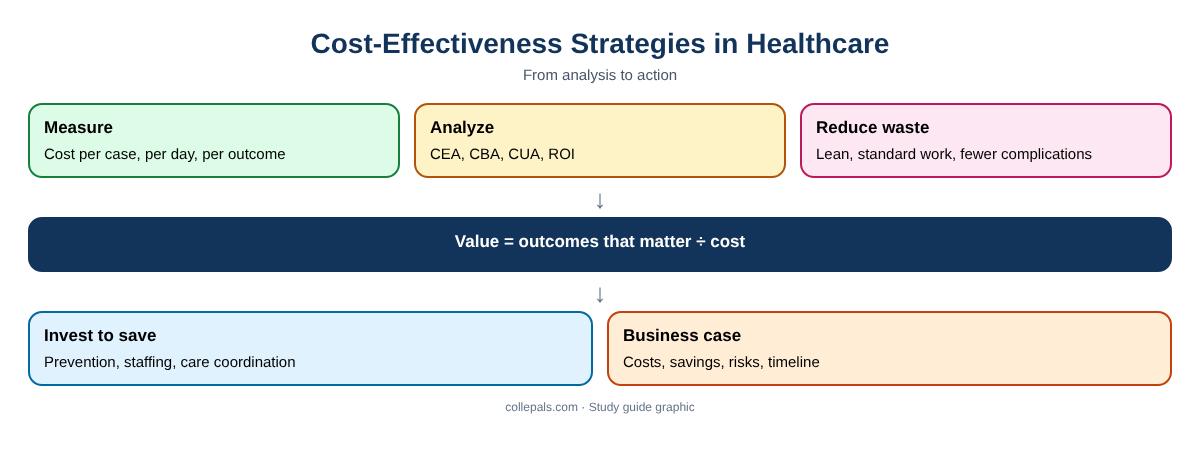
Measure current costs, analyze options with cost-effectiveness, cost-benefit, cost-utility or return-on-investment methods, reduce waste through process improvement, invest in prevention, staffing and care coordination that avoid expensive complications and present a business case with costs, savings, risks and a timeline.
Key Economic Concepts
| Method | What it compares | Example |
|---|---|---|
| Cost-effectiveness analysis (CEA) | Cost per unit of health outcome, such as cost per fall prevented | Comparing two fall prevention programs |
| Cost-utility analysis (CUA) | Cost per quality-adjusted life year (QALY) | Evaluating a chronic disease program |
| Cost-benefit analysis (CBA) | Costs and benefits both in dollars | Program cost vs. avoided hospital costs |
| Return on investment (ROI) | (Savings − investment) ÷ investment | Business case for a new staffing model |
Drummond et al. (2015) describe these methods in detail. For most DNP 880 assignments, a clear cost-benefit or ROI estimate, with stated assumptions, is enough to make your argument credible.
Strategy 1: Prevent Costly Complications
Preventing adverse events is often the most powerful cost strategy. A cost-benefit analysis of the Fall TIPS program found a 19% reduction in falls and avoided costs of more than $14,000 per 1,000 patient days (Dykes et al., 2023). Similar logic applies to pressure injuries, infections and readmissions.
Strategy 2: Invest in Safe Staffing
Staffing is the largest expense for most hospitals, so leaders often try to cut it. Evidence suggests the opposite can save money. Lasater et al. (2021) projected that safer nurse staffing in Illinois hospitals would avoid more than 1,500 deaths and save over $117 million per year in Medicare costs through shorter stays and fewer readmissions. See workforce management strategies for nurse leaders.
Strategy 3: Coordinate and Integrate Care
Integrated, team-based care can reduce costly acute care use. In a meta-analysis of 34 studies, integrated care was associated with lower costs and better outcomes, especially with follow-up beyond 12 months (Rocks et al., 2020), and integrated team-based primary care at Intermountain Healthcare was associated with fewer emergency visits and hospital admissions (Reiss-Brennan et al., 2016).
Strategy 4: Eliminate Waste
Lean methods target waste such as delays, unnecessary tests, excess inventory and rework. Process mapping often reveals simple fixes, such as standardizing supply carts or discharge workflows, that save time and money without reducing quality.
Strategy 5: Align With Value-Based Payment
Payment programs increasingly reward quality and penalize poor outcomes, such as excess readmissions or hospital-acquired conditions. Linking your initiative to these incentives strengthens your business case. Frame proposals using the Triple Aim’s goal of lowering per capita cost while improving care and health (Berwick et al., 2008).
How to Build a Business Case
- Define the problem with local data and its current cost.
- Describe the intervention and its evidence base.
- Estimate costs: staff time, training, equipment and ongoing expenses.
- Estimate savings or benefits: avoided events, shorter stays, reduced overtime or turnover.
- Calculate ROI or cost per outcome and state your assumptions.
- Address risks and propose a pilot to test assumptions.
- Define measures for quality and cost, with a timeline for review.
Simplified ROI example (illustrative numbers)
A unit invests $40,000 in training and a part-time coordinator for a fall prevention program. If the program prevents five injurious falls in a year and each is estimated to cost the hospital $15,000, avoided costs are $75,000. ROI = ($75,000 − $40,000) ÷ $40,000 = 0.875, or about 88%. Replace these illustrative figures with your organization’s data and cite published cost estimates where possible.
Frequently Asked Questions
What is the difference between cost-effectiveness and cost-benefit analysis?
Cost-effectiveness analysis expresses results as cost per health outcome; cost-benefit analysis converts both costs and benefits into dollars.
Do DNP 880 papers require detailed financial analysis?
Usually not at an accountant’s level, but you should estimate costs and savings, state assumptions and link them to quality outcomes.
Where can I find cost data?
Your organization’s finance or quality department, published studies, government reports and professional organizations.
Build a Stronger Business Case With Collepals
Balancing a DNP program with leadership responsibilities at work is demanding. Collepals.com supports DNP students in DNP 880 Strategic Leadership and Business Management and related courses. Our doctoral-level nursing writers and tutors can:
- Help you break down DNP 880 prompts and rubrics and plan your papers and discussion posts.
- Guide you to current scholarly evidence on leadership, quality improvement, cost and workforce topics.
- Provide model papers and discussion responses you can study for structure and depth.
- Edit and proofread your drafts for doctoral-level clarity and APA 7 formatting.
Browse our free model assignments or learn more about our nursing assignment writing service.
Use Collepals examples as study guides and follow Aspen University’s academic integrity and AI policies when you submit your own work.
More DNP 880 study guides
- DNP880 Strategic Leadership and Business Management: Complete Student Guide
- Strategic Leadership in Nursing: Key Concepts for DNP Students
- Healthcare Workforce Management Strategies for Nurse Leaders
- How to Develop a Healthcare Quality Improvement Initiative
- How to Evaluate Healthcare Improvement Initiatives
Collepals is an independent study resource and is not affiliated with or endorsed by Aspen University. Course titles, numbers and requirements change; always follow your current syllabus, rubric and catalog.
References
Berwick, D. M., Nolan, T. W., & Whittington, J. (2008). The triple aim: Care, health, and cost. Health Affairs, 27(3), 759–769. https://doi.org/10.1377/hlthaff.27.3.759
Drummond, M. F., Sculpher, M. J., Claxton, K., Stoddart, G. L., & Torrance, G. W. (2015). Methods for the economic evaluation of health care programmes (4th ed.). Oxford University Press.
Dykes, P. C., Curtin-Bowen, M., Lipsitz, S., Franz, C., Adelman, J., Adkison, L., Bogaisky, M., Carroll, D., Carter, E., Herlihy, L., Lindros, M. E., Ryan, V., Scanlan, M., Walsh, M.-A., Wien, M., & Bates, D. W. (2023). Cost of inpatient falls and cost-benefit analysis of implementation of an evidence-based fall prevention program. JAMA Health Forum, 4(1), Article e225125. https://doi.org/10.1001/jamahealthforum.2022.5125
Lasater, K. B., Aiken, L. H., Sloane, D. M., French, R., Martin, B. M., Alexander, M., & McHugh, M. D. (2021). Patient outcomes and cost savings associated with hospital safe nurse staffing legislation: An observational study. BMJ Open, 11(12), Article e052899. https://doi.org/10.1136/bmjopen-2021-052899
Reiss-Brennan, B., Brunisholz, K. D., Dredge, C., Briot, P., Grazier, K., Wilcox, A., Savitz, L., & James, B. (2016). Association of integrated team-based care with health care quality, utilization, and cost. JAMA, 316(8), 826–834. https://doi.org/10.1001/jama.2016.11232
Rocks, S., Berntson, D., Gil-Salmerón, A., Kadu, M., Ehrenberg, N., Stein, V., & Tsiachristas, A. (2020). Cost and effects of integrated care: A systematic literature review and meta-analysis. The European Journal of Health Economics, 21(8), 1211–1221. https://doi.org/10.1007/s10198-020-01217-5
Get a plagiarism-free answer to this question
Send us your instructions and we’ll match you with the best writer in your subject.
- 100% human-written, zero AI
- Turnitin report included
- Confidential — we never share your data
- Free revisions & refunds