Healthcare Workforce Management Strategies for Nurse Leaders
Need help with this assignment?Get an original answer from a qualified tutor — from $10/page.
Get it written →Workforce needs are central to DNP 880 Strategic Leadership and Business Management at Aspen University, whose course description ties cost-effective strategies to organizational structure, leadership and workforce. Nursing workforce challenges, including burnout, turnover and staffing shortages, affect quality, safety and cost. This guide summarizes evidence-based healthcare workforce management strategies that nurse leaders can use and write about in DNP 880.
Quick answer
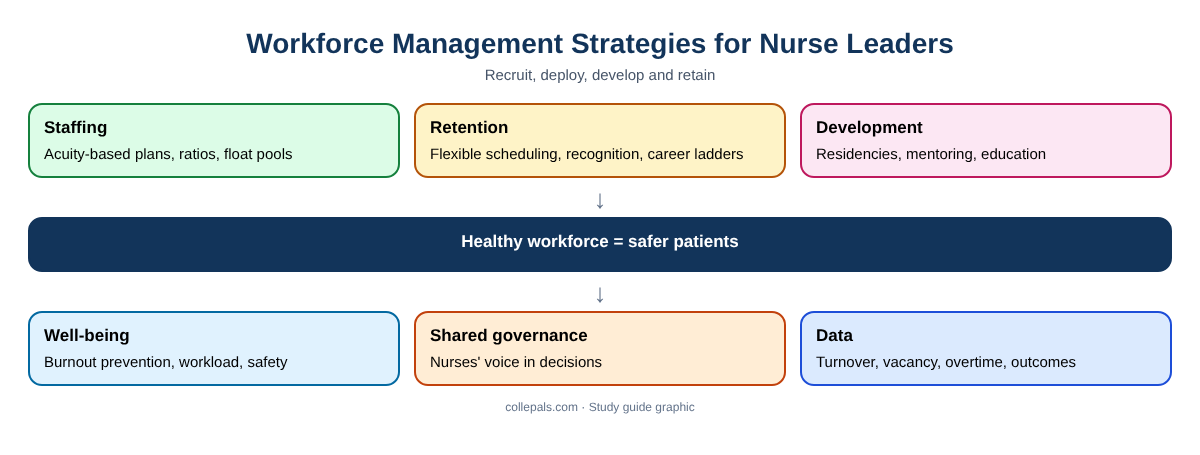
Effective workforce management combines safe, acuity-based staffing, retention strategies such as flexible scheduling, recognition and career ladders, professional development through residencies and mentoring, attention to well-being and workload, shared governance and data-driven monitoring of turnover, vacancy, overtime and patient outcomes.
Why Workforce Management Is a Strategic Issue
Staffing decisions affect patient outcomes. Aiken et al. (2002) found that each additional patient per nurse was associated with higher patient mortality and higher nurse burnout and job dissatisfaction. Two decades later, Lasater et al. (2021) found that each additional patient per nurse in Illinois hospitals was associated with 16% higher odds of in-hospital death and longer stays. The COVID-19 pandemic worsened long-standing burnout and stress among U.S. nurses, contributing to workforce losses and intentions to leave (Martin et al., 2023). The Quadruple Aim recognizes that care of the patient requires care of the provider (Bodenheimer & Sinsky, 2014).
Strategy 1: Safe, Acuity-Based Staffing
- Use acuity and workload tools, not census alone, to set assignments.
- Build float pools and cross-training to cover variability without excessive overtime.
- Engage staff through staffing committees in setting unit staffing plans.
- Monitor outcomes, such as falls, pressure injuries and missed care, alongside staffing data.
Strategy 2: Retention
- Flexible and self-scheduling options, especially for experienced nurses.
- Meaningful recognition programs and fair compensation reviews.
- Clinical ladders and leadership pathways that reward growth.
- Stay interviews to learn why nurses stay and what might make them leave.
Strategy 3: Professional Development
Nurse residency programs support new graduates’ transition to practice, while mentoring, continuing education and tuition support develop experienced staff. Development builds competence and loyalty and creates a pipeline for charge nurse and management roles.
Strategy 4: Well-Being and Healthy Work Environments
- Address workload and administrative burden, such as documentation redesign.
- Provide access to peer support and employee assistance programs.
- Prevent workplace violence through policies, training and security measures.
- Ensure breaks and reasonable shift lengths.
Strategy 5: Shared Governance
Shared governance gives nurses a formal voice in decisions about practice, quality and staffing. It increases engagement and helps leaders identify problems early.
Strategy 6: Use Workforce Data
| Metric | Why it matters |
|---|---|
| Turnover and vacancy rates | Show stability and recruitment needs |
| Overtime and agency use | Signal understaffing and drive cost |
| Staff engagement and burnout scores | Predict turnover and safety risks |
| Nurse-sensitive outcomes | Link staffing to patient safety |
| Time to fill positions | Measure recruitment effectiveness |
Making the Business Case
Turnover is expensive because of recruitment, orientation, overtime and agency costs. Pair turnover costs with outcome data to justify investments in staffing and retention, and use projections such as the savings estimated by Lasater et al. (2021). See cost-effectiveness strategies in healthcare management.
Frequently Asked Questions
What is the most effective nurse retention strategy?
No single strategy works everywhere. Combining flexible scheduling, development, recognition, manageable workloads and shared governance is most effective.
How do staffing levels affect patient outcomes?
Higher patient-to-nurse ratios are associated with higher mortality, longer stays and more nurse burnout in multiple studies.
What workforce data should nurse leaders track?
Turnover, vacancy, overtime, agency use, engagement and burnout scores and nurse-sensitive patient outcomes.
Get Help With Workforce Management Papers at Collepals
Balancing a DNP program with leadership responsibilities at work is demanding. Collepals.com supports DNP students in DNP 880 Strategic Leadership and Business Management and related courses. Our doctoral-level nursing writers and tutors can:
- Help you break down DNP 880 prompts and rubrics and plan your papers and discussion posts.
- Guide you to current scholarly evidence on leadership, quality improvement, cost and workforce topics.
- Provide model papers and discussion responses you can study for structure and depth.
- Edit and proofread your drafts for doctoral-level clarity and APA 7 formatting.
Browse our free model assignments or learn more about our nursing assignment writing service.
Use Collepals examples as study guides and follow Aspen University’s academic integrity and AI policies when you submit your own work.
More DNP 880 study guides
- DNP880 Strategic Leadership and Business Management: Complete Student Guide
- Strategic Leadership in Nursing: Key Concepts for DNP Students
- How to Write DNP Leadership Discussion Posts
- Cost-Effectiveness Strategies in Healthcare Management
- Interprofessional Collaboration in Advanced Nursing Leadership
Collepals is an independent study resource and is not affiliated with or endorsed by Aspen University. Course titles, numbers and requirements change; always follow your current syllabus, rubric and catalog.
References
Aiken, L. H., Clarke, S. P., Sloane, D. M., Sochalski, J., & Silber, J. H. (2002). Hospital nurse staffing and patient mortality, nurse burnout, and job dissatisfaction. JAMA, 288(16), 1987–1993. https://doi.org/10.1001/jama.288.16.1987
Bodenheimer, T., & Sinsky, C. (2014). From triple to quadruple aim: Care of the patient requires care of the provider. Annals of Family Medicine, 12(6), 573–576. https://doi.org/10.1370/afm.1713
Lasater, K. B., Aiken, L. H., Sloane, D. M., French, R., Martin, B. M., Alexander, M., & McHugh, M. D. (2021). Patient outcomes and cost savings associated with hospital safe nurse staffing legislation: An observational study. BMJ Open, 11(12), Article e052899. https://doi.org/10.1136/bmjopen-2021-052899
Martin, B., Kaminski-Ozturk, N., O’Hara, C., & Smiley, R. (2023). Examining the impact of the COVID-19 pandemic on burnout and stress among U.S. nurses. Journal of Nursing Regulation, 14(1), 4–12. https://doi.org/10.1016/S2155-8256(23)00063-7
Get a plagiarism-free answer to this question
Send us your instructions and we’ll match you with the best writer in your subject.
- 100% human-written, zero AI
- Turnitin report included
- Confidential — we never share your data
- Free revisions & refunds