How to Develop a Healthcare Quality Improvement Initiative
Need help with this assignment?Get an original answer from a qualified tutor — from $10/page.
Get it written →Designing an improvement initiative is a core skill in DNP 880 Strategic Leadership and Business Management at Aspen University, which emphasizes system-wide initiatives and quality improvement models. Whether your assignment is a QI proposal or the foundation of your DNP project, the same steps apply. This guide shows how to develop a healthcare quality improvement initiative using the Model for Improvement, with a worked example.
Quick answer
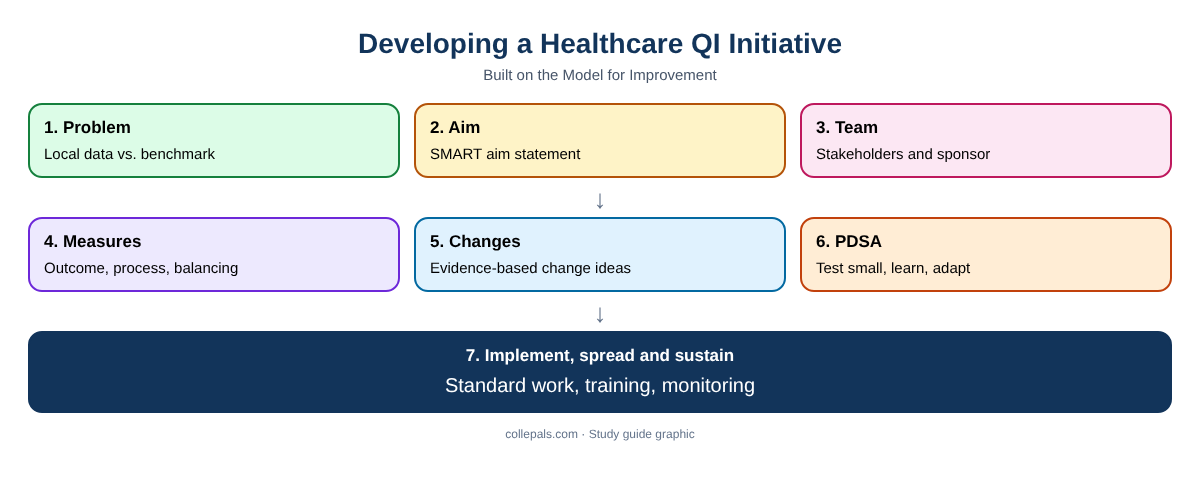
Define the problem with local data and benchmarks, write a SMART aim, assemble a team with an executive sponsor, choose outcome, process and balancing measures, select evidence-based change ideas, test them with PDSA cycles and then implement, spread and sustain successful changes.
Step 1: Define the Problem
Use local data to show the size of the problem and compare it with a benchmark. For example: “Our medical-surgical unit’s fall rate is 4.1 per 1,000 patient days, above the hospital’s goal.” Explain why the problem matters for patients, staff and cost. See how to identify gaps in healthcare service delivery.
Step 2: Write a SMART Aim
An aim answers the first question of the Model for Improvement: what are we trying to accomplish? (Langley et al., 2009). It should be specific, measurable, achievable, relevant and time-bound.
Example aim
Reduce falls on the 32-bed medical-surgical unit by 25%, from 4.1 to 3.1 per 1,000 patient days, within six months of implementing individualized fall prevention plans.
Step 3: Build the Team
Include frontline staff who do the work, an executive sponsor who can remove barriers, a team leader and relevant disciplines, such as physical therapy and pharmacy. Interprofessional input improves solutions and buy-in; see interprofessional collaboration in advanced nursing leadership.
Step 4: Choose Measures
| Type | Question | Fall prevention example |
|---|---|---|
| Outcome | Did patients’ results improve? | Falls and injurious falls per 1,000 patient days |
| Process | Are we doing the change reliably? | Percentage of patients with a documented individualized plan |
| Balancing | Did the change cause problems elsewhere? | Use of restraints, staff time, patient mobility |
Step 5: Select Evidence-Based Changes
Choose interventions supported by evidence. For hospital falls, a meta-analysis found that patient and staff education was the only single intervention that significantly reduced falls (Morris et al., 2022), and the Fall TIPS program, which builds individualized plans with patients, was associated with fewer falls and avoided costs (Dykes et al., 2023). Use an EBP model to appraise the evidence; see evidence-based practice models for healthcare quality improvement.
Step 6: Test With PDSA Cycles
Start small: one nurse, one shift or a few patients. Plan the test and predictions, do it, study the results and act by adopting, adapting or abandoning the change. Build from small tests to larger ones as confidence grows.
Step 7: Implement, Spread and Sustain
Once changes work reliably, standardize them through policies, order sets, documentation templates and training. Continue monitoring with run charts and plan spread to other units. Sustainability depends on leadership support, ownership by staff and ongoing measurement. For detailed planning, see DNP quality improvement project: developing an implementation plan.
Common Mistakes
- Vague aims without numbers or deadlines.
- Measuring only outcomes, not whether the change was carried out.
- Implementing large changes without testing.
- Ignoring frontline staff input.
- Stopping measurement after initial success.
Frequently Asked Questions
What is the Model for Improvement?
A QI framework built on three questions (aim, measures and changes) and PDSA cycles for testing changes.
How long should a QI initiative run?
Long enough to see stable change; many DNP projects run 8 to 12 weeks or more, depending on the measure and program requirements.
Is a QI initiative the same as research?
No. QI applies existing knowledge to improve local care, but your IRB still determines how a project is classified.
Develop Your QI Initiative With Help From Collepals
Balancing a DNP program with leadership responsibilities at work is demanding. Collepals.com supports DNP students in DNP 880 Strategic Leadership and Business Management and related courses. Our doctoral-level nursing writers and tutors can:
- Help you break down DNP 880 prompts and rubrics and plan your papers and discussion posts.
- Guide you to current scholarly evidence on leadership, quality improvement, cost and workforce topics.
- Provide model papers and discussion responses you can study for structure and depth.
- Edit and proofread your drafts for doctoral-level clarity and APA 7 formatting.
Browse our free model assignments or learn more about our nursing assignment writing service.
Use Collepals examples as study guides and follow Aspen University’s academic integrity and AI policies when you submit your own work.
More DNP 880 study guides
- DNP880 Strategic Leadership and Business Management: Complete Student Guide
- Evidence-Based Practice Models for Healthcare Quality Improvement
- How to Identify Gaps in Healthcare Service Delivery
- DNP Quality Improvement Project: Developing an Implementation Plan
- How to Evaluate Healthcare Improvement Initiatives
Collepals is an independent study resource and is not affiliated with or endorsed by Aspen University. Course titles, numbers and requirements change; always follow your current syllabus, rubric and catalog.
References
Dykes, P. C., Curtin-Bowen, M., Lipsitz, S., Franz, C., Adelman, J., Adkison, L., Bogaisky, M., Carroll, D., Carter, E., Herlihy, L., Lindros, M. E., Ryan, V., Scanlan, M., Walsh, M.-A., Wien, M., & Bates, D. W. (2023). Cost of inpatient falls and cost-benefit analysis of implementation of an evidence-based fall prevention program. JAMA Health Forum, 4(1), Article e225125. https://doi.org/10.1001/jamahealthforum.2022.5125
Langley, G. J., Moen, R. D., Nolan, K. M., Nolan, T. W., Norman, C. L., & Provost, L. P. (2009). The improvement guide: A practical approach to enhancing organizational performance (2nd ed.). Jossey-Bass.
Morris, M. E., Webster, K., Jones, C., Hill, A.-M., Haines, T., McPhail, S., Kiegaldie, D., Slade, S., Jazayeri, D., Heng, H., Shorr, R., Carey, L., Barker, A., & Cameron, I. (2022). Interventions to reduce falls in hospitals: A systematic review and meta-analysis. Age and Ageing, 51(5), Article afac077. https://doi.org/10.1093/ageing/afac077
Get a plagiarism-free answer to this question
Send us your instructions and we’ll match you with the best writer in your subject.
- 100% human-written, zero AI
- Turnitin report included
- Confidential — we never share your data
- Free revisions & refunds