Evidence-Based Practice Models for Healthcare Quality Improvement
Need help with this assignment?Get an original answer from a qualified tutor — from $10/page.
Get it written →Choosing the right framework is one of the first decisions in any improvement effort, and it is a recurring topic in DNP 880 Strategic Leadership and Business Management at Aspen University, whose course description includes quality improvement models and evidence-based practices for sustaining improvement. This guide compares the evidence-based practice (EBP) and quality improvement (QI) models most often used by DNP students and explains how to choose one for your paper or DNP project.
Quick answer
EBP models such as the Iowa Model, the Johns Hopkins model and ARCC guide you from a practice question to evidence and implementation. QI models such as the Model for Improvement with PDSA cycles, Lean and Six Sigma guide how you test and spread change locally. Many DNP projects pair one EBP model with a QI method and report results using SQUIRE 2.0.
EBP vs. QI: What Is the Difference?
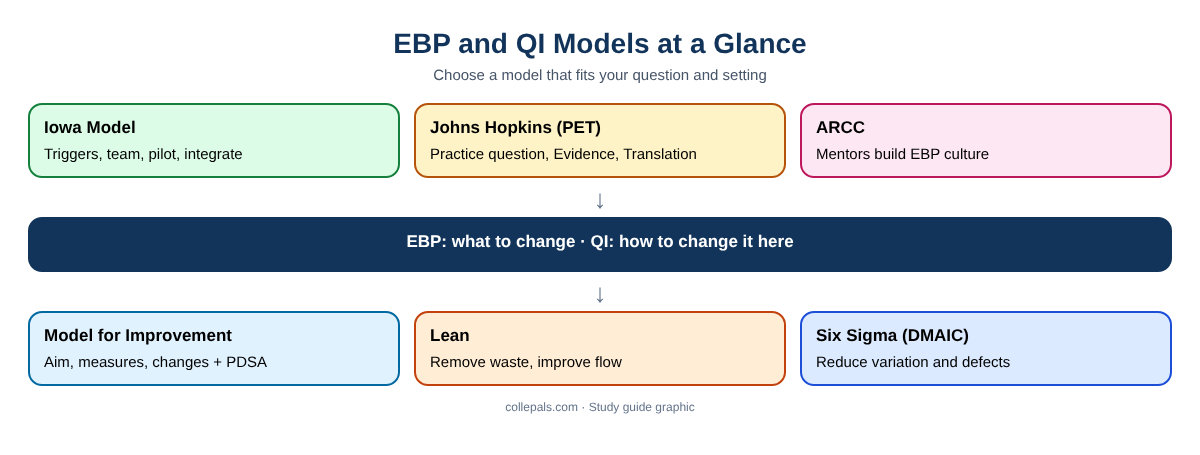
Evidence-based practice asks what should change based on the best available evidence. Quality improvement asks how to make that change work in a specific setting and whether it improves results. Research generates new, generalizable knowledge. DNP projects usually translate existing evidence into practice through QI methods, which is why both kinds of models matter.
Evidence-Based Practice Models
Iowa Model
The revised Iowa Model begins with a trigger, either a problem or new knowledge, and asks whether the topic is an organizational priority. It then guides teams through forming a team, assembling and appraising evidence, piloting the change, deciding whether to adopt it, integrating and sustaining it and disseminating results (Buckwalter et al., 2017). It is popular for DNP projects because it explicitly includes piloting and sustainability.
Johns Hopkins Evidence-Based Practice Model
The Johns Hopkins model uses the PET process: Practice question, Evidence and Translation, supported by tools for rating evidence levels and quality (Dang et al., 2022). Its appraisal tools make it a strong choice when your project depends on a rigorous literature review.
ARCC Model
The Advancing Research and Clinical practice through close Collaboration (ARCC) model focuses on building an organizational culture of EBP through EBP mentors (Melnyk & Fineout-Overholt, 2023). It fits projects aimed at changing culture or building staff capacity.
Quality Improvement Models
Model for Improvement and PDSA
The Model for Improvement asks three questions: What are we trying to accomplish? How will we know that a change is an improvement? What change can we make that will result in improvement? Teams then test changes using Plan-Do-Study-Act (PDSA) cycles (Langley et al., 2009). It is simple, flexible and widely used in DNP projects.
Lean
Lean focuses on improving flow and eliminating waste, such as waiting, unnecessary steps and rework, using tools such as value stream mapping and standard work. It suits throughput, scheduling and supply problems.
Six Sigma
Six Sigma reduces variation and defects through the DMAIC cycle: Define, Measure, Analyze, Improve and Control. It is data-intensive and suits processes with measurable error rates.
Comparison Table
| Model | Best for | Strength | Consider |
|---|---|---|---|
| Iowa Model | Organizational EBP projects | Includes pilot and sustainment | Requires organizational priority |
| Johns Hopkins (PET) | Evidence-heavy projects | Detailed appraisal tools | Translation phase needs local planning |
| ARCC | Culture and capacity building | Mentor-based sustainability | Needs trained mentors |
| Model for Improvement | Testing changes locally | Simple, rapid PDSA learning | Needs good measures |
| Lean | Flow and waste problems | Practical process tools | Less focus on evidence appraisal |
| Six Sigma | Variation and error reduction | Statistical rigor | Data and training intensive |
How to Choose a Model
- Clarify your aim: are you adopting new evidence, fixing a process or changing culture?
- Consider your setting: which models does your organization already use?
- Check your program’s expectations; some DNP programs prefer specific frameworks.
- Pair models when helpful, such as the Iowa Model for the overall project and PDSA cycles for testing.
- Plan reporting with SQUIRE 2.0, the standard guideline for QI reports (Ogrinc et al., 2016).
To apply your chosen model, see how to develop a healthcare quality improvement initiative and developing an implementation plan.
Frequently Asked Questions
Which EBP model is best for a DNP project?
There is no single best model. The Iowa Model and Johns Hopkins model are common; choose based on your aim, setting and program expectations.
Can I combine an EBP model and a QI model?
Yes. Many projects use an EBP model to select the intervention and a QI method, such as PDSA, to implement and test it.
What is SQUIRE 2.0?
A reporting guideline for writing up quality improvement work, covering the problem, intervention, measures, results and lessons learned.
Need Help Choosing and Applying a Model? Ask Collepals
Balancing a DNP program with leadership responsibilities at work is demanding. Collepals.com supports DNP students in DNP 880 Strategic Leadership and Business Management and related courses. Our doctoral-level nursing writers and tutors can:
- Help you break down DNP 880 prompts and rubrics and plan your papers and discussion posts.
- Guide you to current scholarly evidence on leadership, quality improvement, cost and workforce topics.
- Provide model papers and discussion responses you can study for structure and depth.
- Edit and proofread your drafts for doctoral-level clarity and APA 7 formatting.
Browse our free model assignments or learn more about our nursing assignment writing service.
Use Collepals examples as study guides and follow Aspen University’s academic integrity and AI policies when you submit your own work.
More DNP 880 study guides
- DNP880 Strategic Leadership and Business Management: Complete Student Guide
- How to Develop a Healthcare Quality Improvement Initiative
- How to Identify Gaps in Healthcare Service Delivery
- DNP Quality Improvement Project: Developing an Implementation Plan
- How to Evaluate Healthcare Improvement Initiatives
Collepals is an independent study resource and is not affiliated with or endorsed by Aspen University. Course titles, numbers and requirements change; always follow your current syllabus, rubric and catalog.
References
Buckwalter, K. C., Cullen, L., Hanrahan, K., Kleiber, C., McCarthy, A. M., Rakel, B., Steelman, V., Tripp-Reimer, T., & Tucker, S. (2017). Iowa model of evidence-based practice: Revisions and validation. Worldviews on Evidence-Based Nursing, 14(3), 175–182. https://doi.org/10.1111/wvn.12223
Dang, D., Dearholt, S. L., Bissett, K., Ascenzi, J., & Whalen, M. (2022). Johns Hopkins evidence-based practice for nurses and healthcare professionals: Model and guidelines (4th ed.). Sigma Theta Tau International.
Langley, G. J., Moen, R. D., Nolan, K. M., Nolan, T. W., Norman, C. L., & Provost, L. P. (2009). The improvement guide: A practical approach to enhancing organizational performance (2nd ed.). Jossey-Bass.
Melnyk, B. M., & Fineout-Overholt, E. (2023). Evidence-based practice in nursing & healthcare: A guide to best practice (5th ed.). Wolters Kluwer.
Ogrinc, G., Davies, L., Goodman, D., Batalden, P., Davidoff, F., & Stevens, D. (2016). SQUIRE 2.0 (Standards for QUality Improvement Reporting Excellence): Revised publication guidelines from a detailed consensus process. BMJ Quality & Safety, 25(12), 986–992. https://doi.org/10.1136/bmjqs-2015-004411
Get a plagiarism-free answer to this question
Send us your instructions and we’ll match you with the best writer in your subject.
- 100% human-written, zero AI
- Turnitin report included
- Confidential — we never share your data
- Free revisions & refunds