How to Identify Gaps in Healthcare Service Delivery
Need help with this assignment?Get an original answer from a qualified tutor — from $10/page.
Get it written →Before leaders can improve care, they must find where it falls short. The description of DNP 880 Strategic Leadership and Business Management at Aspen University highlights communication and collaboration strategies for addressing gaps and failures in service delivery. This guide explains how to identify gaps in healthcare service delivery systematically, using data, root cause analysis and stakeholder input, and how to turn a gap into an improvement opportunity.
Quick answer
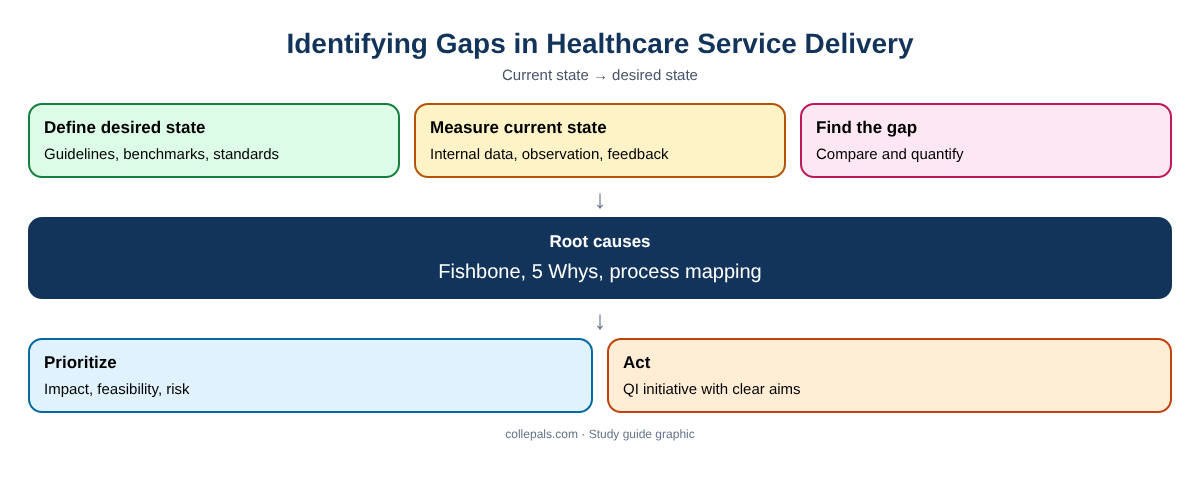
Define the desired state using guidelines, benchmarks and standards, measure the current state with internal data, observation and stakeholder feedback, quantify the gap, analyze root causes with tools such as fishbone diagrams, the 5 Whys and process maps, prioritize gaps by impact and feasibility and launch a focused improvement initiative.
What Is a Service Delivery Gap?
A service delivery gap is the difference between the care an organization provides and the care it should provide according to evidence, standards or patient needs. Gaps can involve access (long wait times), quality (missed screenings), safety (preventable harm), experience (poor communication) or equity (worse outcomes for certain groups).
Step 1: Define the Desired State
Identify what good looks like, using clinical practice guidelines, regulatory and accreditation standards, national benchmarks and organizational goals. The Quintuple Aim, which adds health equity to better care, better health, lower cost and clinician well-being, is a useful lens for defining the desired state (Nundy et al., 2022).
Step 2: Measure the Current State
| Data source | Examples |
|---|---|
| Quality and safety data | Falls, infections, readmissions, incident reports |
| Patient experience | HCAHPS or other survey results, complaints, compliments |
| Operational data | Wait times, length of stay, throughput, missed appointments |
| Workforce data | Turnover, overtime, staffing levels |
| Equity data | Outcomes stratified by race, ethnicity, language, payer or zip code |
| Direct observation | Process walk-throughs, audits, shadowing |
| Stakeholder input | Staff interviews, patient and family feedback, focus groups |
Donabedian’s (1988) framework helps organize what you find into structure (resources, staffing, equipment), process (what is done and how) and outcome (results for patients).
Step 3: Quantify the Gap
Compare current performance with the desired state in numbers whenever possible, such as “62% of eligible patients received discharge teach-back documentation compared with our target of 90%.” Quantifying the gap makes it persuasive and provides a baseline for measuring improvement.
Step 4: Analyze Root Causes
- Fishbone (Ishikawa) diagram: organizes possible causes into categories such as people, methods, equipment, environment and policies.
- 5 Whys: repeatedly asks “why” to move from symptoms to underlying causes.
- Process mapping: diagrams each step to reveal delays, handoff failures and duplication.
- Pareto analysis: identifies the few causes responsible for most problems.
Involve frontline staff and other professions in root cause analysis, because they see failures that leaders miss; see interprofessional collaboration in advanced nursing leadership.
Step 5: Prioritize
Organizations face many gaps. Prioritize using criteria such as impact on patients, frequency, cost, alignment with strategic goals, feasibility and urgency. A simple impact-effort matrix helps leaders choose “quick wins” and plan larger projects.
Step 6: Turn the Gap Into an Improvement Initiative
Write a problem statement and SMART aim, select an evidence-based intervention and plan measures. See how to develop a healthcare quality improvement initiative.
Example: from gap to initiative
Gap: Readmission rates for patients with heart failure are higher than the hospital’s benchmark, and chart audits show inconsistent discharge teaching. Root causes: no standard teaching tool, rushed discharges in the afternoon and limited follow-up calls. Initiative: standardized teach-back education, discharge planning beginning on admission and nurse follow-up calls within 72 hours, measured by readmissions, teaching documentation and call completion.
Frequently Asked Questions
What is a gap analysis in healthcare?
A structured comparison of current performance with a desired state defined by evidence, standards or goals, used to identify improvement priorities.
What tools help find root causes?
Fishbone diagrams, the 5 Whys, process maps and Pareto charts are widely used.
Why include equity data?
Overall averages can hide gaps for specific groups. Stratifying data by demographics reveals inequities.
Get Help Analyzing Service Delivery Gaps at Collepals
Balancing a DNP program with leadership responsibilities at work is demanding. Collepals.com supports DNP students in DNP 880 Strategic Leadership and Business Management and related courses. Our doctoral-level nursing writers and tutors can:
- Help you break down DNP 880 prompts and rubrics and plan your papers and discussion posts.
- Guide you to current scholarly evidence on leadership, quality improvement, cost and workforce topics.
- Provide model papers and discussion responses you can study for structure and depth.
- Edit and proofread your drafts for doctoral-level clarity and APA 7 formatting.
Browse our free model assignments or learn more about our nursing assignment writing service.
Use Collepals examples as study guides and follow Aspen University’s academic integrity and AI policies when you submit your own work.
More DNP 880 study guides
- DNP880 Strategic Leadership and Business Management: Complete Student Guide
- Evidence-Based Practice Models for Healthcare Quality Improvement
- Interprofessional Collaboration in Advanced Nursing Leadership
- How to Develop a Healthcare Quality Improvement Initiative
- How to Evaluate Healthcare Improvement Initiatives
Collepals is an independent study resource and is not affiliated with or endorsed by Aspen University. Course titles, numbers and requirements change; always follow your current syllabus, rubric and catalog.
References
Donabedian, A. (1988). The quality of care: How can it be assessed? JAMA, 260(12), 1743–1748. https://doi.org/10.1001/jama.1988.03410120089033
Nundy, S., Cooper, L. A., & Mate, K. S. (2022). The quintuple aim for health care improvement: A new imperative to advance health equity. JAMA, 327(6), 521–522. https://doi.org/10.1001/jama.2021.25181
Get a plagiarism-free answer to this question
Send us your instructions and we’ll match you with the best writer in your subject.
- 100% human-written, zero AI
- Turnitin report included
- Confidential — we never share your data
- Free revisions & refunds