How to Evaluate Healthcare Improvement Initiatives
Need help with this assignment?Get an original answer from a qualified tutor — from $10/page.
Get it written →An improvement is only an improvement if you can show it. Evaluation is essential in DNP 880 Strategic Leadership and Business Management at Aspen University, which emphasizes evidence-based practices for sustaining quality improvement, and in every DNP project. This guide explains how to evaluate healthcare improvement initiatives using structure, process and outcome measures, run charts, implementation frameworks and standard reporting guidelines.
Quick answer
Evaluate improvement initiatives by measuring structure, process and outcome (Donabedian), adding balancing measures, displaying data over time on run charts, assessing implementation with frameworks such as RE-AIM, interpreting both statistical and practical significance and reporting results with SQUIRE 2.0 before deciding to adopt, adapt or abandon the change.
Start With an Evaluation Plan
Plan evaluation before implementation. The CDC Program Evaluation Framework, updated in 2024, outlines steps that begin with assessing context and describing the program, then focusing evaluation questions and design, gathering credible evidence and generating and supporting conclusions (Kidder et al., 2024). For DNP projects, define your evaluation questions, measures, data sources and analysis methods in your proposal.
Use Structure, Process and Outcome Measures
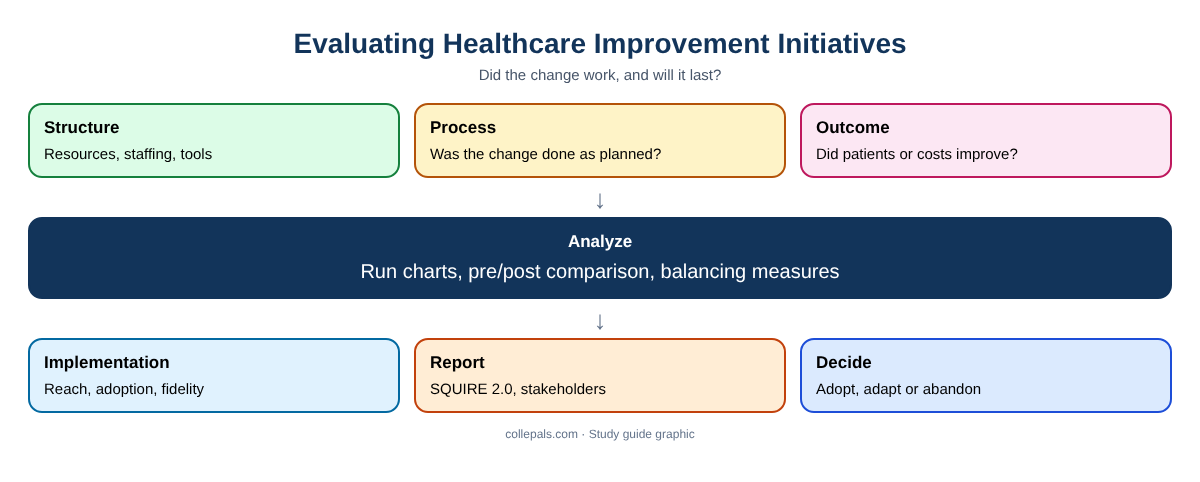
Donabedian (1988) proposed evaluating care through structure, process and outcome:
| Type | Question | Example for a teach-back initiative |
|---|---|---|
| Structure | Were resources in place? | Percentage of nurses trained in teach-back |
| Process | Was the change carried out? | Percentage of discharges with documented teach-back |
| Outcome | Did results improve? | 30-day readmission rate, patient understanding scores |
| Balancing | Were there unintended effects? | Discharge time, nurse workload |
Analyze Data Over Time
Run charts plot a measure over time with a median line and help distinguish real improvement from random variation using simple rules, such as shifts and trends (Perla et al., 2011). They are well suited to QI projects with small samples and frequent measurement. Pre- and post-implementation comparisons, using appropriate statistical tests, can complement run charts when your program requires them. Always report practical significance, whether the change matters to patients and the organization, alongside statistical results.
Evaluate Implementation
An intervention may fail because it did not work or because it was not implemented well. The RE-AIM framework assesses Reach, Effectiveness, Adoption, Implementation and Maintenance (Glasgow et al., 1999). For example, low reach (few eligible patients received the intervention) suggests a different problem from low effectiveness.
Consider Cost
Leaders want to know whether the initiative was worth its cost. Estimate resources used and savings or avoided costs; see cost-effectiveness strategies in healthcare management.
Report Results
SQUIRE 2.0 guides QI reports, covering the problem, rationale, context, intervention, measures, analysis, results, interpretation and limitations (Ogrinc et al., 2016). Tailor summaries to your audience: executives want outcomes and cost; staff want practical lessons.
Decide: Adopt, Adapt or Abandon
- Adopt when results meet your aim and the process is reliable.
- Adapt when results are promising but implementation or context needs adjustment.
- Abandon when the change does not improve outcomes or causes harm.
Plan sustainability for adopted changes; see developing an implementation plan.
Frequently Asked Questions
What is a balancing measure?
A measure that checks whether a change caused problems in another part of the system, such as longer discharge times after adding a new teaching step.
Do I need statistics for a DNP QI project?
Requirements vary by program. Many QI projects use run charts and descriptive statistics; some programs also require inferential tests.
What is the difference between outcome and process measures?
Outcome measures show results for patients or the system; process measures show whether the intended change was actually carried out.
Get Help Evaluating Your Improvement Initiative at Collepals
Balancing a DNP program with leadership responsibilities at work is demanding. Collepals.com supports DNP students in DNP 880 Strategic Leadership and Business Management and related courses. Our doctoral-level nursing writers and tutors can:
- Help you break down DNP 880 prompts and rubrics and plan your papers and discussion posts.
- Guide you to current scholarly evidence on leadership, quality improvement, cost and workforce topics.
- Provide model papers and discussion responses you can study for structure and depth.
- Edit and proofread your drafts for doctoral-level clarity and APA 7 formatting.
Browse our free model assignments or learn more about our nursing assignment writing service.
Use Collepals examples as study guides and follow Aspen University’s academic integrity and AI policies when you submit your own work.
More DNP 880 study guides
- DNP880 Strategic Leadership and Business Management: Complete Student Guide
- Evidence-Based Practice Models for Healthcare Quality Improvement
- How to Develop a Healthcare Quality Improvement Initiative
- How to Identify Gaps in Healthcare Service Delivery
- DNP Quality Improvement Project: Developing an Implementation Plan
Collepals is an independent study resource and is not affiliated with or endorsed by Aspen University. Course titles, numbers and requirements change; always follow your current syllabus, rubric and catalog.
References
Donabedian, A. (1988). The quality of care: How can it be assessed? JAMA, 260(12), 1743–1748. https://doi.org/10.1001/jama.1988.03410120089033
Glasgow, R. E., Vogt, T. M., & Boles, S. M. (1999). Evaluating the public health impact of health promotion interventions: The RE-AIM framework. American Journal of Public Health, 89(9), 1322–1327. https://doi.org/10.2105/AJPH.89.9.1322
Kidder, D. P., Fierro, L. A., Luna, E., Salvaggio, H., McWhorter, A., Bowen, S.-A., Murphy-Hoefer, R., Thigpen, S., Alexander, D., Armstead, T. L., August, E., Bruce, D., Clarke, S. N., Davis, C., Downes, A., Gill, S., House, L. D., Kerzner, M., Kun, K., … Young, K. (2024). CDC program evaluation framework, 2024. MMWR Recommendations and Reports, 73(6), 1–37. https://doi.org/10.15585/mmwr.rr7306a1
Ogrinc, G., Davies, L., Goodman, D., Batalden, P., Davidoff, F., & Stevens, D. (2016). SQUIRE 2.0 (Standards for QUality Improvement Reporting Excellence): Revised publication guidelines from a detailed consensus process. BMJ Quality & Safety, 25(12), 986–992. https://doi.org/10.1136/bmjqs-2015-004411
Perla, R. J., Provost, L. P., & Murray, S. K. (2011). The run chart: A simple analytical tool for learning from variation in healthcare processes. BMJ Quality & Safety, 20(1), 46–51. https://doi.org/10.1136/bmjqs.2009.037895
Get a plagiarism-free answer to this question
Send us your instructions and we’ll match you with the best writer in your subject.
- 100% human-written, zero AI
- Turnitin report included
- Confidential — we never share your data
- Free revisions & refunds