IRB Approval and Ethical Considerations in DNP Quality Improvement Projects
Need help with this assignment?Get an original answer from a qualified tutor — from $10/page.
Get it written →Ethics and IRB requirements are part of DNP 880 Strategic Leadership and Business Management at Aspen University: the 2022–2023 catalog description for DNP880 states that students must obtain Aspen University IRB approval and document immersion hours associated with the DNP Project (Aspen University, 2022). Many students are unsure whether a QI project needs IRB review or how to protect participants. This guide explains the difference between QI and research, ethical principles for DNP projects and how to prepare for IRB submission.
Quick answer
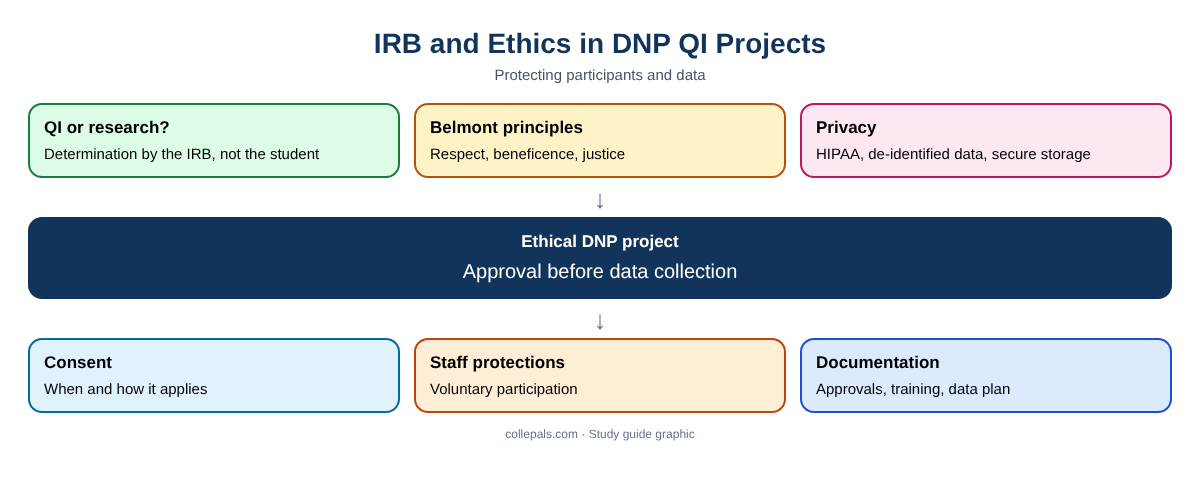
Even though QI projects aim to improve local care rather than create generalizable knowledge, they still raise ethical issues. Follow your program’s rule (Aspen’s DNP880 catalog description requires Aspen IRB approval), let the IRB determine how the project is classified, apply the Belmont principles, protect privacy under HIPAA, plan consent where needed, protect staff participants and obtain all approvals before collecting data.
QI or Research?
Quality improvement typically applies existing evidence to improve care in a specific setting, while research is designed to produce generalizable knowledge. The federal Common Rule defines research as a systematic investigation designed to develop or contribute to generalizable knowledge (Protection of Human Subjects, 2018). The Office for Human Research Protections (OHRP, n.d.) explains that some QI activities are also research and that intent to publish alone is not enough to decide whether an activity is research. Because the distinction can be subtle, the IRB, not the student, makes the determination.
| Feature | Typical QI | Typical research |
|---|---|---|
| Purpose | Improve local care or processes | Generate generalizable knowledge |
| Design | Iterative changes, PDSA cycles | Fixed protocol, often comparison groups |
| Intervention | Evidence-based practice already established | May be untested |
| Risk | Usually minimal | Variable |
Ethical Principles
The Belmont Report’s three principles apply to QI as well as research (National Commission for the Protection of Human Subjects of Biomedical and Behavioral Research, 1979):
- Respect for persons: honor autonomy and protect those with reduced autonomy, including through informed consent when appropriate.
- Beneficence: maximize benefits and minimize risks.
- Justice: distribute benefits and burdens fairly, avoiding exclusion of groups without good reason.
Key Ethical Considerations in DNP QI Projects
Privacy and data security
Collect only the data you need, de-identify it as early as possible, store it on secure, approved systems and follow HIPAA and organizational policies. Avoid emailing or storing patient data on personal devices.
Consent
Some QI projects embedded in routine care may not require individual consent, while surveys or interviews usually require at least an information sheet or consent process. Follow the IRB’s determination.
Staff as participants
When staff complete surveys or education, participation should be voluntary and should not affect employment evaluations. Anonymous surveys reduce pressure.
Conflicts of interest and power
If you supervise participants, take steps to reduce coercion, such as having a neutral person collect consent or surveys.
Risk
Assess whether the intervention could cause harm, such as delays in care or increased workload, and include monitoring and stopping rules where appropriate.
Preparing for IRB Submission
- Confirm your program’s and site’s requirements; some sites require their own IRB or QI review in addition to the university’s.
- Complete required human subjects protection training.
- Obtain a site letter of support or permission.
- Prepare a clear protocol: aim, design, setting, participants, intervention, data collection, data management and analysis.
- Prepare instruments, consent or information documents and recruitment materials.
- Submit early and respond promptly to revision requests.
- Do not collect project data until you have written approval.
After Approval
- Follow the approved protocol; submit amendments before making changes.
- Report adverse events or unexpected problems as required.
- Keep approval letters and training certificates with your project records.
- Report your project transparently, for example using SQUIRE 2.0, which includes a section on ethical considerations (Ogrinc et al., 2016).
For planning the rest of your project, see DNP quality improvement project: developing an implementation plan.
Frequently Asked Questions
Does my DNP QI project need IRB approval?
Follow your program’s requirements. Aspen’s 2022–2023 catalog description for DNP880 states that students must obtain Aspen University IRB approval. The IRB determines whether the project is QI, exempt research or research needing further review.
Can I publish a QI project?
Often yes. OHRP notes that intent to publish alone does not make a QI project research, but check with your IRB before publishing.
Can I start collecting baseline data before approval?
No. Wait for written approvals unless your IRB explicitly states otherwise; using data collected without approval can jeopardize your project.
Get Help Preparing Your IRB Submission at Collepals
Balancing a DNP program with leadership responsibilities at work is demanding. Collepals.com supports DNP students in DNP 880 Strategic Leadership and Business Management and related courses. Our doctoral-level nursing writers and tutors can:
- Help you break down DNP 880 prompts and rubrics and plan your papers and discussion posts.
- Guide you to current scholarly evidence on leadership, quality improvement, cost and workforce topics.
- Provide model papers and discussion responses you can study for structure and depth.
- Edit and proofread your drafts for doctoral-level clarity and APA 7 formatting.
Browse our free model assignments or learn more about our nursing assignment writing service.
Use Collepals examples as study guides and follow Aspen University’s academic integrity and AI policies when you submit your own work.
More DNP 880 study guides
- DNP880 Strategic Leadership and Business Management: Complete Student Guide
- How to Develop a Healthcare Quality Improvement Initiative
- DNP Quality Improvement Project: Developing an Implementation Plan
- How to Evaluate Healthcare Improvement Initiatives
- Evidence-Based Practice Models for Healthcare Quality Improvement
Collepals is an independent study resource and is not affiliated with or endorsed by Aspen University. Course titles, numbers and requirements change; always follow your current syllabus, rubric and catalog.
References
Aspen University. (2022). DNP880 Strategic Leadership and Business Management. In Academic catalog 2022–2023. https://aspen.smartcatalogiq.com/en/academic-year-2022-2023/academic-catalog/courses/dnp-doctor-of-nursing-practice/800/dnp880
National Commission for the Protection of Human Subjects of Biomedical and Behavioral Research. (1979). The Belmont report: Ethical principles and guidelines for the protection of human subjects of research. U.S. Department of Health, Education, and Welfare.
Office for Human Research Protections. (n.d.). Quality improvement activities FAQs. U.S. Department of Health and Human Services. https://www.hhs.gov/ohrp/regulations-and-policy/guidance/faq/quality-improvement-activities
Ogrinc, G., Davies, L., Goodman, D., Batalden, P., Davidoff, F., & Stevens, D. (2016). SQUIRE 2.0 (Standards for QUality Improvement Reporting Excellence): Revised publication guidelines from a detailed consensus process. BMJ Quality & Safety, 25(12), 986–992. https://doi.org/10.1136/bmjqs-2015-004411
Protection of Human Subjects, 45 C.F.R. pt. 46 (2018).
Get a plagiarism-free answer to this question
Send us your instructions and we’ll match you with the best writer in your subject.
- 100% human-written, zero AI
- Turnitin report included
- Confidential — we never share your data
- Free revisions & refunds