DNP Quality Improvement Project: Developing an Implementation Plan
Need help with this assignment?Get an original answer from a qualified tutor — from $10/page.
Get it written →Many students in DNP 880 Strategic Leadership and Business Management at Aspen University are also moving their DNP projects toward implementation; Aspen’s catalog description for DNP880 ties the course to IRB approval and immersion hours associated with the DNP Project (Aspen University, 2022). An implementation plan turns a good idea into a realistic project. This guide explains the components of a DNP quality improvement project implementation plan, with a template you can adapt.
Quick answer
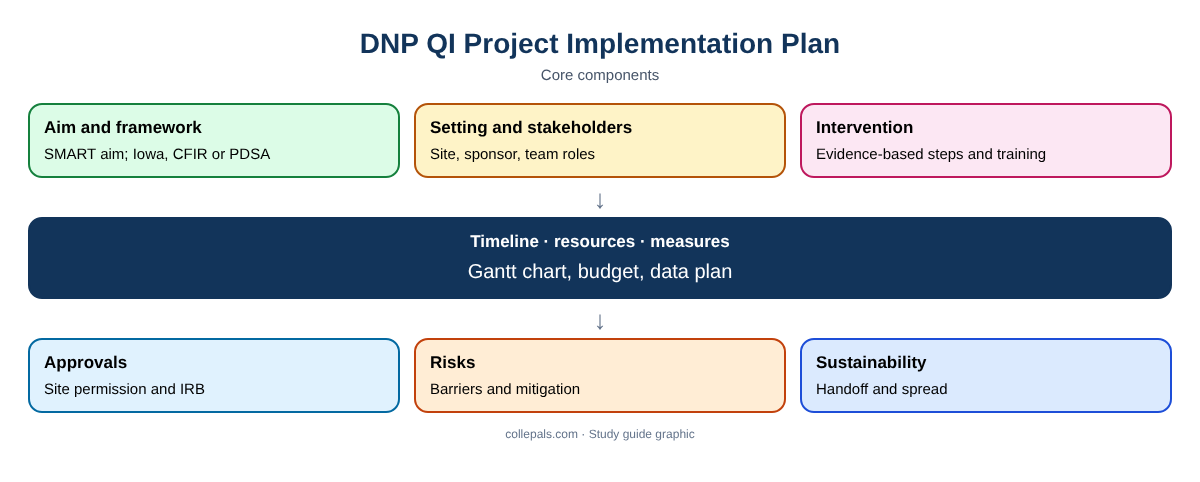
A DNP QI implementation plan states the aim and framework, describes the setting, stakeholders and roles, details the evidence-based intervention and training, sets a timeline, lists resources and budget, defines measures and data collection, identifies approvals such as site permission and IRB, anticipates barriers with mitigation strategies and plans for sustainability.
Component 1: Aim and Framework
Restate your SMART aim and the framework that guides the project, such as the Iowa Model (Buckwalter et al., 2017) or the Model for Improvement with PDSA cycles (Langley et al., 2009). An implementation framework, such as the updated Consolidated Framework for Implementation Research (CFIR), helps you anticipate factors that influence success, including characteristics of the innovation, the inner and outer settings, the individuals involved and the implementation process (Damschroder et al., 2022).
Component 2: Setting and Stakeholders
Describe the site (de-identified if required), the population and the stakeholders: executive sponsor, preceptor or site mentor, frontline staff, interprofessional partners and patients. Define each person’s role and how you will communicate with them.
Component 3: The Intervention
Describe exactly what will change, who will do it, when and how. Include staff education, materials, workflow changes and documentation tools. The more specific the description, the easier it is to carry out the intervention consistently and evaluate it.
Component 4: Timeline
| Phase | Key activities | Sample timing |
|---|---|---|
| Preparation | Approvals, stakeholder meetings, baseline data, materials | Weeks 1–4 |
| Education | Staff training sessions, competency checks | Weeks 5–6 |
| Implementation | Launch, PDSA cycles, coaching | Weeks 7–14 |
| Evaluation | Data analysis, comparison with baseline | Weeks 15–16 |
| Dissemination and handoff | Report to stakeholders, sustainability plan | Weeks 17–18 |
A Gantt chart is a clear way to present the timeline. Align it with your program’s project course sequence and immersion hour requirements.
Component 5: Resources and Budget
List staff time, education costs, printed or digital materials, equipment and data support. Even small projects benefit from a simple budget showing costs and potential savings; see cost-effectiveness strategies in healthcare management.
Component 6: Measures and Data Collection
Define outcome, process and balancing measures, data sources, who collects data, how often and how it will be stored securely. Plan to display data on run charts. See how to evaluate healthcare improvement initiatives.
Component 7: Approvals and Ethics
Obtain written site permission and submit to the appropriate IRB before collecting data. The 2022–2023 catalog description for DNP880 states that students must obtain Aspen University IRB approval (Aspen University, 2022). See IRB approval and ethical considerations in DNP QI projects.
Component 8: Barriers and Mitigation
| Possible barrier | Mitigation |
|---|---|
| Staff resistance | Involve staff early, share data, identify champions |
| Staffing shortages | Short training sessions, flexible timing, unit champions |
| Data access delays | Confirm data sources and permissions before launch |
| Leadership turnover | Secure a backup sponsor and document agreements |
Component 9: Sustainability
Plan how the change will continue after your project ends: policies, order sets, documentation prompts, ongoing audits and a staff owner. Sustainability is a key step in the Iowa Model (Buckwalter et al., 2017).
Frequently Asked Questions
What is the difference between a project proposal and an implementation plan?
A proposal justifies the project; an implementation plan details how, when, by whom and with what resources it will be carried out and evaluated.
Do I need IRB approval for a QI project?
Requirements vary, but the DNP880 catalog description states that Aspen students must obtain Aspen University IRB approval. Never collect project data before approvals.
What implementation framework should I use?
CFIR is widely used to identify barriers and facilitators; your program may also require a specific EBP model.
Get Help With Your DNP Implementation Plan at Collepals
Balancing a DNP program with leadership responsibilities at work is demanding. Collepals.com supports DNP students in DNP 880 Strategic Leadership and Business Management and related courses. Our doctoral-level nursing writers and tutors can:
- Help you break down DNP 880 prompts and rubrics and plan your papers and discussion posts.
- Guide you to current scholarly evidence on leadership, quality improvement, cost and workforce topics.
- Provide model papers and discussion responses you can study for structure and depth.
- Edit and proofread your drafts for doctoral-level clarity and APA 7 formatting.
Browse our free model assignments or learn more about our nursing assignment writing service.
Use Collepals examples as study guides and follow Aspen University’s academic integrity and AI policies when you submit your own work.
More DNP 880 study guides
- DNP880 Strategic Leadership and Business Management: Complete Student Guide
- Evidence-Based Practice Models for Healthcare Quality Improvement
- How to Develop a Healthcare Quality Improvement Initiative
- How to Evaluate Healthcare Improvement Initiatives
- IRB Approval and Ethical Considerations in DNP Quality Improvement Projects
Collepals is an independent study resource and is not affiliated with or endorsed by Aspen University. Course titles, numbers and requirements change; always follow your current syllabus, rubric and catalog.
References
Aspen University. (2022). DNP880 Strategic Leadership and Business Management. In Academic catalog 2022–2023. https://aspen.smartcatalogiq.com/en/academic-year-2022-2023/academic-catalog/courses/dnp-doctor-of-nursing-practice/800/dnp880
Buckwalter, K. C., Cullen, L., Hanrahan, K., Kleiber, C., McCarthy, A. M., Rakel, B., Steelman, V., Tripp-Reimer, T., & Tucker, S. (2017). Iowa model of evidence-based practice: Revisions and validation. Worldviews on Evidence-Based Nursing, 14(3), 175–182. https://doi.org/10.1111/wvn.12223
Damschroder, L. J., Reardon, C. M., Widerquist, M. A. O., & Lowery, J. (2022). The updated Consolidated Framework for Implementation Research based on user feedback. Implementation Science, 17, Article 75. https://doi.org/10.1186/s13012-022-01245-0
Langley, G. J., Moen, R. D., Nolan, K. M., Nolan, T. W., Norman, C. L., & Provost, L. P. (2009). The improvement guide: A practical approach to enhancing organizational performance (2nd ed.). Jossey-Bass.
Get a plagiarism-free answer to this question
Send us your instructions and we’ll match you with the best writer in your subject.
- 100% human-written, zero AI
- Turnitin report included
- Confidential — we never share your data
- Free revisions & refunds