Writing Evidence-Based Policy Recommendations
Need help with this assignment?Get an original answer from a qualified tutor — from $10/page.
Get it written →Healthcare policy recommendations tell decision-makers what to do, who should do it and why. Strong recommendations are the payoff of policy briefs and analyses in NURS 6050: Policy and Advocacy for Improving Population Health. This guide explains how to write evidence-based recommendations that are specific, feasible and measurable.
Quick answer
An evidence-based healthcare policy recommendation names the action, the responsible body and the timeline. It cites evidence of effectiveness, shows the policy is feasible, sets measurable outcomes and addresses equity. In NURS 6050: Policy and Advocacy for Improving Population Health, one strong, specific recommendation backed by evidence beats a list of vague suggestions.
Examples, cases, bills and organizations on this page are fictional unless cited and written by Collepals for study purposes. NURS 6050: Policy and Advocacy for Improving Population Health is a Walden University course; assignments vary by term, so follow your own syllabus and rubric. Policy facts were current when written; check for later changes. This content is educational, not legal advice. Collepals is not affiliated with Walden University.
Sample document: a policy recommendation builder with fictional examples (Word).
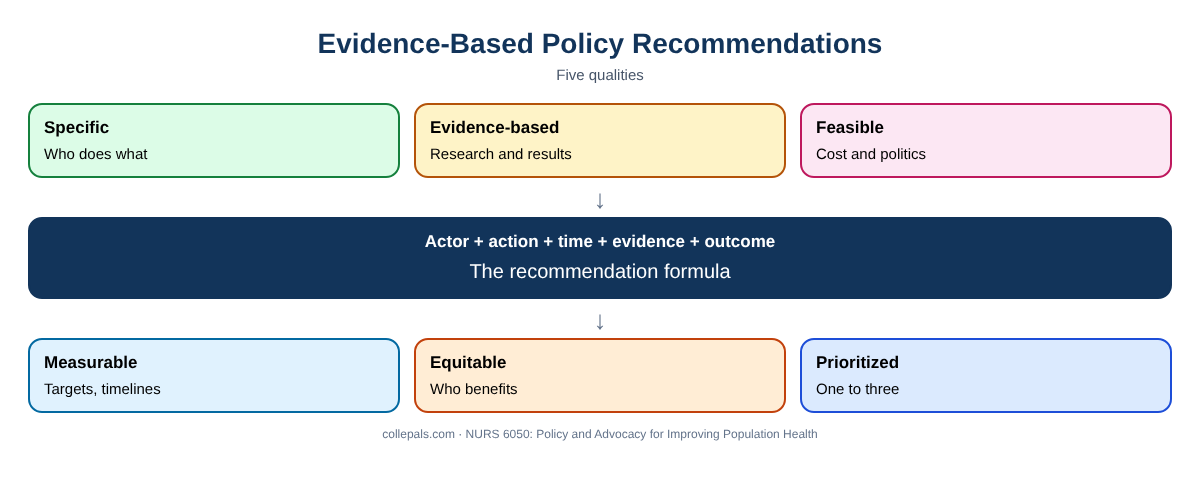
Five Qualities of a Strong Recommendation
| Quality | Meaning | Example |
|---|---|---|
| Specific | Says exactly what should be done and by whom | “The state should fund…” not “we should address…” |
| Evidence-based | Backed by research or results from other places | Cite studies or other states |
| Feasible | Realistic for cost, politics and administration | Phasing, pilots |
| Measurable | Has outcomes you can track | Targets and timelines |
| Equitable | Considers who benefits and who could be harmed | Disparities analysis |
Weak vs. Strong (Fictional)
| Weak | Strong |
|---|---|
| “We need more school nurses.” | “The state legislature should fund one RN per 750 students in high-need districts over three years and track asthma-related absences each year.” |
| “Improve mental health access.” | “The state Medicaid agency should reimburse collaborative care codes in primary care by July next year and report wait times every quarter.” |
A Recommendation Formula
[Actor] should [action] by [time], because [evidence], measured by [outcome].
Tips
- Lead with the recommendation, then give the evidence.
- Address the strongest objection.
- Estimate cost or point to a funding source.
- Limit yourself to one to three recommendations.
Related: How to Write a Healthcare Policy Brief, Healthcare Policy Analysis: A Guide for Graduate Nursing Students and health equity policy proposal example.
Frequently Asked Questions
How many recommendations should a brief include?
Usually one to three, ranked by priority.
Where do I find evidence?
Peer-reviewed studies, government evaluations and results from states or countries that have tried the policy.
Should I include costs?
Yes, whenever possible. Decision-makers will ask.
Get Help Writing Healthcare Policy Recommendations
Policy and advocacy assignments demand current evidence, clear analysis and persuasive APA writing. Collepals.com helps students in NURS 6050: Policy and Advocacy for Improving Population Health and other health policy courses:
- Analyze policies, bills and programs with a clear framework.
- Write discussion posts, peer responses and reflections.
- Build policy briefs, fact sheets, comparison grids and advocacy letters.
- Find current evidence, cite in APA 7 and get drafts edited and proofread.
Browse our free model assignments or learn more about our nursing assignment writing service.
Use Collepals examples as study guides and follow your school’s academic integrity and AI policies.
More NURS 6050: Policy and Advocacy for Improving Population Health guides
Collepals is an independent study resource. Follow your program’s instructions and rubric and write your own work.
References
Bardach, E., & Patashnik, E. M. (2020). A practical guide for policy analysis: The eightfold path to more effective problem solving (6th ed.). CQ Press.
National Academies of Sciences, Engineering, and Medicine. (2021). The future of nursing 2020–2030: Charting a path to achieve health equity. The National Academies Press. https://doi.org/10.17226/25982
Short, N. M. (Ed.). (2023). Milstead’s health policy & politics: A nurse’s guide (7th ed.). Jones & Bartlett Learning.
Get a plagiarism-free answer to this question
Send us your instructions and we’ll match you with the best writer in your subject.
- 100% human-written, zero AI
- Turnitin report included
- Confidential — we never share your data
- Free revisions & refunds