Healthcare Policy Analysis: A Guide for Graduate Nursing Students
Need help with this assignment?Get an original answer from a qualified tutor — from $10/page.
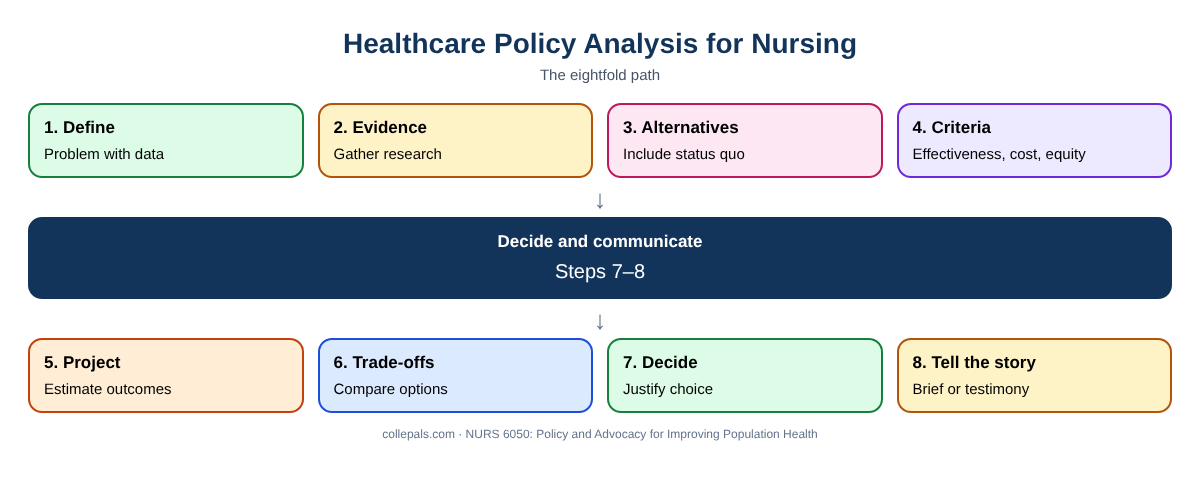
Get it written →Healthcare policy analysis is a structured way to define a health problem, compare policy options and recommend the best one. Graduate nursing students use it in courses such as NURS 6050: Policy and Advocacy for Improving Population Health. This guide adapts Bardach and Patashnik’s eightfold path for nursing assignments. Healthcare policy analysis nursing assignments reward a named framework, so this guide uses one throughout.
Quick answer
Healthcare policy analysis in nursing follows eight steps: define the problem with data, assemble evidence, build realistic alternatives including the status quo, choose criteria such as effectiveness, cost, equity and feasibility, project outcomes, weigh trade-offs, decide and communicate the result. Students in NURS 6050: Policy and Advocacy for Improving Population Health use it for briefs, grids and papers.
Examples, cases, bills and organizations on this page are fictional unless cited and written by Collepals for study purposes. NURS 6050: Policy and Advocacy for Improving Population Health is a Walden University course; assignments vary by term, so follow your own syllabus and rubric. Policy facts were current when written; check for later changes. This content is educational, not legal advice. Collepals is not affiliated with Walden University.
Sample document: a healthcare policy analysis worksheet with an options matrix (Word).
The Eightfold Path, Adapted for Nursing
| Step | What to do | Nursing examples |
|---|---|---|
| 1. Define the problem | State it with data, not with a solution in mind | Scope, trend, population, cost |
| 2. Assemble evidence | Gather data and research | Government data, peer-reviewed studies |
| 3. Construct alternatives | List realistic policy options | Include the status quo |
| 4. Select criteria | Decide how to judge options | Effectiveness, cost, equity, feasibility |
| 5. Project outcomes | Estimate each option’s effects | Use evidence, not hope |
| 6. Confront trade-offs | Compare options across criteria | A matrix helps |
| 7. Decide | Choose and justify | Your recommendation |
| 8. Tell your story | Communicate to the audience | Brief, fact sheet, testimony |
Adapted from Bardach and Patashnik (2020).
Options Matrix (Fictional)
| Option | Effectiveness | Cost | Equity | Feasibility |
|---|---|---|---|---|
| Status quo | Low | None new | Gaps persist | High |
| Telehealth parity law | Moderate | Low | Helps rural, needs broadband | Moderate |
| Fund mobile clinics | Moderate–high | Moderate | Targets underserved areas | Moderate |
Ratings are illustrative. Justify yours with evidence.
Why Nurses Are Well Placed for Policy Analysis
Nurses see the effects of policy directly in patient care. The Future of Nursing 2020–2030 report calls on nurses to use that experience to shape policies that advance health equity (National Academies of Sciences, Engineering, and Medicine, 2021).
Apply it: NURS 6050 Healthcare Policy Analysis: Assignment Guide, Writing Evidence-Based Policy Recommendations and How to Write a Healthcare Policy Brief.
Frequently Asked Questions
What criteria should I use?
Common criteria are effectiveness, cost, equity, feasibility (political and administrative) and unintended effects.
Is the status quo an option?
Yes. Always include it as a baseline.
Do I need a model or framework?
Most rubrics reward a named framework, such as the eightfold path or your textbook’s model.
Get Help With Healthcare Policy Analysis
Policy and advocacy assignments demand current evidence, clear analysis and persuasive APA writing. Collepals.com helps students in NURS 6050: Policy and Advocacy for Improving Population Health and other health policy courses:
- Analyze policies, bills and programs with a clear framework.
- Write discussion posts, peer responses and reflections.
- Build policy briefs, fact sheets, comparison grids and advocacy letters.
- Find current evidence, cite in APA 7 and get drafts edited and proofread.
Browse our free model assignments or learn more about our nursing assignment writing service.
Use Collepals examples as study guides and follow your school’s academic integrity and AI policies.
More NURS 6050: Policy and Advocacy for Improving Population Health guides
- NURS 6050: Policy and Advocacy for Improving Population Health – Complete Course Guide
- NURS 6050 Healthcare Policy Analysis: Assignment Guide
- Writing Evidence-Based Policy Recommendations
- The Healthcare Policy Process: A Nursing Student’s Guide
- How to Conduct a Healthcare Policy Stakeholder Analysis
Collepals is an independent study resource. Follow your program’s instructions and rubric and write your own work.
References
Bardach, E., & Patashnik, E. M. (2020). A practical guide for policy analysis: The eightfold path to more effective problem solving (6th ed.). CQ Press.
National Academies of Sciences, Engineering, and Medicine. (2021). The future of nursing 2020–2030: Charting a path to achieve health equity. The National Academies Press. https://doi.org/10.17226/25982
Short, N. M. (Ed.). (2023). Milstead’s health policy & politics: A nurse’s guide (7th ed.). Jones & Bartlett Learning.
Get a plagiarism-free answer to this question
Send us your instructions and we’ll match you with the best writer in your subject.
- 100% human-written, zero AI
- Turnitin report included
- Confidential — we never share your data
- Free revisions & refunds