How to Write a NURS 6050 Reflection Assignment
Need help with this assignment?Get an original answer from a qualified tutor — from $10/page.
Get it written →A NURS 6050 reflection asks you to look back on what you learned about policy and advocacy and how you will use it as an advanced practice nurse. This guide gives a Gibbs-based structure for NURS 6050: Policy and Advocacy for Improving Population Health reflections and a fictional sample.
Quick answer
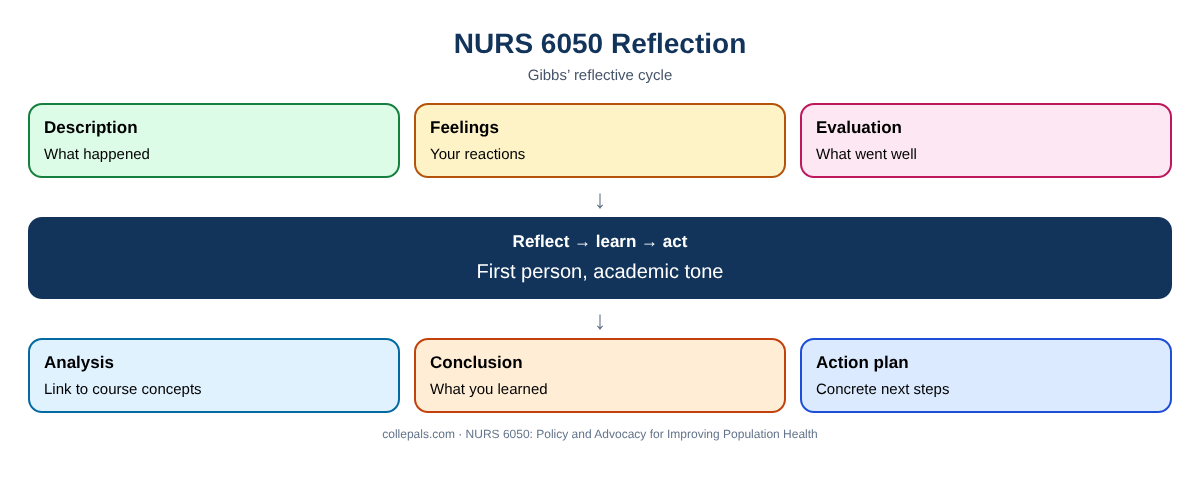
To write a NURS 6050 reflection, describe the learning experience, note your reactions, evaluate what went well, analyze why using course concepts and sources, state what you learned and set a concrete action plan for practice. Gibbs’ reflective cycle works well. In NURS 6050: Policy and Advocacy for Improving Population Health, write in the first person while keeping academic tone and citations.
Examples, cases, bills and organizations on this page are fictional unless cited and written by Collepals for study purposes. NURS 6050: Policy and Advocacy for Improving Population Health is a Walden University course; assignments vary by term, so follow your own syllabus and rubric. Policy facts were current when written; check for later changes. This content is educational, not legal advice. Collepals is not affiliated with Walden University.
Sample document: a NURS 6050 reflection template based on Gibbs’ cycle (Word).
Gibbs-Based Reflection Structure
| Stage | Content | Tips |
|---|---|---|
| Description | What happened in the course or assignment | Brief and factual |
| Feelings | Your reactions | Surprise, frustration, motivation |
| Evaluation | What went well or poorly | Specific moments |
| Analysis | Why, linked to course concepts and sources | Policy process, advocacy |
| Conclusion | What you learned | Skills and insights |
| Action plan | How you will apply it in practice | Concrete next steps |
Fictional Sample Excerpt
Sample (fictional)
Before this course I thought policy was something that happened far from the bedside. Writing a fact sheet on rural maternal care changed that. I saw how a single statistic about local ER closures could turn a vague concern into a concrete ask (Short, 2023). Next year I plan to join my state nurses association’s legislative committee and testify on one bill…
This excerpt is fictional. Reflect on your own experience.
Tips
- First person is fine; keep it professional.
- Link insights to course concepts such as agenda setting, stakeholders and evaluation.
- Make the action plan specific: who, what and when.
- Cite sources when you analyze.
Related: How Nurses Can Influence Healthcare Legislation and NURS 6050: Policy and Advocacy for Improving Population Health – Complete Course Guide.
Frequently Asked Questions
Can I use “I” in a NURS 6050 reflection?
Yes. Reflections are usually written in the first person.
Does a reflection need references?
Often yes, especially in the analysis section; check your rubric.
What model should I use?
Gibbs’ cycle is common; follow any model your instructor names.
Get Help With Your NURS 6050 Reflection
Policy and advocacy assignments demand current evidence, clear analysis and persuasive APA writing. Collepals.com helps students in NURS 6050: Policy and Advocacy for Improving Population Health and other health policy courses:
- Analyze policies, bills and programs with a clear framework.
- Write discussion posts, peer responses and reflections.
- Build policy briefs, fact sheets, comparison grids and advocacy letters.
- Find current evidence, cite in APA 7 and get drafts edited and proofread.
Browse our free model assignments or learn more about our nursing assignment writing service.
Use Collepals examples as study guides and follow your school’s academic integrity and AI policies.
More NURS 6050: Policy and Advocacy for Improving Population Health guides
Collepals is an independent study resource. Follow your program’s instructions and rubric and write your own work.
References
American Psychological Association. (2020). Publication manual of the American Psychological Association (7th ed.). https://doi.org/10.1037/0000165-000
Gibbs, G. (1988). Learning by doing: A guide to teaching and learning methods. Further Education Unit, Oxford Polytechnic.
Short, N. M. (Ed.). (2023). Milstead’s health policy & politics: A nurse’s guide (7th ed.). Jones & Bartlett Learning.
Get a plagiarism-free answer to this question
Send us your instructions and we’ll match you with the best writer in your subject.
- 100% human-written, zero AI
- Turnitin report included
- Confidential — we never share your data
- Free revisions & refunds