NURS 6050 Health Advocacy Campaign: Complete Assignment Guide
Need help with this assignment?Get an original answer from a qualified tutor — from $10/page.
Get it written →A NURS 6050 advocacy campaign assignment asks you to plan how nurses could move a population health issue toward a policy change. In NURS 6050: Policy and Advocacy for Improving Population Health, this may be a standalone campaign plan or part of a testimony or advocacy statement. This complete guide explains the seven parts of a campaign and gives a fictional example.
Quick answer
A NURS 6050 advocacy campaign plan sets one measurable goal, names the decision-makers and influencers to target, and states a short problem-solution-ask message. It also builds a coalition, chooses tactics such as letters, testimony and meetings, sets a timeline around the legislative calendar and defines how success will be measured. In NURS 6050: Policy and Advocacy for Improving Population Health, support every claim with current evidence.
Examples, cases, bills and organizations on this page are fictional unless cited and written by Collepals for study purposes. NURS 6050: Policy and Advocacy for Improving Population Health is a Walden University course; assignments vary by term, so follow your own syllabus and rubric. Policy facts were current when written; check for later changes. This content is educational, not legal advice. Collepals is not affiliated with Walden University.
Sample document: a NURS 6050 advocacy campaign planner with a fictional example (Word).
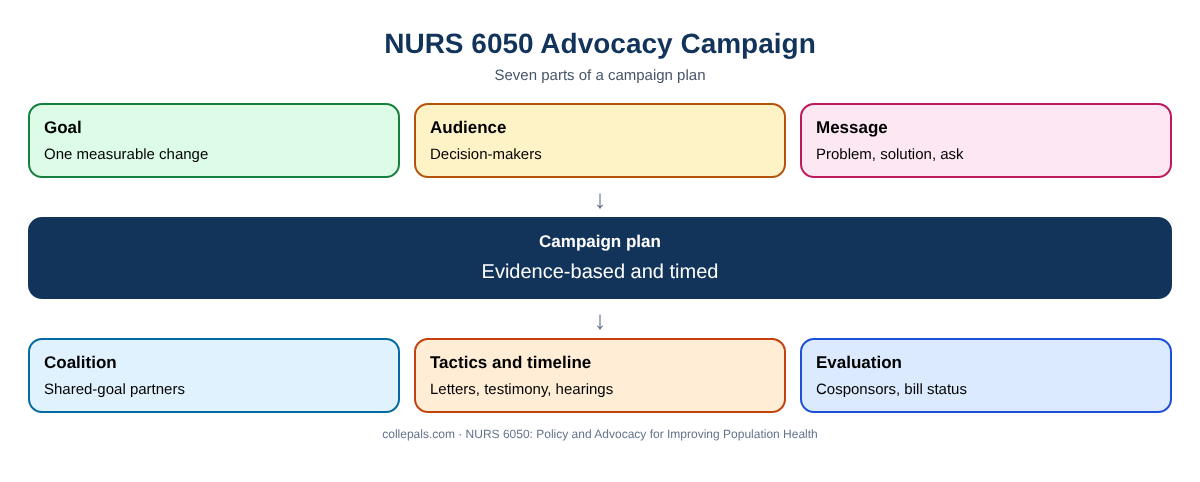
Seven Parts of an Advocacy Campaign
| Part | Description | Examples |
|---|---|---|
| 1. Goal | One measurable change | Pass a bill, fund a program, change a rule |
| 2. Audience | Decision-makers and those who influence them | Legislators, agency heads, voters |
| 3. Message | Problem, solution and ask in one or two sentences | Story plus data |
| 4. Coalition | Partners who share the goal | Nursing associations, patient groups |
| 5. Tactics | Ways to reach the audience | Letters, testimony, social media, meetings |
| 6. Timeline | Tie actions to the legislative calendar | Committee hearings, budget deadlines |
| 7. Evaluation | How you will know it worked | Meetings held, cosponsors gained, bill status |
Fictional Example
Campaign: Safe Staffing for Rural Clinics (fictional)
Goal: secure a hearing for a state bill that funds nurse practitioner positions in rural clinics. Audience: members of the health committee, especially the chair. Message: “Three counties have no primary care clinic open after 5 p.m. Funding two NP positions per county would cut avoidable ER visits.” Coalition: the state nurses association, rural hospitals and a farmworkers’ group. Tactics: a constituent letter drive, a capitol visit day and op-eds by local nurses. Evaluation: the hearing is scheduled and two new cosponsors sign on.
This example is fictional.
Tips
- Advocacy is legal and expected for nurses. The ANA Code calls on nurses to address social justice and health policy (American Nurses Association, 2025).
- Check your employer’s rules before advocating in your professional role, and separate personal from organizational positions.
- Match the tactic to the stage of the bill: early letters, testimony at the hearing and calls before the vote.
Related: How Nurses Can Influence Healthcare Legislation, How to Write a Nursing Advocacy Letter to a Legislator and Week 8 nursing role in program design.
Frequently Asked Questions
Is a campaign plan the same as an advocacy statement?
No. The statement is the persuasive argument; the campaign plan describes how you will deliver that argument to decision-makers.
How do I measure advocacy success?
Use process measures, such as meetings held and letters sent, and outcome measures, such as cosponsors gained and the bill’s progress.
Do I need a real bill?
Usually yes for NURS 6050. Use Congress.gov or your state legislature’s site.
Get Help With Your NURS 6050 Advocacy Campaign
Policy and advocacy assignments demand current evidence, clear analysis and persuasive APA writing. Collepals.com helps students in NURS 6050: Policy and Advocacy for Improving Population Health and other health policy courses:
- Analyze policies, bills and programs with a clear framework.
- Write discussion posts, peer responses and reflections.
- Build policy briefs, fact sheets, comparison grids and advocacy letters.
- Find current evidence, cite in APA 7 and get drafts edited and proofread.
Browse our free model assignments or learn more about our nursing assignment writing service.
Use Collepals examples as study guides and follow your school’s academic integrity and AI policies.
More NURS 6050: Policy and Advocacy for Improving Population Health guides
Collepals is an independent study resource. Follow your program’s instructions and rubric and write your own work.
References
American Nurses Association. (2025). Code of ethics for nurses. https://codeofethics.ana.org
National Academies of Sciences, Engineering, and Medicine. (2021). The future of nursing 2020–2030: Charting a path to achieve health equity. The National Academies Press. https://doi.org/10.17226/25982
Short, N. M. (Ed.). (2023). Milstead’s health policy & politics: A nurse’s guide (7th ed.). Jones & Bartlett Learning.
Get a plagiarism-free answer to this question
Send us your instructions and we’ll match you with the best writer in your subject.
- 100% human-written, zero AI
- Turnitin report included
- Confidential — we never share your data
- Free revisions & refunds