How to Conduct a Healthcare Policy Stakeholder Analysis
Need help with this assignment?Get an original answer from a qualified tutor — from $10/page.
Get it written →Healthcare policy stakeholders are the people and groups who affect a policy or are affected by it. A stakeholder analysis maps their interests, power and likely positions. It is a key step in NURS 6050: Policy and Advocacy for Improving Population Health assignments such as the Legislation Comparison Grid. This guide shows how to do one.
Quick answer
To conduct a healthcare policy stakeholder analysis, list everyone affected by or able to influence the policy, describe each group’s interests and likely position, rate its power and interest, place it on a power-interest grid and plan how to engage it. In NURS 6050: Policy and Advocacy for Improving Population Health, use stakeholder analysis to explain who supports or opposes a bill and why.
Examples, cases, bills and organizations on this page are fictional unless cited and written by Collepals for study purposes. NURS 6050: Policy and Advocacy for Improving Population Health is a Walden University course; assignments vary by term, so follow your own syllabus and rubric. Policy facts were current when written; check for later changes. This content is educational, not legal advice. Collepals is not affiliated with Walden University.
Sample document: a stakeholder analysis template with a power-interest grid (Word).
Five Steps
- Identify stakeholders: government, payers, providers, industry, patients, community groups.
- Describe each one’s interests in the policy.
- Estimate its likely position: support, oppose or neutral.
- Rate its power, such as votes, money and influence, and its interest.
- Plan engagement for each group.
Brugha and Varvasovszky (2000) describe stakeholder analysis as a way to understand actors’ interests and influence in health policy.
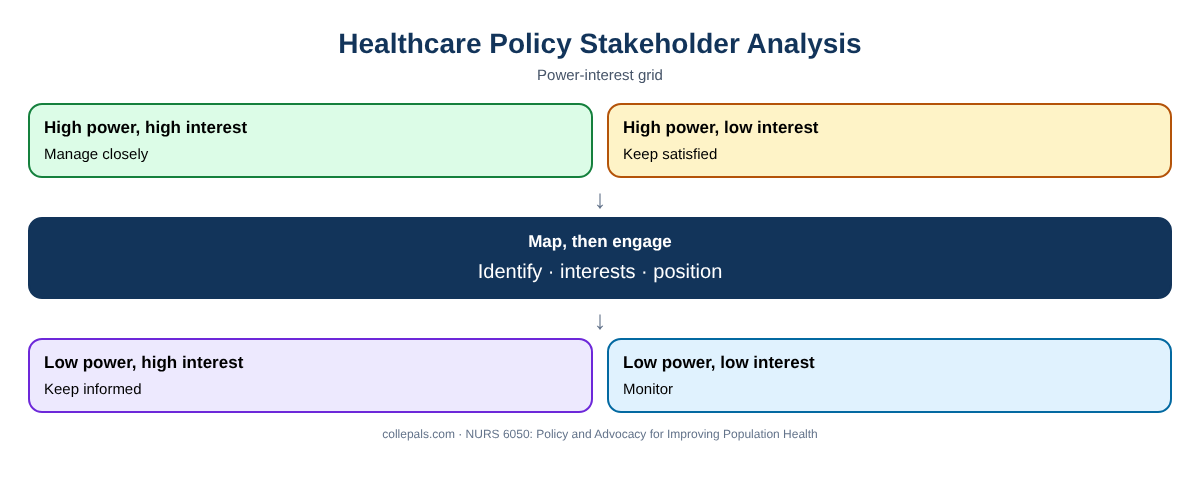
Power-Interest Grid
| Quadrant | Strategy | Examples |
|---|---|---|
| High power, high interest | Manage closely | Committee chair, state Medicaid agency |
| High power, low interest | Keep satisfied | Governor’s budget office, large employers |
| Low power, high interest | Keep informed and engaged | Patient advocacy groups, nurses |
| Low power, low interest | Monitor | General public |
Fictional Example
Bill: Nurse staffing ratios (fictional)
Supporters: the state nurses association and patient safety groups (high interest, moderate power). Opponents: the hospital association, which worries about cost and workforce shortages (high interest, high power). Undecided: rural legislators. Strategy: meet with rural legislators using local data and propose a phased timeline to address cost concerns.
Example on Collepals: presenting a healthcare policy to stakeholders. Related: NURS 6050 Healthcare Policy Analysis: Assignment Guide and How Nurses Can Influence Healthcare Legislation.
Frequently Asked Questions
Who counts as a stakeholder?
Anyone affected by or able to influence the policy, including opponents.
How do I know a stakeholder’s position?
Check testimony, press releases, lobbying disclosures and public comments.
Why include opponents?
Understanding objections helps you design compromises and stronger arguments.
Get Help With Healthcare Policy Stakeholder Analysis
Policy and advocacy assignments demand current evidence, clear analysis and persuasive APA writing. Collepals.com helps students in NURS 6050: Policy and Advocacy for Improving Population Health and other health policy courses:
- Analyze policies, bills and programs with a clear framework.
- Write discussion posts, peer responses and reflections.
- Build policy briefs, fact sheets, comparison grids and advocacy letters.
- Find current evidence, cite in APA 7 and get drafts edited and proofread.
Browse our free model assignments or learn more about our nursing assignment writing service.
Use Collepals examples as study guides and follow your school’s academic integrity and AI policies.
More NURS 6050: Policy and Advocacy for Improving Population Health guides
Collepals is an independent study resource. Follow your program’s instructions and rubric and write your own work.
References
Brugha, R., & Varvasovszky, Z. (2000). Stakeholder analysis: A review. Health Policy and Planning, 15(3), 239–246. https://doi.org/10.1093/heapol/15.3.239
Short, N. M. (Ed.). (2023). Milstead’s health policy & politics: A nurse’s guide (7th ed.). Jones & Bartlett Learning.
Get a plagiarism-free answer to this question
Send us your instructions and we’ll match you with the best writer in your subject.
- 100% human-written, zero AI
- Turnitin report included
- Confidential — we never share your data
- Free revisions & refunds