NURS 6050 Assignments: Complete Student Guide
Need help with this assignment?Get an original answer from a qualified tutor — from $10/page.
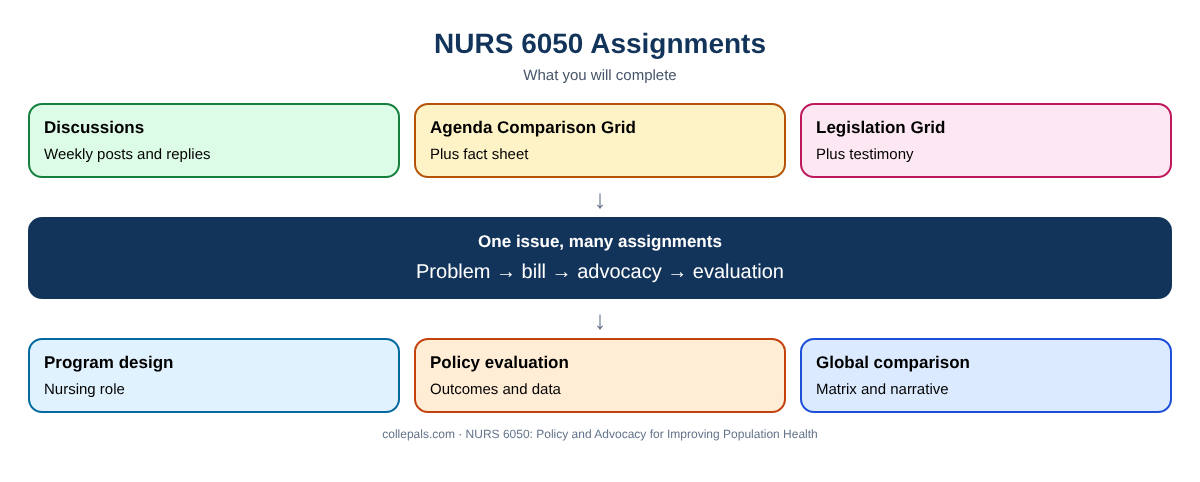
Get it written →Most NURS 6050 assignments in NURS 6050: Policy and Advocacy for Improving Population Health follow one thread. You pick a population health issue, study how it reaches the policy agenda, analyze legislation about it, advocate for change, and evaluate a program or policy. This student guide explains each assignment type and how they connect.
Quick answer
NURS 6050 assignments in NURS 6050: Policy and Advocacy for Improving Population Health typically include weekly discussions, an Agenda Comparison Grid with a fact sheet, a Legislation Comparison Grid with a testimony or advocacy statement, a program design analysis, a program or policy evaluation, and a global healthcare comparison matrix. Each assignment rewards specific, current policy details, credible sources and writing aimed at a defined audience.
Examples, cases, bills and organizations on this page are fictional unless cited and written by Collepals for study purposes. NURS 6050: Policy and Advocacy for Improving Population Health is a Walden University course; assignments vary by term, so follow your own syllabus and rubric. Policy facts were current when written; check for later changes. This content is educational, not legal advice. Collepals is not affiliated with Walden University.
Sample document: a NURS 6050 assignment checklist with rubric reminders (Word).
The Main NURS 6050 Assignments
| Assignment | Purpose | What graders look for |
|---|---|---|
| Agenda Comparison Grid | Compare how administrations have treated one population health issue | Agencies, funding, priorities, cited sources |
| Fact Sheet or Talking Points Brief | Inform a legislator or the public about the issue | 1–2 pages, plain language, data and an ask |
| Legislation Comparison Grid | Analyze a bill: sponsor, status, purpose, supporters and opponents | Bill number, Congress.gov details |
| Testimony or Advocacy Statement | Argue for or against the bill | Persuasive, evidence-based, addresses opposing views |
| Program Design Analysis | Explain the RN/APRN role in designing a program | Needs assessment, stakeholders, evidence |
| Program/Policy Evaluation | Judge whether a program met its goals | Outcomes, data, stakeholders, recommendations |
| Global Healthcare Comparison | Compare the U.S. and another country on one issue | Matrix plus narrative statement |
Assignment names and order vary by term, so treat this table as a map, not a syllabus.
How the Assignments Connect
Using the same issue throughout saves time. For example, a student focused on rural maternal health might compare how two administrations approached it, then write a fact sheet for a state legislator. Next comes analysis of a postpartum coverage bill and a statement supporting it. The term ends with an evaluation of a home-visiting program and a comparison with maternity care in another country. See Maternal Health Policy and Population Health Outcomes for the policy background.
Writing Tips That Raise Grades
- Name the policy precisely: bill number, sponsor, Congress or session and date checked.
- Separate facts (what the law does) from analysis (likely effects) and advocacy (what you recommend).
- Cite primary sources such as Congress.gov, Federal Register and agency pages, along with peer-reviewed evidence.
- Use rubric headings as your own headings.
- Keep fact sheets and briefs short. Busy readers skim.
Examples on Collepals
- Agenda Comparison Grid and Fact Sheet assignment
- Week 8: Advocating for the Nursing Role in Program Design
- Healthcare Program/Policy Evaluation template example
- Week 11: Global Healthcare Comparison Matrix
Guides for each type: NURS 6050 Healthcare Policy Analysis: Assignment Guide, How to Create a Health Policy Fact Sheet, NURS 6050 Case Studies: Policy and Population Health Analysis and Healthcare Policy Implementation and Evaluation.
Frequently Asked Questions
Can I use the same topic for every NURS 6050 assignment?
Often yes, and it saves research time, but check your syllabus and instructor’s rules.
What sources count as credible?
Government sites, nonpartisan research groups such as KFF, and peer-reviewed journals. Avoid opinion blogs and homework sites.
How long are NURS 6050 papers?
Usually two to four pages, plus grids and references; follow your rubric.
Get Help With NURS 6050 Assignments
Policy and advocacy assignments demand current evidence, clear analysis and persuasive APA writing. Collepals.com helps students in NURS 6050: Policy and Advocacy for Improving Population Health and other health policy courses:
- Analyze policies, bills and programs with a clear framework.
- Write discussion posts, peer responses and reflections.
- Build policy briefs, fact sheets, comparison grids and advocacy letters.
- Find current evidence, cite in APA 7 and get drafts edited and proofread.
Browse our free model assignments or learn more about our nursing assignment writing service.
Use Collepals examples as study guides and follow your school’s academic integrity and AI policies.
More NURS 6050: Policy and Advocacy for Improving Population Health guides
Collepals is an independent study resource. Follow your program’s instructions and rubric and write your own work.
References
Congress.gov. (n.d.). The legislative process. Library of Congress. https://www.congress.gov/legislative-process
Short, N. M. (Ed.). (2023). Milstead’s health policy & politics: A nurse’s guide (7th ed.). Jones & Bartlett Learning.
Walden University. (n.d.). NURS 6050 – Policy and advocacy for improving population health [Course catalog]. https://academics.waldenu.edu/catalog/courses/nurs/6050
Get a plagiarism-free answer to this question
Send us your instructions and we’ll match you with the best writer in your subject.
- 100% human-written, zero AI
- Turnitin report included
- Confidential — we never share your data
- Free revisions & refunds