Healthcare Policy Implementation and Evaluation
Need help with this assignment?Get an original answer from a qualified tutor — from $10/page.
Get it written →Healthcare policy evaluation asks whether a program or policy did what it was meant to do, for whom and at what cost. NURS 6050: Policy and Advocacy for Improving Population Health includes a program or policy evaluation assignment. This guide explains implementation, evaluation frameworks such as RE-AIM and the CDC framework, and the nursing role.
Quick answer
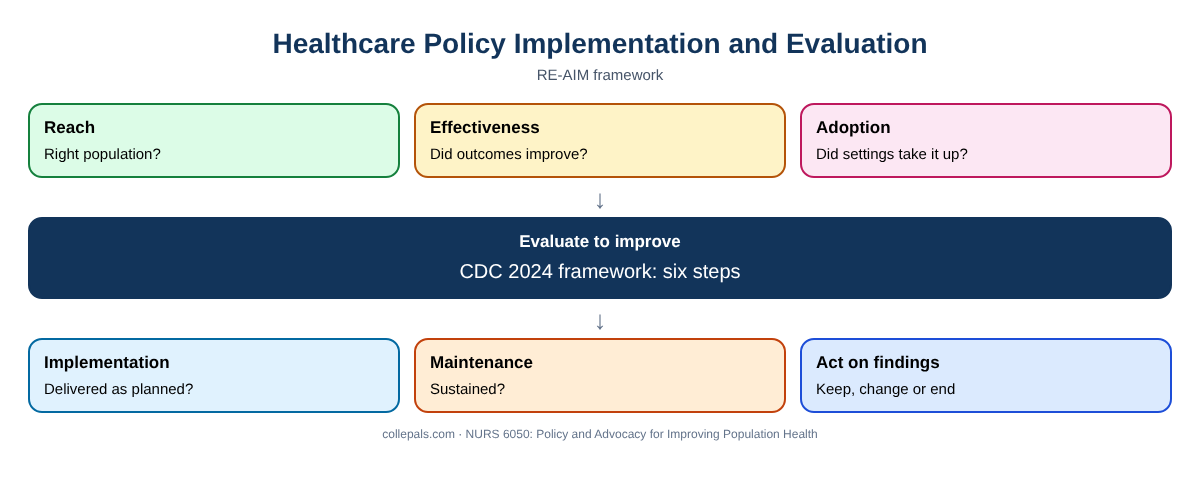
Healthcare policy evaluation measures whether a policy reached its population, improved outcomes, was adopted and implemented as planned and was sustained (RE-AIM). The CDC 2024 framework adds six steps: assess context, describe the program, focus the design, gather credible evidence, generate and support conclusions and act on findings. In NURS 6050: Policy and Advocacy for Improving Population Health, students evaluate a real program.
Examples, cases, bills and organizations on this page are fictional unless cited and written by Collepals for study purposes. NURS 6050: Policy and Advocacy for Improving Population Health is a Walden University course; assignments vary by term, so follow your own syllabus and rubric. Policy facts were current when written; check for later changes. This content is educational, not legal advice. Collepals is not affiliated with Walden University.
Sample document: a healthcare policy evaluation template using RE-AIM (Word).
Implementation: Putting Policy Into Action
After a law passes, agencies write rules, assign funds and issue guidance. Implementation often decides whether a policy succeeds. Watch for barriers such as staffing, data systems and confusing enrollment steps.
RE-AIM Framework
| Dimension | Question | Measures |
|---|---|---|
| Reach | Did it reach the intended population? | Enrollment, demographics |
| Effectiveness | Did outcomes improve? | Health measures, costs |
| Adoption | Did settings and staff take it up? | Sites participating |
| Implementation | Was it delivered as planned? | Fidelity, cost, adaptations |
| Maintenance | Are effects and delivery sustained? | Outcomes after 6 months or more; funding |
Based on Glasgow et al. (1999).
CDC Program Evaluation Framework (2024)
The updated CDC framework organizes evaluation into six steps: assess context, describe the program, focus the evaluation questions and design, gather credible evidence, generate and support conclusions and act on findings. Three cross-cutting actions run through every step: engage collaboratively, promote fair and just evaluation practices and learn from and use insights. Five federal evaluation standards also apply: relevance and utility, rigor, independence and objectivity, transparency and ethics (Kidder et al., 2024).
Nursing Role in Evaluation
- Collect and share outcome data from practice.
- Serve on evaluation teams and advisory boards.
- Report unintended effects on patients.
- Recommend changes based on results.
Example on Collepals: NURS 6050 Healthcare Program/Policy Evaluation: Hospital Readmissions Reduction Program. Related: The Healthcare Policy Process: A Nursing Student’s Guide and Writing Evidence-Based Policy Recommendations.
Frequently Asked Questions
What is the difference between process and outcome evaluation?
Process evaluation asks whether the program was delivered as planned. Outcome evaluation asks whether it changed health or cost.
Which framework should I use in NURS 6050?
RE-AIM, the CDC framework or your course text’s approach all work; name the one you use.
Where can I find evaluation data?
Government reports, such as those from CMS, GAO and state agencies, plus peer-reviewed studies.
Get Help With Healthcare Policy Evaluation
Policy and advocacy assignments demand current evidence, clear analysis and persuasive APA writing. Collepals.com helps students in NURS 6050: Policy and Advocacy for Improving Population Health and other health policy courses:
- Analyze policies, bills and programs with a clear framework.
- Write discussion posts, peer responses and reflections.
- Build policy briefs, fact sheets, comparison grids and advocacy letters.
- Find current evidence, cite in APA 7 and get drafts edited and proofread.
Browse our free model assignments or learn more about our nursing assignment writing service.
Use Collepals examples as study guides and follow your school’s academic integrity and AI policies.
More NURS 6050: Policy and Advocacy for Improving Population Health guides
Collepals is an independent study resource. Follow your program’s instructions and rubric and write your own work.
References
Glasgow, R. E., Vogt, T. M., & Boles, S. M. (1999). Evaluating the public health impact of health promotion interventions: The RE-AIM framework. American Journal of Public Health, 89(9), 1322–1327. https://doi.org/10.2105/AJPH.89.9.1322
Kidder, D. P., Fierro, L. A., Luna, E., Salvaggio, H., McWhorter, A., Bowen, S.-A., Murphy-Hoefer, R., Thigpen, S., Alexander, D., Armstead, T. L., August, E., Bruce, D., Clarke, S. N., Davis, C., Downes, A., Gill, S., House, L. D., Kerzner, M., Kun, K., … CDC Evaluation Framework Work Group. (2024). CDC program evaluation framework, 2024. MMWR Recommendations and Reports, 73(6), 1–37. https://doi.org/10.15585/mmwr.rr7306a1
Short, N. M. (Ed.). (2023). Milstead’s health policy & politics: A nurse’s guide (7th ed.). Jones & Bartlett Learning.
Get a plagiarism-free answer to this question
Send us your instructions and we’ll match you with the best writer in your subject.
- 100% human-written, zero AI
- Turnitin report included
- Confidential — we never share your data
- Free revisions & refunds