How to Develop an Evaluation Plan for a Nursing Capstone Project
Need help with this assignment?Get an original answer from a qualified tutor — from $10/page.
Get it written →An evaluation plan explains how you will know whether your capstone project worked. Planning evaluation before implementation ensures that you collect the right baseline data. This guide explains how to develop an evaluation plan for a nursing capstone project, with a sample measures table you can download.
Quick answer
A capstone evaluation plan defines outcome, process and balancing measures, with operational definitions, data sources, collection frequency, targets and analysis methods. It specifies baseline data, how results will be compared (such as run charts or pre-post comparison) and how findings will be reported.
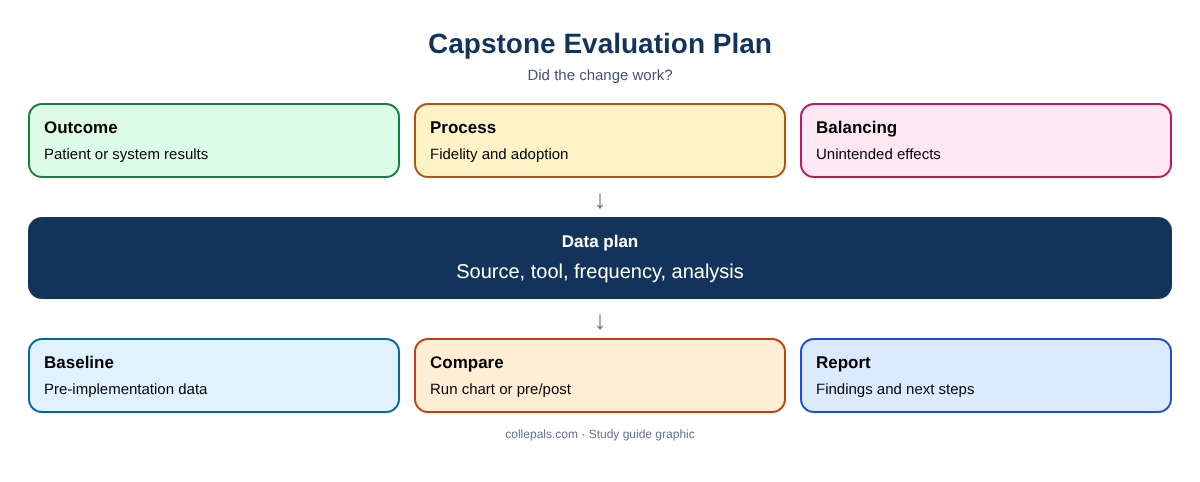
Sample document: an evaluation plan table with definitions, sources, frequency and targets (Word).
Types of Measures
| Type | Purpose | Example |
|---|---|---|
| Outcome | Did patients or the system improve? | Falls per 1,000 patient days |
| Process | Was the change carried out? | % patients with a documented plan |
| Balancing | Were there unintended effects? | Added nurse time per admission |
Donabedian’s (1988) structure-process-outcome framework is a helpful lens: structure (resources), process (what is done) and outcome (results).
Data Plan
For each measure, specify the operational definition, data source, sample, frequency and target. Collect baseline data before you begin.
Analysis
Run charts display data over time and help distinguish real improvement from random variation (Perla et al., 2011). Pre- and post-implementation comparisons with percentages or simple statistics are common in capstones. See how to measure outcomes.
Reporting
Present results in tables and charts, discuss practical significance and limitations and recommend next steps.
Frequently Asked Questions
How much baseline data do I need?
Ideally several weeks or months, matching your post-implementation period.
Do I need statistics?
It depends on your program; many capstones use descriptive statistics and run charts.
What is a balancing measure?
A measure that checks whether the change caused problems elsewhere.
Get Help With Your Evaluation Plan at Collepals
Capstone and practicum courses combine clinical hours, project milestones and weekly writing. Collepals.com supports BSN, MSN and DNP students through every stage:
- Choosing a feasible topic and writing a clear problem statement and PICOT question.
- Finding and synthesizing current evidence for your literature review and EBP proposal.
- Building implementation and evaluation plans, reflective journals and final presentations.
- Model documents you can study, plus editing and APA 7 formatting for your drafts.
Browse our free model assignments or learn more about our nursing assignment writing service.
Use Collepals samples as study guides and follow your school’s academic integrity and AI policies.
More capstone and practicum guides
Collepals is an independent study resource. Sample documents use a fictional falls-prevention project and illustrative data; follow your program’s templates, rubrics and approval processes, and write your own work.
References
Donabedian, A. (1988). The quality of care: How can it be assessed? JAMA, 260(12), 1743–1748. https://doi.org/10.1001/jama.1988.03410120089033
Perla, R. J., Provost, L. P., & Murray, S. K. (2011). The run chart: A simple analytical tool for learning from variation in healthcare processes. BMJ Quality & Safety, 20(1), 46–51. https://doi.org/10.1136/bmjqs.2009.037895
Get a plagiarism-free answer to this question
Send us your instructions and we’ll match you with the best writer in your subject.
- 100% human-written, zero AI
- Turnitin report included
- Confidential — we never share your data
- Free revisions & refunds