Professional Capstone and Practicum Reflective Journal: Complete Guide
Need help with this assignment?Get an original answer from a qualified tutor — from $10/page.
Get it written →Many capstone and practicum courses require a reflective journal that documents your experiences, learning and growth across the practicum. Journals often must address specific topics, such as practice changes, leadership, collaboration, ethics, population health and technology. This complete guide explains how to write a professional capstone and practicum reflective journal, with a journal template you can download.
Quick answer
A capstone reflective journal records weekly experiences and connects them to course outcomes and professional competencies. Strong entries describe the experience, analyze it with evidence and course concepts and plan next steps. Common topics include practice changes, leadership, interprofessional collaboration, ethics and policy, population health and equity, technology and self-care.
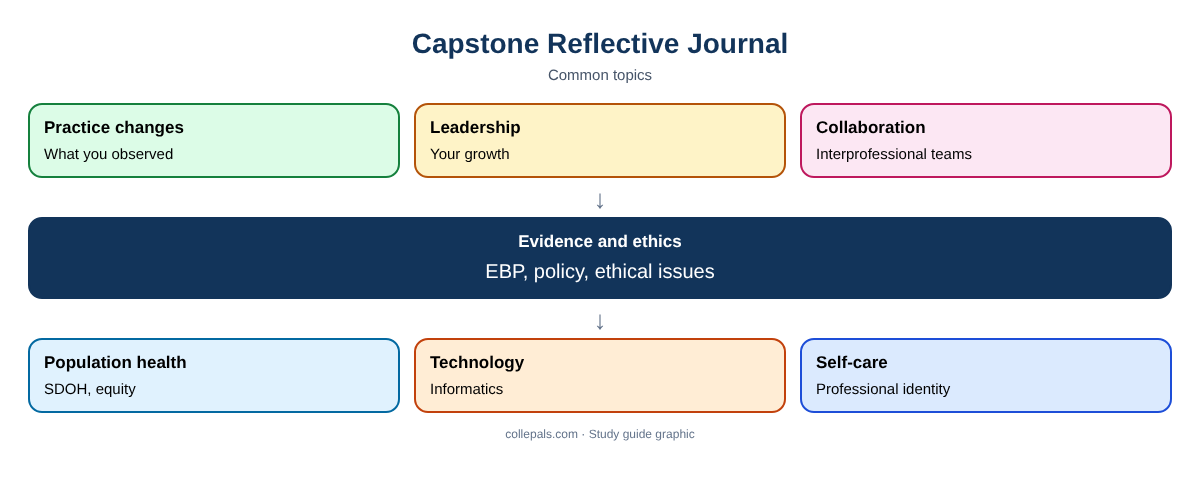
Sample document: a reflective journal template organized by week and focus area (Word).
Why Reflection Matters
Reflection turns experience into learning. Schön (1983) described reflective practitioners who think both in action and on action, examining their decisions to improve future practice. The AACN (2021) Essentials include personal, professional and leadership development, which reflective journals help demonstrate.
Common Journal Topics
| Topic | Questions to address |
|---|---|
| Practice changes | What evidence-based changes did you observe or lead? |
| Leadership | How did you lead or observe leadership? |
| Interprofessional collaboration | How did teams work together? |
| Ethics and policy | What ethical or policy issues arose? |
| Population health and equity | How did social determinants affect care? |
| Technology and informatics | How did technology support or hinder care? |
| Self-care and professional identity | How did you manage stress and grow? |
A Simple Structure
Use a model such as Gibbs’ (1988) reflective cycle or a What? So what? Now what? format. See how to write weekly practicum reflections.
Tips
- Write weekly, while details are fresh.
- Be specific and honest about challenges.
- Connect experiences to evidence and course concepts.
- Never include patient or staff identifiers.
- Log practicum hours alongside entries if required.
For examples, see capstone practicum reflection examples. See also our complete guide to reflective journals.
Frequently Asked Questions
How long should a reflective journal entry be?
Follow your course; many entries are 250–500 words.
Can I write in first person?
Yes; reflective writing uses first person.
Should I include citations?
Many rubrics expect you to connect reflections to evidence or course readings.
Get Help With Your Reflective Journal at Collepals
Capstone and practicum courses combine clinical hours, project milestones and weekly writing. Collepals.com supports BSN, MSN and DNP students through every stage:
- Choosing a feasible topic and writing a clear problem statement and PICOT question.
- Finding and synthesizing current evidence for your literature review and EBP proposal.
- Building implementation and evaluation plans, reflective journals and final presentations.
- Model documents you can study, plus editing and APA 7 formatting for your drafts.
Browse our free model assignments or learn more about our nursing assignment writing service.
Use Collepals samples as study guides and follow your school’s academic integrity and AI policies.
More capstone and practicum guides
Collepals is an independent study resource. Sample documents use a fictional falls-prevention project and illustrative data; follow your program’s templates, rubrics and approval processes, and write your own work.
References
American Association of Colleges of Nursing. (2021). The essentials: Core competencies for professional nursing education. https://www.aacnnursing.org/essentials
Gibbs, G. (1988). Learning by doing: A guide to teaching and learning methods. Further Education Unit, Oxford Polytechnic.
Schön, D. A. (1983). The reflective practitioner: How professionals think in action. Basic Books.
Get a plagiarism-free answer to this question
Send us your instructions and we’ll match you with the best writer in your subject.
- 100% human-written, zero AI
- Turnitin report included
- Confidential — we never share your data
- Free revisions & refunds