Capstone Practicum Reflection Examples for Nursing Students
Need help with this assignment?Get an original answer from a qualified tutor — from $10/page.
Get it written →Seeing strong examples makes reflective writing easier. These capstone practicum reflection examples for nursing students cover leadership, ethics, technology, population health and self-care, each showing specific detail, analysis and forward planning. A downloadable document includes the full set.
Quick answer
Strong practicum reflections are specific (one real experience), analytical (connecting the experience to evidence, theory or course outcomes) and forward-looking (a concrete plan). The examples below cover practice change, leadership, ethics, collaboration, technology, equity and self-care.
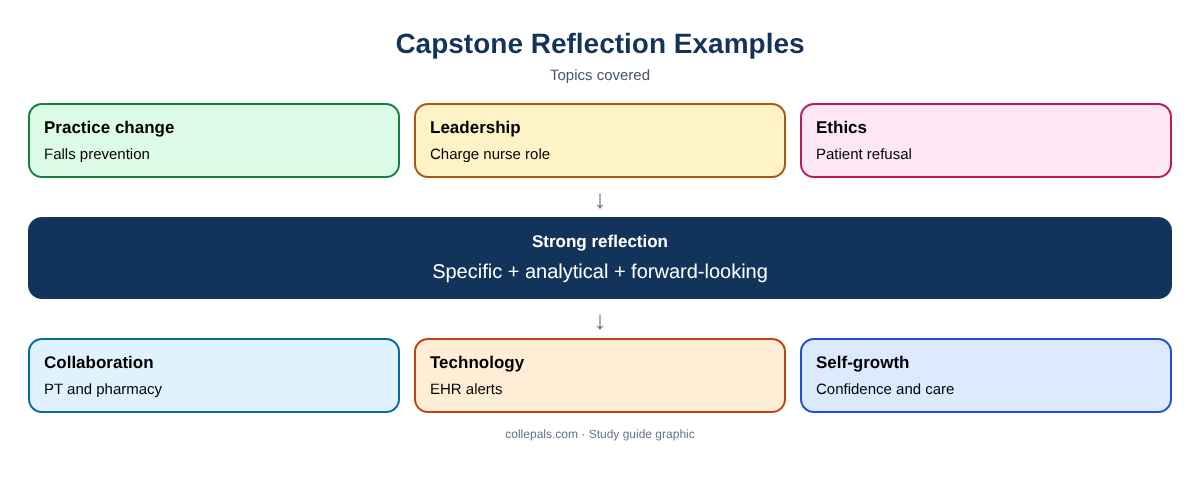
Sample document: a set of capstone practicum reflection examples (Word).
Example 1: Leadership
Fictional
Serving as charge nurse alongside my preceptor taught me that leading change requires listening first. When an experienced nurse disagreed with the fall plan, I asked what would make it workable, and her suggestion became part of the final template. I learned that involving staff builds ownership, consistent with Kotter’s (2012) emphasis on building a guiding coalition. In future, I will invite input before finalizing changes.
Example 2: Ethics
Fictional
A patient at high fall risk refused a bed alarm. Respecting autonomy while protecting safety required shared decision-making: we agreed on hourly rounding and call-light reminders, documented the discussion and informed the provider. I realized that safety plans must respect patient values, and I will practice explaining risks without coercion.
Example 3: Interprofessional Collaboration
Fictional
Pharmacy identified sedating medications that increased fall risk for several patients. Including the pharmacist in our huddle twice a week led to earlier medication reviews. This experience showed me the value of understanding each profession’s role (Interprofessional Education Collaborative [IPEC], 2023).
Example 4: Technology
Fictional
Adding a fall plan prompt to admission documentation increased completion more than reminders alone. Technology that fits the workflow supports consistent practice, and I will look for ways to embed future changes in the EHR.
Example 5: Self-Care
Fictional
Balancing practicum hours, work and family was exhausting. Scheduling protected study time and a weekly walk with a classmate helped me stay focused. Recognizing my limits made me more patient with staff who were also stretched thin.
For structure, see weekly reflections guide; for collaboration reflections, see reflecting on interprofessional collaboration.
Frequently Asked Questions
Can I copy these examples?
No. Use them to understand structure and depth, then write about your own experiences.
How specific should I be?
Specific enough that a reader understands the situation, without identifying patients or staff.
Should every reflection cite a source?
Many rubrics expect evidence or course connections; include them where relevant.
Get Help Writing Practicum Reflections at Collepals
Capstone and practicum courses combine clinical hours, project milestones and weekly writing. Collepals.com supports BSN, MSN and DNP students through every stage:
- Choosing a feasible topic and writing a clear problem statement and PICOT question.
- Finding and synthesizing current evidence for your literature review and EBP proposal.
- Building implementation and evaluation plans, reflective journals and final presentations.
- Model documents you can study, plus editing and APA 7 formatting for your drafts.
Browse our free model assignments or learn more about our nursing assignment writing service.
Use Collepals samples as study guides and follow your school’s academic integrity and AI policies.
More capstone and practicum guides
Collepals is an independent study resource. Sample documents use a fictional falls-prevention project and illustrative data; follow your program’s templates, rubrics and approval processes, and write your own work.
References
Interprofessional Education Collaborative. (2023). IPEC core competencies for interprofessional collaborative practice: Version 3. https://www.ipecollaborative.org/ipec-core-competencies
Kotter, J. P. (2012). Leading change. Harvard Business Review Press.
Get a plagiarism-free answer to this question
Send us your instructions and we’ll match you with the best writer in your subject.
- 100% human-written, zero AI
- Turnitin report included
- Confidential — we never share your data
- Free revisions & refunds