How to Conduct a Literature Review for a Nursing Capstone
Need help with this assignment?Get an original answer from a qualified tutor — from $10/page.
Get it written →The literature review shows that your capstone intervention is grounded in evidence. It is not a list of article summaries but a synthesis that answers your PICOT question. This guide explains how to conduct a literature review for a nursing capstone, from search to synthesis, with a sample evidence matrix you can download.
Quick answer
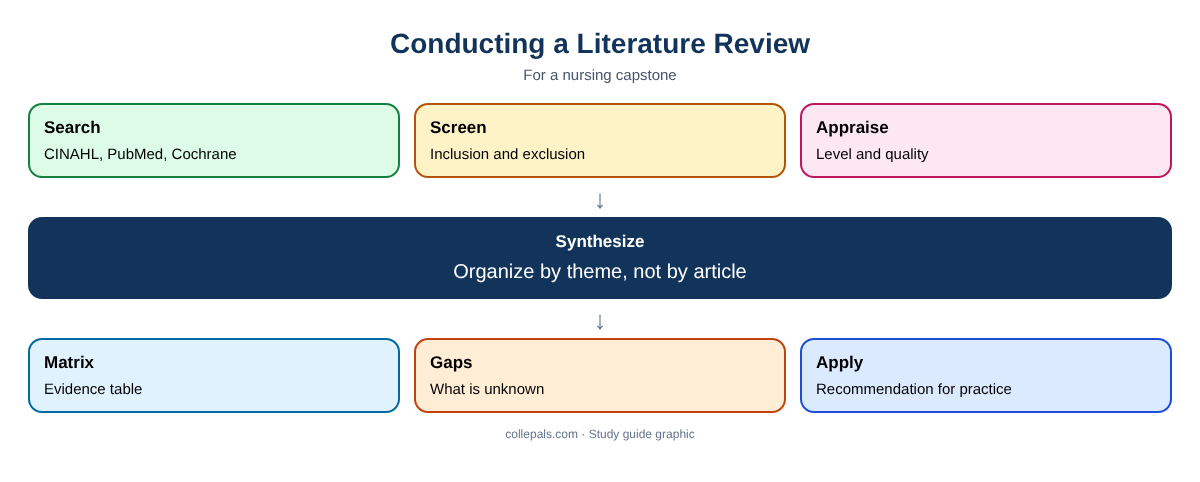
Search databases such as CINAHL, PubMed and Cochrane using PICOT-based terms, screen results with inclusion and exclusion criteria, appraise the level and quality of evidence, record key details in an evidence matrix, synthesize findings by theme, identify gaps and state a recommendation for practice.
Sample document: a literature review evidence matrix with a thematic synthesis (Word).
Step 1: Search
Use your PICOT terms with synonyms and Boolean operators. Limit to the last five years unless seminal or guideline sources are needed. Track your search strategy.
Step 2: Screen
Apply inclusion and exclusion criteria (population, setting, design, language, date). For systematic approaches, a flow diagram like the PRISMA 2020 statement’s helps document screening (Page et al., 2021).
Step 3: Appraise
Rate the level and quality of each source using an evidence hierarchy, such as the Johns Hopkins evidence levels (Dang et al., 2022).
Step 4: Build an Evidence Matrix
| Column | Content |
|---|---|
| Citation | Author, year |
| Design and level | e.g., meta-analysis, Level I |
| Sample and setting | Who and where |
| Intervention | What was tested |
| Findings | Key results with numbers |
| Relevance | How it applies to your project |
Step 5: Synthesize by Theme
Sample synthesis paragraph
Across studies, education of patients and staff emerged as the most consistent effective strategy. A meta-analysis found that education was the only single intervention that significantly reduced hospital falls, while bed and chair alarms did not (Morris et al., 2022). Programs that individualized prevention plans with patients reduced falls by 19% and avoided costs (Dykes et al., 2023), and international guidelines recommend multifactorial, person-centered prevention (Montero-Odasso et al., 2022). Together, these findings support an intervention combining individualized plans and education.
Step 6: Identify Gaps and Recommend
Note what the evidence does not answer and state your practice recommendation; this leads into your EBP proposal.
Frequently Asked Questions
How many articles should a capstone literature review include?
Follow your rubric; many require 5–10 or more current scholarly sources.
Can I use guidelines?
Yes; clinical practice guidelines are high-level evidence.
What is the difference between summary and synthesis?
Summary describes each article; synthesis compares and integrates findings by theme.
Get Help With Your Literature Review at Collepals
Capstone and practicum courses combine clinical hours, project milestones and weekly writing. Collepals.com supports BSN, MSN and DNP students through every stage:
- Choosing a feasible topic and writing a clear problem statement and PICOT question.
- Finding and synthesizing current evidence for your literature review and EBP proposal.
- Building implementation and evaluation plans, reflective journals and final presentations.
- Model documents you can study, plus editing and APA 7 formatting for your drafts.
Browse our free model assignments or learn more about our nursing assignment writing service.
Use Collepals samples as study guides and follow your school’s academic integrity and AI policies.
More capstone and practicum guides
Collepals is an independent study resource. Sample documents use a fictional falls-prevention project and illustrative data; follow your program’s templates, rubrics and approval processes, and write your own work.
References
Dang, D., Dearholt, S. L., Bissett, K., Ascenzi, J., & Whalen, M. (2022). Johns Hopkins evidence-based practice for nurses and healthcare professionals: Model and guidelines (4th ed.). Sigma Theta Tau International.
Dykes, P. C., Curtin-Bowen, M., Lipsitz, S., Franz, C., Adelman, J., Adkison, L., Bogaisky, M., Carroll, D., Carter, E., Herlihy, L., Lindros, M. E., Ryan, V., Scanlan, M., Walsh, M.-A., Wien, M., & Bates, D. W. (2023). Cost of inpatient falls and cost-benefit analysis of implementation of an evidence-based fall prevention program. JAMA Health Forum, 4(1), Article e225125. https://doi.org/10.1001/jamahealthforum.2022.5125
Montero-Odasso, M., van der Velde, N., Martin, F. C., Petrovic, M., Tan, M. P., Ryg, J., Aguilar-Navarro, S., Alexander, N. B., Becker, C., Blain, H., Bourke, R., Cameron, I. D., Camicioli, R., Clemson, L., Close, J., Delbaere, K., Duan, L., Duque, G., Dyer, S. M., … Masud, T. (2022). World guidelines for falls prevention and management for older adults: A global initiative. Age and Ageing, 51(9), Article afac205. https://doi.org/10.1093/ageing/afac205
Morris, M. E., Webster, K., Jones, C., Hill, A.-M., Haines, T., McPhail, S., Kiegaldie, D., Slade, S., Jazayeri, D., Heng, H., Shorr, R., Carey, L., Barker, A., & Cameron, I. (2022). Interventions to reduce falls in hospitals: A systematic review and meta-analysis. Age and Ageing, 51(5), Article afac077. https://doi.org/10.1093/ageing/afac077
Page, M. J., McKenzie, J. E., Bossuyt, P. M., Boutron, I., Hoffmann, T. C., Mulrow, C. D., Shamseer, L., Tetzlaff, J. M., Akl, E. A., Brennan, S. E., Chou, R., Glanville, J., Grimshaw, J. M., Hróbjartsson, A., Lalu, M. M., Li, T., Loder, E. W., Mayo-Wilson, E., McDonald, S., … Moher, D. (2021). The PRISMA 2020 statement: An updated guideline for reporting systematic reviews. BMJ, 372, Article n71. https://doi.org/10.1136/bmj.n71
Get a plagiarism-free answer to this question
Send us your instructions and we’ll match you with the best writer in your subject.
- 100% human-written, zero AI
- Turnitin report included
- Confidential — we never share your data
- Free revisions & refunds