Nursing Concept Map Examples With Nursing Diagnoses and Interventions
Need help with this assignment?Get an original answer from a qualified tutor — from $10/page.
Get it written →Seeing a finished concept map is often the fastest way to understand what your instructor expects. This article walks through three nursing concept map examples with nursing diagnoses and interventions: heart failure, type 2 diabetes with hyperglycemia and a postoperative hip replacement. Each example shows the assessment data, prioritized nursing diagnoses, SMART goals, interventions with rationales and evaluation, so you can see how the parts connect.
These examples use sample patients for study purposes. Diagnosis labels follow commonly taught NANDA-I wording; check the current edition and the format your program requires (Herdman et al., 2024). Never copy an example into your own assignment; your map must reflect your patient’s real data.
How These Concept Map Examples Are Organized
Each example follows the same structure most nursing programs use:
- Center: patient summary and medical diagnosis.
- Assessment clusters: the subjective and objective cues that support each problem.
- Nursing diagnoses: written as problem, related to (etiology) and as evidenced by (cues), in priority order.
- Goals, interventions and rationales.
- Evaluation and the links between problems.
If you are building your first map, start with our step-by-step guide to creating a nursing concept map for a patient.
Example 1: Heart Failure Concept Map
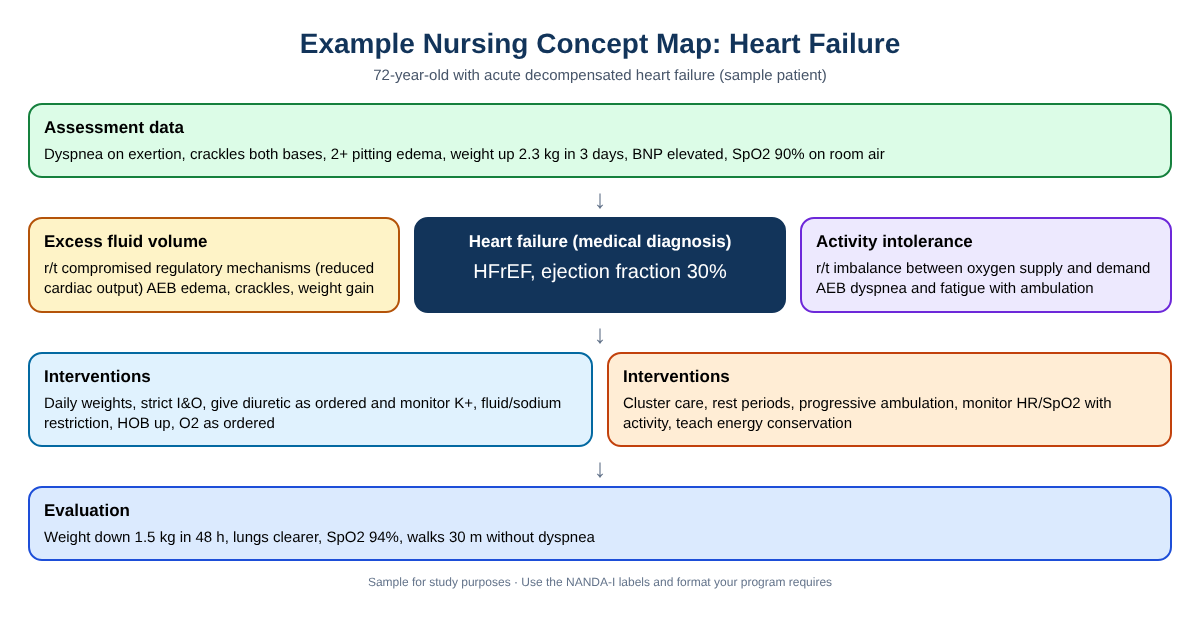
Patient summary: A 72-year-old man with heart failure with reduced ejection fraction (ejection fraction 30%) is admitted with worsening shortness of breath and leg swelling.
Assessment data: dyspnea on exertion, crackles in both lung bases, 2+ pitting edema in both ankles, weight gain of 2.3 kg over three days, elevated B-type natriuretic peptide (BNP), SpO2 90% on room air and fatigue after walking to the bathroom.
| Nursing diagnosis | Goal | Key interventions and rationales |
|---|---|---|
| 1. Excess fluid volume related to compromised regulatory mechanisms (reduced cardiac output) as evidenced by edema, crackles and 2.3 kg weight gain | Patient will lose at least 1 kg and have decreased crackles within 48 hours. | Weigh daily at the same time on the same scale (most sensitive indicator of fluid status); strict intake and output; give loop diuretic as ordered and monitor potassium (diuretics cause potassium loss); maintain sodium and fluid restriction as ordered; elevate head of bed to ease breathing. |
| 2. Activity intolerance related to imbalance between oxygen supply and demand as evidenced by dyspnea and fatigue with ambulation | Patient will walk 30 meters with SpO2 at or above 92% and no dyspnea by discharge. | Monitor heart rate, blood pressure and SpO2 before and after activity; cluster care to allow rest; progress ambulation gradually; teach energy-conservation techniques. |
| 3. Deficient knowledge (heart failure self-care) related to new diagnosis as evidenced by patient’s questions about diet and weight | Patient will state three signs to report and demonstrate daily weight recording before discharge. | Teach daily weights and when to call the provider (for example, a weight gain of about 1–1.5 kg in a day or 2 kg in a week, per the provider’s instructions); review low-sodium food choices; use teach-back. |
Connections: fluid overload worsens breathing, which drives activity intolerance; the diuretic treats fluid overload but creates a risk of hypokalemia, which links to cardiac rhythm monitoring.
Evaluation: weight down 1.5 kg in 48 hours, crackles decreased, SpO2 94% on room air and the patient walked 30 meters with mild fatigue only. Goals 1 and 2 met; goal 3 in progress.
Example 2: Type 2 Diabetes With Hyperglycemia Concept Map
Patient summary: A 55-year-old woman with type 2 diabetes is admitted with a foot ulcer and blood glucose readings above 300 mg/dL.
Assessment data: blood glucose 285–340 mg/dL, HbA1c 10.2%, polyuria and thirst, a 2 cm ulcer on the left plantar foot with redness and drainage, decreased sensation on monofilament testing and the statement “I stopped checking my sugar because the strips cost too much.”
| Nursing diagnosis | Goal | Key interventions and rationales |
|---|---|---|
| 1. Risk for unstable blood glucose level as evidenced by (risk factors) inadequate glucose monitoring, infection and medication nonadherence | Blood glucose will be 140–180 mg/dL before meals within 72 hours (or per the provider’s target). | Check glucose before meals and at bedtime; give insulin as ordered, matching mealtime doses to intake; monitor for hypoglycemia signs; coordinate meal timing with insulin. |
| 2. Impaired skin integrity related to impaired circulation and sensation as evidenced by a 2 cm plantar ulcer with drainage | Wound will show decreased size and no signs of spreading infection by discharge. | Assess and measure the wound each shift; perform wound care as ordered; offload pressure from the foot; give antibiotics on schedule; monitor temperature and white blood cell count. |
| 3. Ineffective health self-management related to financial barriers as evidenced by stopping glucose monitoring | Patient will identify an affordable monitoring plan and demonstrate glucose checks before discharge. | Consult the case manager or social worker about affordable supplies; teach glucose monitoring and foot inspection; use teach-back. |
Connections: hyperglycemia impairs healing and immune function, so diagnosis 1 directly worsens diagnosis 2; the financial barrier explains both.
Example 3: Postoperative Total Hip Replacement Concept Map
Patient summary: A 70-year-old man is on postoperative day 1 after a right total hip arthroplasty for osteoarthritis.
Assessment data: pain 7/10 with movement, guarding, reluctance to get out of bed, a dressing that is clean, dry and intact, use of an anticoagulant for clot prevention and a history of falls at home.
| Nursing diagnosis | Goal | Key interventions and rationales |
|---|---|---|
| 1. Acute pain related to surgical tissue trauma as evidenced by pain 7/10 with movement and guarding | Pain will be at or below 3/10 (or the patient’s acceptable level) within one hour of intervention. | Assess pain with a scale before and after interventions; give analgesics as ordered, timed before therapy; use ice and positioning; reassess within the appropriate time after each dose. |
| 2. Impaired physical mobility related to pain and surgical restrictions as evidenced by reluctance to move | Patient will walk to the hallway with a walker and assistance of one by postoperative day 2. | Coordinate with physical therapy; reinforce hip precautions ordered by the surgeon; assist with early ambulation, which also helps prevent clots and pneumonia. |
| 3. Risk for falls as evidenced by (risk factors) history of falls, opioid use and new walker | Patient will remain free of falls during hospitalization. | Use a fall-risk score; keep bed low and call light within reach; nonskid footwear; assist with toileting; teach to call before getting up. |
Connections: controlling pain makes mobility possible; opioids relieve pain but increase fall risk; mobility reduces the risk of venous thromboembolism, which the anticoagulant also targets.
What These Examples Have in Common
- Every nursing diagnosis is supported by specific cues from the patient, not textbook lists.
- Physiological problems come first; teaching and self-management follow.
- Goals include a number and a time frame.
- Interventions have frequencies and rationales.
- Lines between problems explain how one affects another.
To see how to move from the disease itself to these nursing diagnoses, read how to write a nursing concept map based on a medical diagnosis, and for deeper links between disease processes and nursing actions, see how to connect pathophysiology and patient care in a nursing concept map. You can also study a full model assignment in our pyelonephritis concept map example.
Frequently Asked Questions
Should a concept map include risk diagnoses?
Yes, if they are a priority. Risk diagnoses list risk factors instead of “as evidenced by” signs, because the problem has not occurred yet.
How many interventions should each nursing diagnosis have?
Usually three to five, including assessment, therapeutic, teaching and collaborative actions, each with a rationale.
Can I use the same nursing diagnosis for every patient with the same disease?
No. Two patients with heart failure may have different priorities. Choose diagnoses based on the cues your patient actually shows.
Related guides
References
Herdman, T. H., Kamitsuru, S., & Lopes, C. T. (Eds.). (2024). NANDA-I international nursing diagnoses: Definitions and classification, 2024–2026 (13th ed.). Thieme.
Get a plagiarism-free answer to this question
Send us your instructions and we’ll match you with the best writer in your subject.
- 100% human-written, zero AI
- Turnitin report included
- Confidential — we never share your data
- Free revisions & refunds