How to Create a Nursing Concept Map for a Patient: Step-by-Step Guide
Need help with this assignment?Get an original answer from a qualified tutor — from $10/page.
Get it written →A nursing concept map turns a pile of patient data into a picture of how that patient’s problems connect. Instead of listing findings in columns, you place the patient at the center and draw relationships between assessment cues, nursing diagnoses, interventions and outcomes. This guide explains how to create a nursing concept map for a patient step by step, from chart review to the final evaluation, with tips that match what clinical instructors look for.
Quick answer
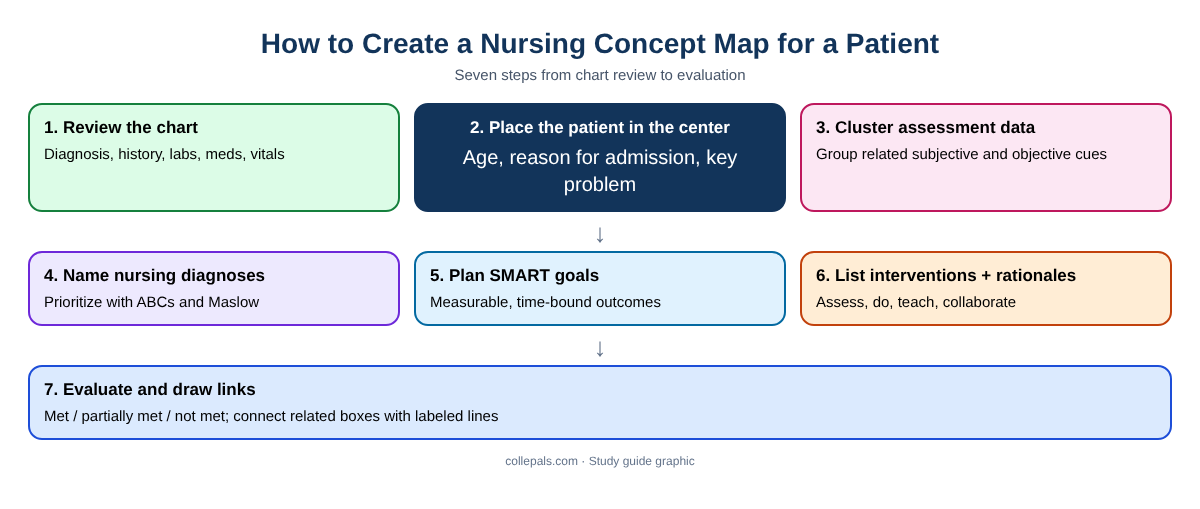
To create a nursing concept map, (1) review the patient’s chart, (2) put the patient and primary medical diagnosis in the center, (3) cluster related assessment data, (4) identify and prioritize two to four nursing diagnoses, (5) write SMART goals, (6) list interventions with rationales and (7) evaluate outcomes and draw labeled lines that show how problems, medications and findings connect.
What Is a Nursing Concept Map?
A concept map is a diagram that shows concepts in boxes and the relationships between them as labeled lines. Educational researchers Novak and Cañas (2008) describe concept maps as tools for organizing knowledge, in which the linking words between concepts are as important as the concepts themselves. In nursing education, a concept map is a visual care plan: it shows why the patient has each problem, how the problems affect one another and what the nurse will do about them.
Concept maps are popular in nursing programs because they build clinical reasoning. A 2025 meta-analysis of 44 studies found that the concept mapping teaching method significantly improved educational performance among nursing students and nurses (Faraji et al., 2025). They also mirror the thinking that the NCSBN Clinical Judgment Measurement Model asks of new nurses: recognize cues, analyze cues, prioritize hypotheses, generate solutions, take action and evaluate outcomes (National Council of State Boards of Nursing [NCSBN], n.d.).
Before You Start: Gather the Right Patient Data
A strong map depends on accurate data. During clinical or from your case study, collect:
- Demographics and reason for admission: age, sex, admitting and secondary medical diagnoses.
- History: past medical and surgical history, allergies, social history and home medications.
- Assessment findings: head-to-toe assessment, vital signs, pain, intake and output, mobility and psychosocial status.
- Diagnostics: abnormal labs (with normal ranges), imaging and other test results.
- Treatments and medications: current orders, IV fluids, oxygen, procedures and why each was ordered.
Remove all patient identifiers. Use initials or “Patient A,” and never include names, birth dates or record numbers in a school assignment.
Step-by-Step: How to Create a Nursing Concept Map for a Patient
Step 1: Review the chart and the medical diagnosis
Read the provider’s notes, the history and physical and recent progress notes. Look up the primary medical diagnosis and review its pathophysiology so you understand why the patient’s findings are occurring. If you need help with this step, see our guide on how to write a nursing concept map based on a medical diagnosis.
Step 2: Put the patient at the center
Draw a central box with the patient’s age, sex, primary medical diagnosis and reason for admission. Some programs also want relevant history and key medications in or near the center. Everything else on the map will branch from this box.
Step 3: Cluster the assessment data
Group related cues together. For example, crackles, oxygen saturation of 90% and dyspnea belong in a respiratory cluster; edema, weight gain and intake greater than output belong in a fluid cluster. Include both subjective data (what the patient says) and objective data (what you observe or measure). Clustering is where clinical reasoning begins, because each cluster usually points to a nursing problem.
Step 4: Identify and prioritize nursing diagnoses
Name a nursing diagnosis for each major cluster using the label format your program requires, often the current NANDA-I taxonomy (Herdman et al., 2024). Write each in problem-etiology-symptom format: problem related to cause as evidenced by cues. Then prioritize: airway, breathing and circulation come first, followed by safety and other physiological needs, then psychosocial and learning needs. Most assignments ask for two to four diagnoses, numbered by priority.
Step 5: Write SMART goals
For each nursing diagnosis, write at least one goal that is specific, measurable, achievable, relevant and time-bound. “Patient will maintain SpO2 at or above 92% on 2 L nasal cannula throughout the shift” is measurable; “patient will breathe better” is not.
Step 6: List nursing interventions with rationales
Choose interventions that directly address the “related to” part of each diagnosis. Include a mix of assessment (“monitor respiratory rate and SpO2 every 2 hours”), therapeutic actions (“elevate head of bed 30–45 degrees”), teaching (“teach incentive spirometer use, 10 times per hour while awake”) and collaboration (“consult respiratory therapy”). Add a brief rationale explaining why each intervention works.
Step 7: Evaluate and draw the connections
State whether each goal was met, partially met or not met, using evidence (“SpO2 94% on 2 L at 1500”). Then draw labeled lines between related boxes. For example, a line from “furosemide” to “risk for electrolyte imbalance” labeled “can cause hypokalemia” shows real understanding. These connections are what separate a concept map from a care plan in boxes.
Example: A Short Patient Concept Map
Consider a 68-year-old patient admitted with community-acquired pneumonia. The central box lists the diagnosis, history of type 2 diabetes and current treatments (IV antibiotics, oxygen at 2 L). The respiratory cluster (crackles in the right lower lobe, productive cough, SpO2 90% on room air, respiratory rate 24) leads to impaired gas exchange. A second cluster (temperature 38.6 °C, elevated white blood cell count) supports hyperthermia or an infection-related risk diagnosis, depending on your program’s labels. A third cluster (blood glucose 245 mg/dL while on steroids) supports a problem related to unstable blood glucose. Lines connect the steroid order to the high glucose and the fever to increased oxygen demand, showing how one problem worsens another. For full worked examples, see our nursing concept map examples with nursing diagnoses and interventions.
Tips for a Concept Map That Earns Full Marks
- Use only this patient’s data. Textbook signs and symptoms belong in your pathophysiology notes, not in the assessment cluster unless the patient actually has them.
- Prioritize clearly. Number diagnoses and explain why the first one comes first.
- Label every line. Words such as “causes,” “worsens,” “treats” or “monitors for” show reasoning.
- Link medications to problems. For each drug, show its indication and what the nurse monitors.
- Keep it readable. Use a template, color code clusters and avoid tiny fonts. Digital tools such as PowerPoint, Word SmartArt, Canva, Lucidchart or diagrams.net make revisions easy.
- Connect pathophysiology to care. Explain how the disease process produces each cue; our guide on connecting pathophysiology and patient care in a nursing concept map shows how.
Common Mistakes to Avoid
- Writing medical diagnoses (such as “pneumonia”) as nursing diagnoses.
- Listing generic interventions (“monitor patient”) without frequency or parameters.
- Including too many diagnoses instead of focusing on the priorities.
- Leaving out abnormal lab values or not explaining why they are abnormal.
- Drawing lines without explaining the relationship.
Frequently Asked Questions
How many nursing diagnoses should a concept map have?
Most programs ask for two to four prioritized nursing diagnoses. Check your rubric; some require one actual, one risk and one health-promotion diagnosis.
What is the difference between a concept map and a nursing care plan?
A care plan lists problems, goals and interventions in columns. A concept map shows the same elements visually and adds the relationships between them, which demonstrates clinical reasoning.
What should go in the center of a nursing concept map?
The patient’s age, primary medical diagnosis and reason for admission. Some instructors also want key history and medications in the center.
Can I make a concept map by hand?
Yes, if your program allows it, but digital templates are easier to read and revise.
Related guides and examples
- Nursing Concept Map Examples With Nursing Diagnoses and Interventions
- How to Write a Nursing Concept Map Based on a Medical Diagnosis
- How to Connect Pathophysiology and Patient Care in a Nursing Concept Map
- Nursing Concept Map Assignments: A Complete Guide for Students
- Pyelonephritis concept map: nursing example
References
Faraji, A., Banafshi, Z., Jalali, R., & Jalali, A. (2025). Concept mapping teaching method and nursing education: A systematic review and meta-analysis. BMC Medical Education, 25, Article 792. https://doi.org/10.1186/s12909-025-07392-4
Herdman, T. H., Kamitsuru, S., & Lopes, C. T. (Eds.). (2024). NANDA-I international nursing diagnoses: Definitions and classification, 2024–2026 (13th ed.). Thieme.
National Council of State Boards of Nursing. (n.d.). Next Generation NCLEX: Clinical judgment measurement model. https://www.nclex.com/next-generation-nclex.page
Novak, J. D., & Cañas, A. J. (2008). The theory underlying concept maps and how to construct and use them (Technical Report IHMC CmapTools 2006-01 Rev 01-2008). Florida Institute for Human and Machine Cognition.
Get a plagiarism-free answer to this question
Send us your instructions and we’ll match you with the best writer in your subject.
- 100% human-written, zero AI
- Turnitin report included
- Confidential — we never share your data
- Free revisions & refunds