How to Write a Nursing Concept Map Based on a Medical Diagnosis
Need help with this assignment?Get an original answer from a qualified tutor — from $10/page.
Get it written →Many nursing assignments give you a medical diagnosis, such as COPD, heart failure or sepsis, and ask you to build a concept map around it. The challenge is turning a disease that the provider treats into nursing problems that you can act on. This guide explains how to write a nursing concept map based on a medical diagnosis, using a COPD exacerbation as a worked example.
Quick answer
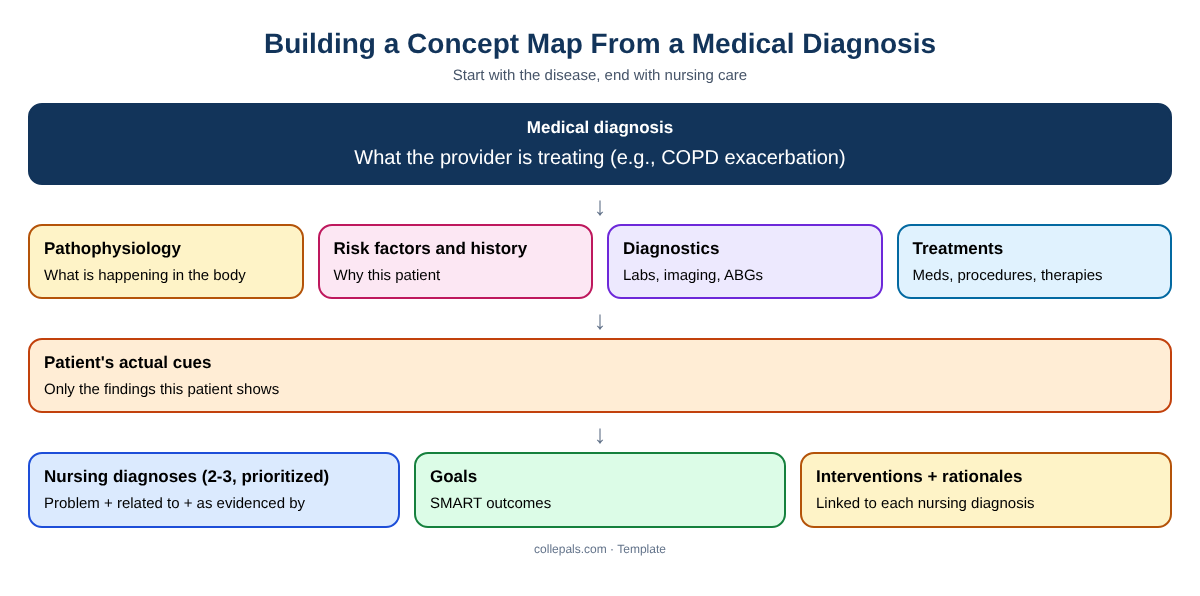
Put the medical diagnosis in the center, then branch out to its pathophysiology, risk factors, diagnostic findings and treatments. Next, list the cues your patient actually shows. Use those cues to write two to four prioritized nursing diagnoses, each with goals, interventions and rationales. Finally, draw labeled lines showing how the disease process produces each nursing problem.
Medical Diagnosis vs. Nursing Diagnosis: Why the Difference Matters
A medical diagnosis names a disease or condition that a provider diagnoses and treats, such as “chronic obstructive pulmonary disease.” A nursing diagnosis is a clinical judgment about the patient’s response to a health problem that nurses can address independently, such as “ineffective airway clearance” (Herdman et al., 2024). A concept map built around a medical diagnosis must make this translation visible: it shows how the disease leads to patient responses, and how nursing care addresses those responses.
A common mistake is listing the medical diagnosis as a nursing problem, for example “Problem 1: COPD.” Instructors expect you to identify what the disease is doing to this patient and what you, as the nurse, will do about it.
Step 1: Research the Medical Diagnosis
Before you draw anything, build a short “disease profile”:
- Definition and pathophysiology: what is happening at the tissue and organ level.
- Risk factors and causes: for COPD, smoking history, occupational exposures and, rarely, alpha-1 antitrypsin deficiency.
- Expected signs and symptoms: what patients with the condition commonly show.
- Diagnostic tests: labs, imaging and other findings used to confirm or monitor it.
- Medical treatments: medications, oxygen, procedures and why each is used.
- Complications: what you must watch for.
Use your course textbook, drug references and reliable clinical sources. Write this section in your own words, because instructors grade understanding, not copied definitions.
Step 2: Place the Medical Diagnosis at the Center
Your central box should include the medical diagnosis plus a brief patient summary: age, relevant history and reason for admission. For example: “68-year-old woman, COPD exacerbation, 45 pack-year smoking history, admitted with increased dyspnea and sputum.”
Step 3: Branch Out to Pathophysiology, Diagnostics and Treatments
Create branches from the center for each part of your disease profile. For COPD:
- Pathophysiology: chronic inflammation narrows airways and increases mucus; destruction of alveolar walls (emphysema) reduces surface area for gas exchange and causes air trapping.
- Diagnostics: arterial blood gases showing low oxygen and possibly elevated carbon dioxide, chest X-ray showing hyperinflation, spirometry history.
- Treatments: bronchodilators, corticosteroids, antibiotics if infection is suspected and controlled oxygen therapy targeted to the prescribed saturation range.
For a deeper look at how to link each step of the disease process to nursing care, see how to connect pathophysiology and patient care in a nursing concept map.
Step 4: Identify Your Patient’s Actual Cues
Next, list only the findings your patient actually has. Your sample patient shows: respiratory rate 26, SpO2 87% on room air (prescribed target 88–92%), wheezes and diminished breath sounds, thick yellow sputum, use of accessory muscles, anxiety (“I can’t catch my breath”), fatigue and poor appetite with weight loss over the past month.
Comparing your patient’s cues with the textbook profile shows which problems are active now. Textbook symptoms the patient does not have should not drive your nursing diagnoses.
Step 5: Translate the Cues Into Nursing Diagnoses
Group the cues and name the nursing problems, in priority order:
- Ineffective airway clearance related to excessive, thick secretions as evidenced by wheezes, diminished breath sounds and thick sputum.
- Impaired gas exchange related to alveolar destruction and ventilation-perfusion imbalance as evidenced by SpO2 87% on room air and tachypnea.
- Anxiety related to breathlessness as evidenced by the patient’s statement and restlessness.
- Imbalanced nutrition: less than body requirements (or the current NANDA-I equivalent) related to fatigue and increased work of breathing as evidenced by poor appetite and weight loss.
Airway and breathing problems come first because they threaten life most immediately.
Step 6: Add Goals, Interventions and Rationales
For each nursing diagnosis, add a measurable goal and targeted interventions. For example, for ineffective airway clearance:
- Goal: patient will cough up secretions effectively and have clearer breath sounds within 24 hours.
- Interventions: assess lung sounds every 4 hours; teach controlled or “huff” coughing; encourage fluids unless restricted to thin secretions; give bronchodilators as ordered and assess response; position upright to improve lung expansion.
For impaired gas exchange, interventions include titrating oxygen to the prescribed saturation range, monitoring arterial blood gases and mental status and teaching pursed-lip breathing, which helps reduce air trapping.
Step 7: Draw the Connections
Finally, link boxes with labeled lines: “airway inflammation causes thick secretions,” “steroids may raise blood glucose; monitor,” “anxiety increases oxygen demand.” These links show your instructor that you understand how the medical diagnosis, treatments and nursing problems interact.
For complete examples using other diagnoses, see our nursing concept map examples with nursing diagnoses and interventions.
Frequently Asked Questions
Can a concept map have more than one medical diagnosis?
Yes. Put the primary diagnosis in the center and list secondary diagnoses, such as diabetes or hypertension, nearby, showing how they affect the main problem.
Where do medications go on a concept map?
Usually in a treatment branch, with lines linking each drug to the problem it treats and to the nursing assessments it requires.
Should I include expected symptoms the patient does not have?
Include them in your disease profile if your template asks, but base nursing diagnoses only on the patient’s actual cues.
Related guides
References
Herdman, T. H., Kamitsuru, S., & Lopes, C. T. (Eds.). (2024). NANDA-I international nursing diagnoses: Definitions and classification, 2024–2026 (13th ed.). Thieme.
Get a plagiarism-free answer to this question
Send us your instructions and we’ll match you with the best writer in your subject.
- 100% human-written, zero AI
- Turnitin report included
- Confidential — we never share your data
- Free revisions & refunds