Nursing Concept Map Assignments: A Complete Guide for Students
Need help with this assignment?Get an original answer from a qualified tutor — from $10/page.
Get it written →Concept maps are among the most common, and most time-consuming, assignments in nursing school. Whether your instructor calls it a concept map, a care map or a mind map, the expectations can feel unclear the first time. This complete guide covers the types of nursing concept map assignments, what instructors grade, a time plan for finishing on schedule and where nursing students can find legitimate help.
In this guide
- Types of nursing concept map assignments
- What instructors grade (with a checklist)
- A step-by-step time plan
- Tools and templates
- Where to get help with nursing concept map assignments
Why Nursing Programs Assign Concept Maps
Concept maps show how well you can connect patient data, disease processes and nursing care, the core of clinical judgment. Concept maps were developed as tools for organizing knowledge and showing relationships between ideas (Novak & Cañas, 2008), and in nursing education they are associated with better learning outcomes; a 2025 meta-analysis of 44 studies found that concept mapping significantly improved educational performance (Faraji et al., 2025). They also prepare you for the clinical judgment questions on the Next Generation NCLEX (National Council of State Boards of Nursing [NCSBN], n.d.).
Types of Nursing Concept Map Assignments
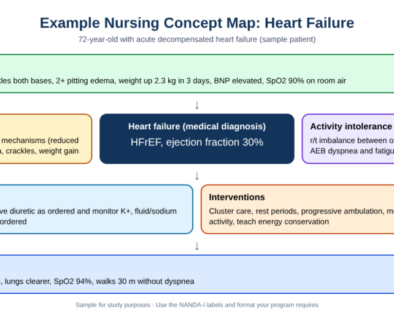
- Patient care concept map: built from a real clinical patient or case study, with assessment data, nursing diagnoses, goals, interventions and evaluation. See how to create a nursing concept map for a patient.
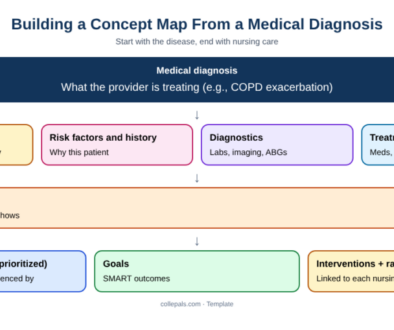
- Medical diagnosis concept map: centered on a disease, such as heart failure or COPD, connecting pathophysiology, diagnostics, treatments and nursing care. See how to write a nursing concept map based on a medical diagnosis.
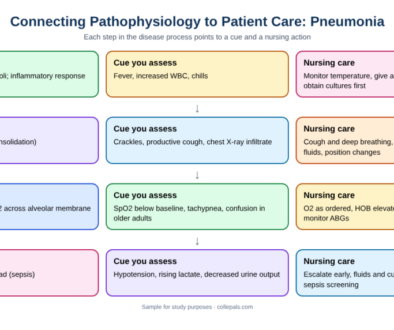
- Pathophysiology map: traces a disease process step by step and links it to signs and nursing actions. See connecting pathophysiology and patient care.
- Pharmacology concept map: organizes a drug or drug class by mechanism, indications, adverse effects and nursing considerations. For a model, see our NUR 1141 pharmacology concept map example.
- Concept-based maps: used in concept-based curricula, linking a nursing concept (such as perfusion or oxygenation) to exemplar conditions.
What Instructors Grade: A Checklist
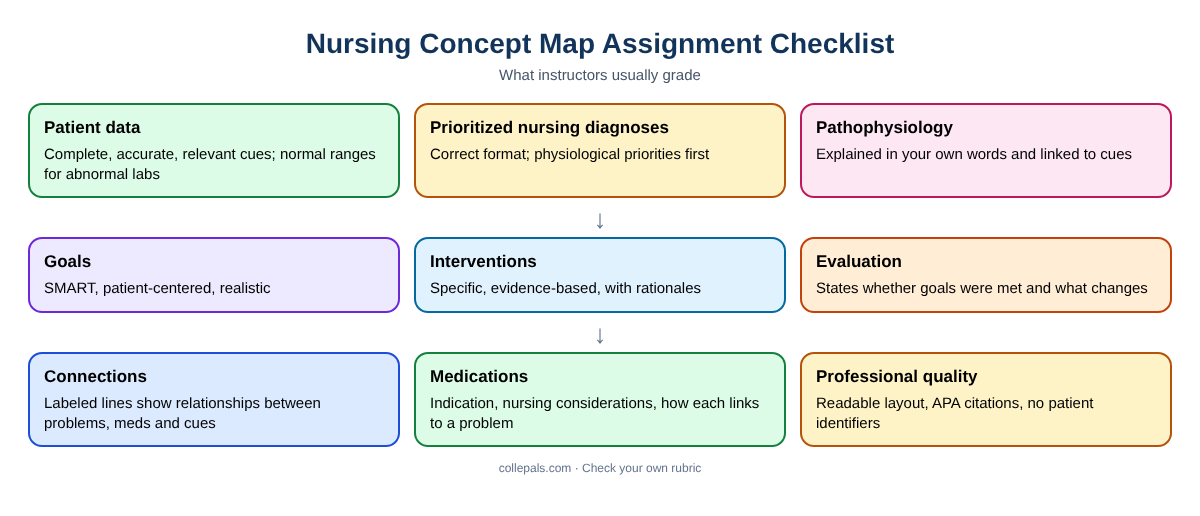
Rubrics vary, but most evaluate the same elements:
- Accurate, relevant patient data, including abnormal labs with normal ranges.
- Correctly written, prioritized nursing diagnoses using your program’s labels, often NANDA-I (Herdman et al., 2024).
- Pathophysiology in your own words, linked to the patient’s cues.
- SMART goals for each diagnosis.
- Specific, evidence-based interventions with rationales.
- Evaluation stating whether goals were met.
- Labeled connections among problems, medications and findings.
- Medications with indications and nursing considerations.
- Professional presentation: readable layout, APA citations and no patient identifiers.
Compare your draft against your actual rubric before submitting; the rubric always takes priority over general guidance.
A Step-by-Step Time Plan
| When | Task |
|---|---|
| During or right after clinical | Record patient data, labs, medications and your assessment (without identifiers). |
| Day 1 (1–2 hours) | Research the medical diagnosis, pathophysiology and medications. |
| Day 2 (1–2 hours) | Cluster cues, choose and prioritize nursing diagnoses, write goals. |
| Day 3 (2 hours) | Add interventions, rationales and evaluation; build the visual map. |
| Day 4 (1 hour) | Draw labeled connections, check the rubric, proofread and format citations. |
Starting the same day as clinical, while details are fresh, saves the most time.
Tools and Templates
- Microsoft Word or PowerPoint (SmartArt or shapes) and Google Slides: widely available and easy to submit.
- Canva: attractive templates and color coding.
- Lucidchart, Miro or diagrams.net: flexible diagramming with connectors that move with boxes.
- Your program’s template: if one is provided, use it, because rubrics are usually aligned to it.
Where to Get Help With Nursing Concept Map Assignments
If you are stuck, start with help that builds your own skills:
- Your clinical instructor or course faculty: ask about expectations early, especially for your first map.
- Peer study groups: compare how classmates cluster cues and prioritize diagnoses.
- Tutoring and writing centers: many schools offer nursing tutors and APA help.
- Worked examples: studying a completed model helps you see how the parts fit. Browse our nursing concept map examples with nursing diagnoses and interventions and full model assignments such as the pyelonephritis concept map.
Use examples to learn the structure and reasoning, then build your own map from your patient’s data and in your own words. Submitting someone else’s map as your own violates academic integrity policies and, more importantly, skips the clinical reasoning practice the assignment is designed to build.
Frequently Asked Questions
How long does a nursing concept map take?
Usually five to eight hours for a full patient care map, depending on complexity and your experience. Later maps go faster as the process becomes familiar.
Do nursing concept maps need references?
Most do. Cite your textbook, drug guide and any other sources for pathophysiology and rationales in APA format.
What is the difference between a concept map and a mind map?
A mind map usually branches outward from one central idea, while a concept map emphasizes labeled relationships among many concepts, including cross-links between branches.
What if my patient has many problems?
Focus on the two to four highest-priority problems, using airway, breathing and circulation, then safety and other needs, and note others briefly if your rubric allows.
Related guides
References
Faraji, A., Banafshi, Z., Jalali, R., & Jalali, A. (2025). Concept mapping teaching method and nursing education: A systematic review and meta-analysis. BMC Medical Education, 25, Article 792. https://doi.org/10.1186/s12909-025-07392-4
Herdman, T. H., Kamitsuru, S., & Lopes, C. T. (Eds.). (2024). NANDA-I international nursing diagnoses: Definitions and classification, 2024–2026 (13th ed.). Thieme.
National Council of State Boards of Nursing. (n.d.). Next Generation NCLEX: Clinical judgment measurement model. https://www.nclex.com/next-generation-nclex.page
Novak, J. D., & Cañas, A. J. (2008). The theory underlying concept maps and how to construct and use them (Technical Report IHMC CmapTools 2006-01 Rev 01-2008). Florida Institute for Human and Machine Cognition.
Get a plagiarism-free answer to this question
Send us your instructions and we’ll match you with the best writer in your subject.
- 100% human-written, zero AI
- Turnitin report included
- Confidential — we never share your data
- Free revisions & refunds