Healthcare Financing Models Explained for Nursing Students
Need help with this assignment?Get an original answer from a qualified tutor — from $10/page.
Get it written →Healthcare financing is how a country raises money for care and pays providers. Financing decisions shape cost, quality and access, the three outcomes NURS 6050: Policy and Advocacy for Improving Population Health asks students to analyze. This guide explains the four classic financing models, U.S. payment methods and current spending data. Healthcare financing nursing assignments test whether you can link payment to cost, quality and access.
Quick answer
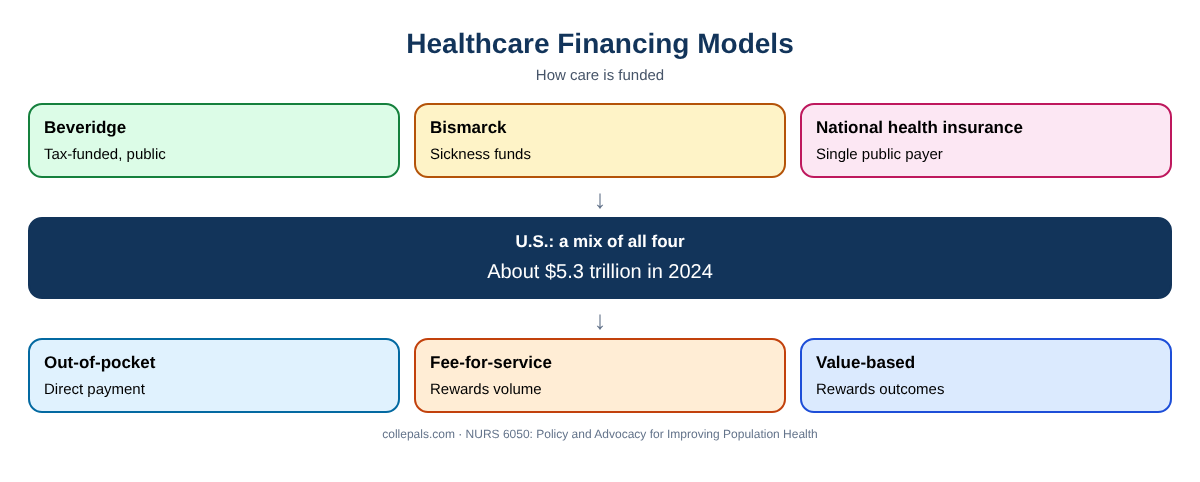
Healthcare financing models include the Beveridge model (tax-funded, government-provided), the Bismarck model (social insurance through sickness funds), national health insurance (a single public payer) and out-of-pocket payment. The U.S. uses all four. U.S. spending reached about $5.3 trillion, or about 18% of GDP, in 2024. In NURS 6050: Policy and Advocacy for Improving Population Health, students link financing to cost, quality and access.
Examples, cases, bills and organizations on this page are fictional unless cited and written by Collepals for study purposes. NURS 6050: Policy and Advocacy for Improving Population Health is a Walden University course; assignments vary by term, so follow your own syllabus and rubric. Policy facts were current when written; check for later changes. This content is educational, not legal advice. Collepals is not affiliated with Walden University.
Sample document: a healthcare financing models comparison sheet (Word).
Four Financing Models
| Model | How it works | Example |
|---|---|---|
| Beveridge model | Government funds and often provides care through taxes | UK National Health Service |
| Bismarck model | Social insurance funded by employers and employees through nonprofit sickness funds | Germany |
| National health insurance | A single public insurer pays private providers | Canada |
| Out-of-pocket | Patients pay directly; little insurance | Many low-income countries |
| U.S. mix | All four models in one system | VA (Beveridge), employer coverage (Bismarck-like), Medicare (NHI-like), uninsured (out-of-pocket) |
How Providers Are Paid
| Method | How it works | Incentive |
|---|---|---|
| Fee-for-service | Paid per service | Rewards volume |
| Capitation | Fixed amount per person per month | Rewards prevention and efficiency; risk of under-service |
| Bundled payment | One payment per episode of care | Encourages coordination |
| Value-based/ACO | Shared savings tied to quality | Rewards outcomes |
U.S. Spending in 2024
- Total national health spending was about $5.3 trillion, up 7.2%.
- That works out to about $15,474 per person, or about 18% of GDP.
- Private health insurance spending was about $1.6 trillion, Medicare about $1.1 trillion and Medicaid about $931.7 billion.
Source: Centers for Medicare & Medicaid Services (2025) national health expenditure data.
Why It Matters for Nurses
Payment drives practice. Fee-for-service rewards volume, while value-based models reward prevention and care coordination, areas where nurses lead. Understanding financing helps nurses argue for funding nursing roles.
Related: Healthcare Access and Affordability: Policy Analysis Guide, Global Health Policy: A Guide for Nursing Students and Healthcare Reform and Its Impact on Nursing Practice.
Frequently Asked Questions
Which financing model does the U.S. use?
A mix: the VA resembles Beveridge, employer insurance resembles Bismarck, Medicare resembles national health insurance, and the uninsured pay out of pocket.
What is value-based payment?
Paying providers based on quality and outcomes rather than the number of services.
How much does the U.S. spend on healthcare?
About $5.3 trillion in 2024, roughly 18% of GDP, according to CMS.
Get Help With Healthcare Financing Assignments
Policy and advocacy assignments demand current evidence, clear analysis and persuasive APA writing. Collepals.com helps students in NURS 6050: Policy and Advocacy for Improving Population Health and other health policy courses:
- Analyze policies, bills and programs with a clear framework.
- Write discussion posts, peer responses and reflections.
- Build policy briefs, fact sheets, comparison grids and advocacy letters.
- Find current evidence, cite in APA 7 and get drafts edited and proofread.
Browse our free model assignments or learn more about our nursing assignment writing service.
Use Collepals examples as study guides and follow your school’s academic integrity and AI policies.
More NURS 6050: Policy and Advocacy for Improving Population Health guides
Collepals is an independent study resource. Follow your program’s instructions and rubric and write your own work.
References
Blumenthal, D., Gumas, E. D., Shah, A., Gunja, M. Z., & Williams, R. D., II. (2024). Mirror, mirror 2024: A portrait of the failing U.S. health system. The Commonwealth Fund. https://www.commonwealthfund.org/publication/fund-report/2024/sep/mirror-mirror-2024
Centers for Medicare & Medicaid Services. (2025). National health expenditure data: Historical. https://www.cms.gov/data-research/statistics-trends-and-reports/national-health-expenditure-data/historical
Short, N. M. (Ed.). (2023). Milstead’s health policy & politics: A nurse’s guide (7th ed.). Jones & Bartlett Learning.
Get a plagiarism-free answer to this question
Send us your instructions and we’ll match you with the best writer in your subject.
- 100% human-written, zero AI
- Turnitin report included
- Confidential — we never share your data
- Free revisions & refunds