Healthcare Policy and Vulnerable Populations
Need help with this assignment?Get an original answer from a qualified tutor — from $10/page.
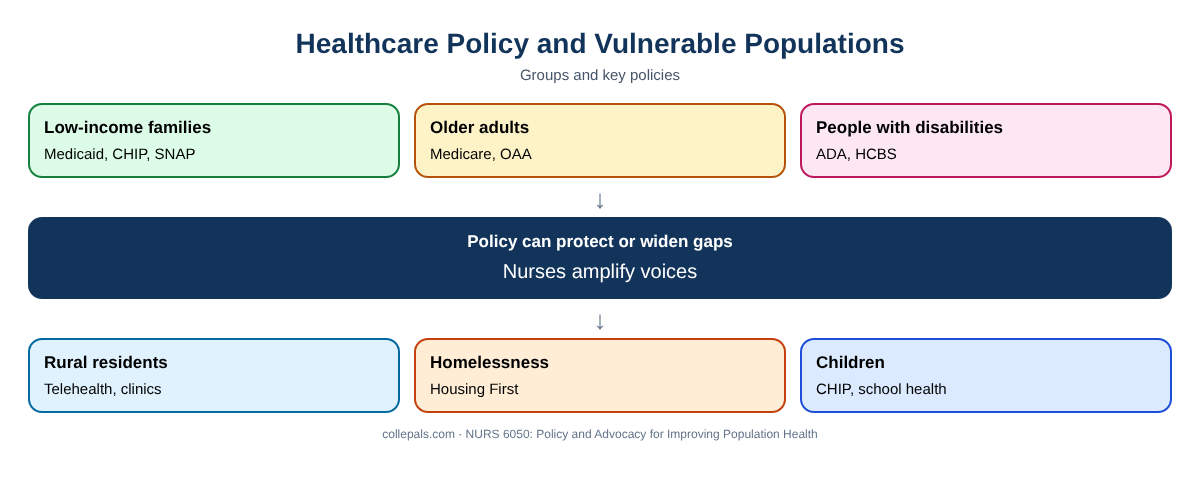
Get it written →Vulnerable populations in healthcare are groups at higher risk of poor health because of social, economic or health factors. Policy can either protect them or widen gaps. Many NURS 6050: Policy and Advocacy for Improving Population Health assignments focus on one such group. This guide explains who is vulnerable, the policies that matter and how nurses advocate. Vulnerable populations healthcare policy is where nurse advocacy often has the most impact.
Quick answer
Vulnerable populations in healthcare include low-income families, older adults, people with disabilities, rural residents, people experiencing homelessness and children. They face higher risk because of barriers such as cost, distance and discrimination. In NURS 6050: Policy and Advocacy for Improving Population Health, students analyze how specific policies, such as Medicaid, CHIP and the ADA, protect or affect a vulnerable group.
Examples, cases, bills and organizations on this page are fictional unless cited and written by Collepals for study purposes. NURS 6050: Policy and Advocacy for Improving Population Health is a Walden University course; assignments vary by term, so follow your own syllabus and rubric. Policy facts were current when written; check for later changes. This content is educational, not legal advice. Collepals is not affiliated with Walden University.
Sample document: a vulnerable population policy analysis worksheet (Word).
Groups and Key Policies
| Population | Common risks | Key policies |
|---|---|---|
| Low-income families | Coverage gaps, food and housing insecurity | Medicaid, CHIP, SNAP |
| Older adults | Chronic illness, cost of care, isolation | Medicare, Older Americans Act |
| People with disabilities | Physical and communication barriers | ADA, Medicaid home and community-based services |
| Rural residents | Distance, hospital closures, workforce shortages | Telehealth, rural health clinics |
| People experiencing homelessness | Exposure, untreated illness, mental health needs | Housing First, health care for the homeless programs |
| Children | Dependence on adults and schools | CHIP, school health services |
Policy Changes to Watch
- Medicaid work requirements under the 2025 reconciliation law start by January 1, 2027. Mandatory exemptions include medically frail people, pregnant and postpartum people and parents of children 13 and under (KFF, 2025).
- Coverage changes affect low-income and rural groups most, because Medicaid covers a large share of these populations.
How to Write the Assignment
- Define the population and give data on its health status.
- Explain why it is vulnerable, using SDOH.
- Analyze one policy that affects it.
- Recommend changes and describe nursing advocacy.
Nursing Advocacy
Nurses can amplify the voices of vulnerable groups by sharing de-identified stories, partnering with community organizations and testifying. The ANA Code supports this role (American Nurses Association, 2025).
Related: Social Determinants of Health: A Nursing Assignment Guide, Health Equity and Healthcare Disparities: A Nursing Guide and Aging Populations and Healthcare Policy.
Frequently Asked Questions
Who are vulnerable populations in healthcare?
Groups at higher risk of poor health, such as low-income, older, disabled, rural, homeless and very young people.
Which policies protect vulnerable populations?
Medicaid, CHIP, Medicare, the ADA, the Older Americans Act and programs such as SNAP and Housing First.
How do nurses advocate for vulnerable groups?
By collecting data, sharing stories, joining coalitions and contacting legislators.
Get Help With Vulnerable Populations Assignments
Policy and advocacy assignments demand current evidence, clear analysis and persuasive APA writing. Collepals.com helps students in NURS 6050: Policy and Advocacy for Improving Population Health and other health policy courses:
- Analyze policies, bills and programs with a clear framework.
- Write discussion posts, peer responses and reflections.
- Build policy briefs, fact sheets, comparison grids and advocacy letters.
- Find current evidence, cite in APA 7 and get drafts edited and proofread.
Browse our free model assignments or learn more about our nursing assignment writing service.
Use Collepals examples as study guides and follow your school’s academic integrity and AI policies.
More NURS 6050: Policy and Advocacy for Improving Population Health guides
Collepals is an independent study resource. Follow your program’s instructions and rubric and write your own work.
References
American Nurses Association. (2025). Code of ethics for nurses. https://codeofethics.ana.org
KFF. (2025). A closer look at the work requirement provisions in the 2025 federal budget reconciliation law. https://www.kff.org/medicaid/a-closer-look-at-the-work-requirement-provisions-in-the-2025-federal-budget-reconciliation-law/
U.S. Department of Health and Human Services, Office of Disease Prevention and Health Promotion. (n.d.). Social determinants of health. Healthy People 2030. https://odphp.health.gov/healthypeople/priority-areas/social-determinants-health
Get a plagiarism-free answer to this question
Send us your instructions and we’ll match you with the best writer in your subject.
- 100% human-written, zero AI
- Turnitin report included
- Confidential — we never share your data
- Free revisions & refunds