Maternal Health Policy and Population Health Outcomes
Need help with this assignment?Get an original answer from a qualified tutor — from $10/page.
Get it written →Maternal health policy shapes outcomes for mothers and infants, from prenatal coverage to postpartum care. U.S. maternal mortality and its racial disparities make it a common choice of issue in NURS 6050: Policy and Advocacy for Improving Population Health. This guide gives the latest data, key policies and an analysis structure.
Quick answer
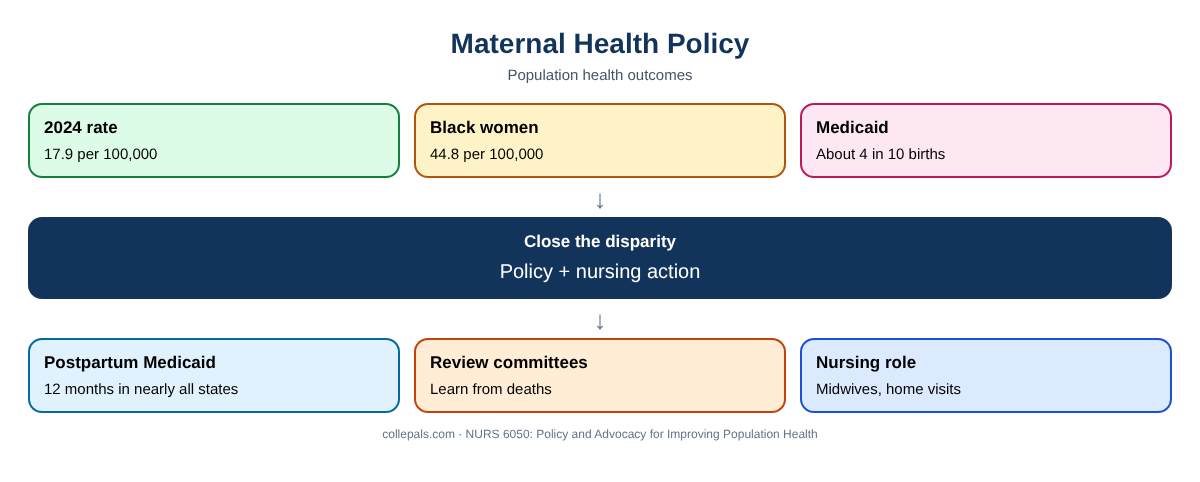
Maternal health policy covers prenatal, delivery and postpartum care, along with workforce and data systems. In 2024, the U.S. maternal mortality rate was 17.9 per 100,000 live births, and the rate for Black women was 44.8. Medicaid pays for about 4 in 10 births, and nearly all states have extended postpartum Medicaid to 12 months. In NURS 6050: Policy and Advocacy for Improving Population Health, students analyze these policies.
Examples, cases, bills and organizations on this page are fictional unless cited and written by Collepals for study purposes. NURS 6050: Policy and Advocacy for Improving Population Health is a Walden University course; assignments vary by term, so follow your own syllabus and rubric. Policy facts were current when written; check for later changes. This content is educational, not legal advice. Collepals is not affiliated with Walden University.
Sample document: a maternal health policy analysis worksheet with 2024 data (Word).
Maternal Mortality Data (per 100,000 Live Births)
| Group | 2024 | 2023 |
|---|---|---|
| All women | 17.9 | 18.6 |
| Black, non-Hispanic | 44.8 | 50.3 |
| White, non-Hispanic | 14.2 | 14.5 |
| Hispanic | 12.1 | 12.4 |
| Asian, non-Hispanic | 18.1 | 10.7 |
Source: National Center for Health Statistics (2026). The changes from 2023 to 2024 were not statistically significant, but the rate for Black women remained significantly higher than for other groups. There were 649 maternal deaths in 2024.
Key Policies
- Postpartum Medicaid extension: the American Rescue Plan Act of 2021 gave states the option to extend postpartum coverage from 60 days to 12 months. KFF reports that nearly all states have adopted it (KFF, 2026).
- Medicaid pays for about 4 in 10 U.S. births, so Medicaid policy has a large effect on maternal health.
- Maternal mortality review committees, perinatal quality collaboratives and doula coverage in some states.
Analysis Structure
- Problem and disparities, with current data.
- Policy and its provisions.
- Stakeholders.
- Impact and gaps, such as rural maternity care deserts.
- Recommendation and nursing role, such as midwives, postpartum home visits and advocacy.
Related: Health Equity and Healthcare Disparities: A Nursing Guide, Agenda Setting in Healthcare Policy and Global Health Policy: A Guide for Nursing Students.
Frequently Asked Questions
What is the U.S. maternal mortality rate?
17.9 deaths per 100,000 live births in 2024, according to NCHS.
Why are Black women at higher risk?
The causes are structural, including racism, unequal access and quality of care, and chronic conditions, not individual factors alone.
How long does postpartum Medicaid last?
Federal law requires 60 days; states can extend it to 12 months, and nearly all have.
Get Help With Maternal Health Policy Assignments
Policy and advocacy assignments demand current evidence, clear analysis and persuasive APA writing. Collepals.com helps students in NURS 6050: Policy and Advocacy for Improving Population Health and other health policy courses:
- Analyze policies, bills and programs with a clear framework.
- Write discussion posts, peer responses and reflections.
- Build policy briefs, fact sheets, comparison grids and advocacy letters.
- Find current evidence, cite in APA 7 and get drafts edited and proofread.
Browse our free model assignments or learn more about our nursing assignment writing service.
Use Collepals examples as study guides and follow your school’s academic integrity and AI policies.
More NURS 6050: Policy and Advocacy for Improving Population Health guides
Collepals is an independent study resource. Follow your program’s instructions and rubric and write your own work.
References
Braveman, P., Arkin, E., Orleans, T., Proctor, D., & Plough, A. (2017). What is health equity? And what difference does a definition make? Robert Wood Johnson Foundation.
KFF. (2026). Medicaid postpartum coverage extension tracker. https://www.kff.org/medicaid/medicaid-postpartum-coverage-extension-tracker/
National Center for Health Statistics. (2026). Maternal mortality rates in the United States, 2024 (NCHS Health E-Stats). https://www.cdc.gov/nchs/data/hestat/hestat113.htm
Get a plagiarism-free answer to this question
Send us your instructions and we’ll match you with the best writer in your subject.
- 100% human-written, zero AI
- Turnitin report included
- Confidential — we never share your data
- Free revisions & refunds