Healthcare Access and Affordability: Policy Analysis Guide
Need help with this assignment?Get an original answer from a qualified tutor — from $10/page.
Get it written →Healthcare access is whether people can get timely, affordable and appropriate care. Access and affordability are core outcomes in NURS 6050: Policy and Advocacy for Improving Population Health policy analyses. This guide gives an access framework, current coverage data and recent policy changes to analyze. Healthcare access nursing assignments usually ask how a policy changes who can get care.
Quick answer
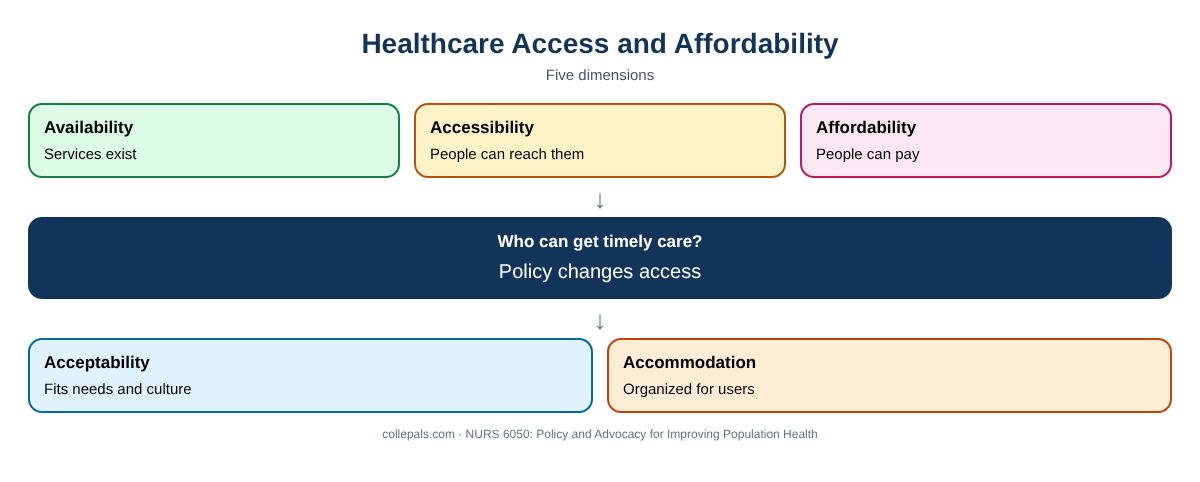
Healthcare access and affordability can be analyzed through five dimensions: availability, accessibility, affordability, acceptability and accommodation. About 8% of people had no health insurance at any point in 2024. The 2025 reconciliation law adds Medicaid work requirements starting by January 1, 2027. In NURS 6050: Policy and Advocacy for Improving Population Health, students assess how policies change access.
Examples, cases, bills and organizations on this page are fictional unless cited and written by Collepals for study purposes. NURS 6050: Policy and Advocacy for Improving Population Health is a Walden University course; assignments vary by term, so follow your own syllabus and rubric. Policy facts were current when written; check for later changes. This content is educational, not legal advice. Collepals is not affiliated with Walden University.
Sample document: a healthcare access and affordability analysis worksheet (Word).
Five Dimensions of Access
| Dimension | Question | Examples |
|---|---|---|
| Availability | Are services and providers there? | Provider shortages, rural closures |
| Accessibility | Can people reach them? | Distance, transport, hours, telehealth |
| Affordability | Can people pay? | Premiums, deductibles, uninsurance |
| Acceptability | Do services fit people’s needs and culture? | Language, trust, respect |
| Accommodation | Are services organized for users? | Appointments, wait times |
Coverage Snapshot (2024)
- 92.0% of people had health insurance for some or all of 2024, so about 8% had none at any point in the year.
- 66.1% had private coverage and 35.5% had public coverage. Some people have both.
Source: U.S. Census Bureau (2025).
Policy Changes to Analyze
- Medicaid work requirements: many expansion adults must document 80 hours a month of qualifying activity or meet an exemption, starting by January 1, 2027. CBO estimated that an earlier House version would leave millions more people uninsured by 2034 (KFF, 2025).
- Preventive services without cost sharing remain required after Kennedy v. Braidwood (2025).
- State actions on telehealth, scope of practice and price transparency.
Check for later changes before citing.
Nursing Role
- Help patients enroll and keep coverage.
- Advocate for community health centers and APRN scope.
- Measure access barriers in your setting.
Related: Healthcare Financing Models Explained for Nursing Students, Healthcare Reform and Its Impact on Nursing Practice and Healthcare Policy and Vulnerable Populations.
Frequently Asked Questions
What is the uninsured rate in the U.S.?
Census data show about 8% of people had no health insurance at any point in 2024.
What affects affordability besides insurance?
Deductibles, copays, surprise bills and prescription prices.
How do work requirements affect access?
They can cause eligible people to lose coverage because of paperwork and reporting barriers, so nurses can help with enrollment and exemptions.
Get Help With Healthcare Access Policy Analysis
Policy and advocacy assignments demand current evidence, clear analysis and persuasive APA writing. Collepals.com helps students in NURS 6050: Policy and Advocacy for Improving Population Health and other health policy courses:
- Analyze policies, bills and programs with a clear framework.
- Write discussion posts, peer responses and reflections.
- Build policy briefs, fact sheets, comparison grids and advocacy letters.
- Find current evidence, cite in APA 7 and get drafts edited and proofread.
Browse our free model assignments or learn more about our nursing assignment writing service.
Use Collepals examples as study guides and follow your school’s academic integrity and AI policies.
More NURS 6050: Policy and Advocacy for Improving Population Health guides
- NURS 6050: Policy and Advocacy for Improving Population Health – Complete Course Guide
- Healthcare Financing Models Explained for Nursing Students
- Healthcare Reform and Its Impact on Nursing Practice
- Healthcare Policy and Vulnerable Populations
- Social Determinants of Health: A Nursing Assignment Guide
Collepals is an independent study resource. Follow your program’s instructions and rubric and write your own work.
References
Kennedy v. Braidwood Management, Inc., No. 24-316 (U.S. June 27, 2025).
KFF. (2025). A closer look at the work requirement provisions in the 2025 federal budget reconciliation law. https://www.kff.org/medicaid/a-closer-look-at-the-work-requirement-provisions-in-the-2025-federal-budget-reconciliation-law/
U.S. Census Bureau. (2025). Health insurance coverage in the United States: 2024 (Current Population Reports P60-288). https://www.census.gov/library/publications/2025/demo/p60-288.html
Get a plagiarism-free answer to this question
Send us your instructions and we’ll match you with the best writer in your subject.
- 100% human-written, zero AI
- Turnitin report included
- Confidential — we never share your data
- Free revisions & refunds