Nursing SOAP Note Examples for Different Patient Conditions: Endometriosis, Endometrial Disease, IBS, PID, Erectile Dysfunction and Hypothyroidism
Need help with this assignment?Get an original answer from a qualified tutor — from $10/page.
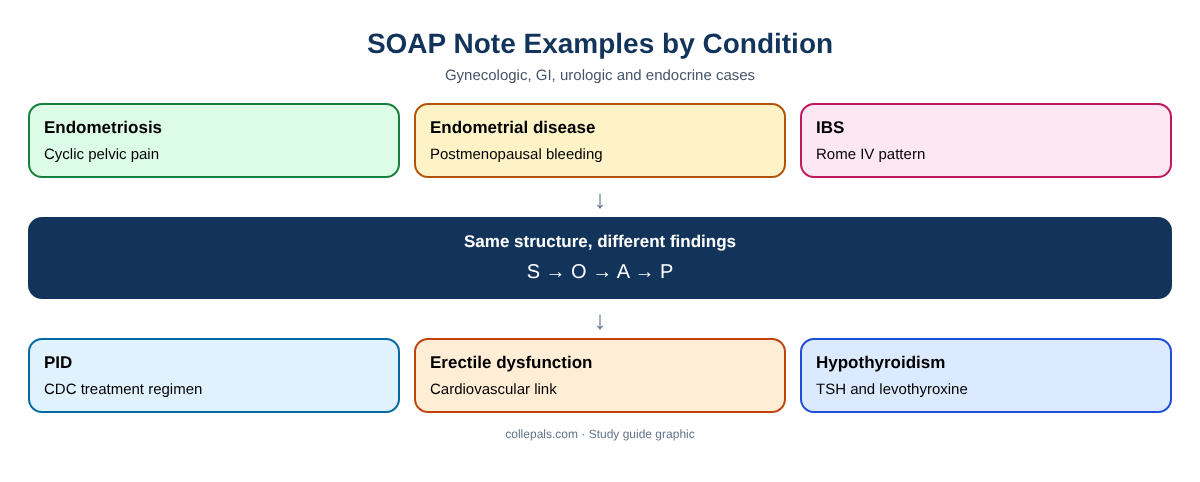
Get it written →Seeing the SOAP format applied to different conditions is one of the best ways to learn it. This article provides nursing SOAP note examples for different patient conditions: endometriosis, endometrial disease presenting as postmenopausal bleeding, irritable bowel syndrome, pelvic inflammatory disease, erectile dysfunction and a glandular (thyroid) disorder. Each example follows the same structure, with differential diagnoses and a guideline-based plan.
Quick answer
Each example below documents what the patient reports (S), what was found (O), the diagnosis with differentials (A) and a guideline-based plan (P). The structure stays the same across conditions; what changes are the key history questions, exam findings, tests and treatments for each condition.
Patients in these examples are fictional and are used for study purposes only. Treatments and doses are illustrative; follow current guidelines, your facility’s protocols and your scope of practice. This article is educational and is not medical advice.
1. Endometriosis
SOAP note: suspected endometriosis
S: 29-year-old G0 reports worsening painful periods for 2 years, now missing 2 workdays monthly; deep dyspareunia; cyclic pelvic pain starting 2 days before menses. Ibuprofen gives partial relief. Trying to conceive in 2 years. LMP 10 days ago. No fever or abnormal discharge.
O: T 36.8 °C, BP 116/72. Abdomen soft, mild suprapubic tenderness. Pelvic exam: tenderness and nodularity along the posterior fornix; no cervical motion tenderness. Urine hCG negative. Transvaginal ultrasound: no endometrioma.
A: Suspected endometriosis (clinical diagnosis). Differentials: adenomyosis, chronic PID (no infectious signs), irritable bowel syndrome (no bowel pattern change).
P: Scheduled NSAID with meals during menses; offer hormonal therapy such as a combined hormonal contraceptive or progestogen, which guidelines support without requiring surgical diagnosis first (Becker et al., 2022); discuss fertility goals; refer to gynecology if pain persists or for fertility planning; follow up in 3 months.
2. Endometrial Disease: Postmenopausal Bleeding
SOAP note: postmenopausal bleeding
S: 58-year-old, menopause at 52, reports three episodes of vaginal spotting over 2 months. No hormone therapy. History of hypertension and obesity. No pain or discharge.
O: BP 138/84, BMI 36. Pelvic exam: normal cervix, no lesions, small amount of old blood in vault. Transvaginal ultrasound: endometrial thickness 9 mm.
A: Postmenopausal bleeding with thickened endometrium; must rule out endometrial hyperplasia and endometrial cancer (obesity is a risk factor). Differentials: atrophic vaginitis, endometrial polyp, cervical lesion.
P: Endometrial biopsy; ACOG notes that an endometrial thickness of 4 mm or less in women with postmenopausal bleeding has a very low cancer risk, so a thicker endometrium warrants further evaluation such as sampling (American College of Obstetricians and Gynecologists [ACOG], 2018). Discuss results within 1–2 weeks; gynecology referral for abnormal findings or persistent bleeding.
3. Irritable Bowel Syndrome
SOAP note: irritable bowel syndrome with diarrhea
S: 32-year-old reports 8 months of crampy lower abdominal pain about 2 days per week, relieved by bowel movements, with loose stools 3–4 times daily on symptomatic days. Worse with stress and dairy. Denies rectal bleeding, weight loss, nocturnal symptoms or family history of colon cancer or celiac disease.
O: Vitals normal, weight stable. Abdomen soft, mild diffuse tenderness, no masses. CBC and CRP normal; celiac serology negative; fecal calprotectin normal.
A: Irritable bowel syndrome, diarrhea-predominant (IBS-D), meeting Rome IV criteria. No alarm features. Differentials: celiac disease and inflammatory bowel disease (excluded by testing), lactose intolerance.
P: Positive diagnostic strategy rather than extensive testing; limited trial of a low-FODMAP diet with dietitian support; soluble fiber; consider gut-directed psychotherapy; rifaximin is an option for IBS-D if symptoms persist (Lacy et al., 2021). Follow up in 6–8 weeks.
4. Pelvic Inflammatory Disease
SOAP note: pelvic inflammatory disease
S: 22-year-old reports 4 days of lower abdominal pain, increased vaginal discharge and pain with intercourse. New sexual partner 2 months ago; inconsistent condom use. LMP 2 weeks ago.
O: T 38.1 °C, HR 96, BP 118/74. Lower abdominal tenderness; pelvic exam: mucopurulent cervical discharge, cervical motion tenderness and bilateral adnexal tenderness. Urine hCG negative. Gonorrhea and chlamydia NAAT pending.
A: Pelvic inflammatory disease, mild to moderate (tolerating oral intake, no tubo-ovarian abscess suspected). Differentials: ectopic pregnancy (hCG negative), appendicitis, ovarian torsion.
P: Outpatient regimen per CDC: ceftriaxone 500 mg IM once plus doxycycline 100 mg orally twice daily for 14 days with metronidazole 500 mg orally twice daily for 14 days (Workowski et al., 2021). Reevaluate in 72 hours; hospitalize if no improvement. Test for HIV and syphilis; treat partners; abstain until treatment is complete.
5. Erectile Dysfunction
SOAP note: erectile dysfunction
S: 56-year-old reports gradual difficulty maintaining erections for 1 year; fewer morning erections. History of type 2 diabetes, hypertension and 30 pack-year smoking. Medications: metformin, lisinopril. No nitrate use. Relationship stable; mood good.
O: BP 142/88, BMI 31. Normal genital exam; normal peripheral pulses. A1C 7.8%; lipid panel pending; morning total testosterone pending.
A: Erectile dysfunction, likely vasculogenic, associated with diabetes, hypertension and smoking; ED may signal increased cardiovascular risk. Differentials: hypogonadism, medication-related, psychogenic ED.
P: Assess cardiovascular risk and optimize diabetes, blood pressure and lipids (Burnett et al., 2018); smoking cessation support; start a PDE5 inhibitor, such as sildenafil, with teaching on use and side effects, and confirm no nitrate use; follow up in 4–6 weeks with testosterone and lipid results.
6. Glandular Disorder: Hypothyroidism
SOAP note: primary hypothyroidism
S: 45-year-old reports 6 months of fatigue, 10-lb weight gain, cold intolerance, constipation and dry skin. Mother has thyroid disease. No current medications.
O: HR 58, BP 124/80. Dry skin, mild periorbital puffiness, delayed relaxation of ankle reflexes. TSH 9.8 mIU/L (elevated), free T4 low; TPO antibodies positive.
A: Primary hypothyroidism, likely Hashimoto’s thyroiditis. Differentials: depression, anemia (CBC pending), sleep apnea.
P: Levothyroxine, with full replacement dosing based on weight in otherwise healthy adults and lower starting doses for older adults or those with heart disease (Jonklaas et al., 2014); take on an empty stomach, separate from calcium and iron; recheck TSH in 6–8 weeks; educate on symptoms of over- and under-replacement.
What These Examples Have in Common
- The subjective section includes pertinent negatives that help exclude differentials.
- The objective section includes targeted exam findings and relevant tests.
- Each assessment names a diagnosis and alternatives.
- Each plan is specific, guideline-based and includes follow-up.
Use our SOAP note template to structure your own notes.
Frequently Asked Questions
Can I use these examples for my assignment?
Use them to learn structure and reasoning. Your SOAP note must reflect your own patient or case data.
Why include differential diagnoses?
They show diagnostic reasoning and are required in most nurse practitioner SOAP notes.
How detailed should the plan be?
Include diagnostics, treatment with doses when you prescribe, education, referrals and follow-up timing.
Get Help With Condition-Specific SOAP Notes at Collepals
SOAP notes are a weekly assignment in many nursing and nurse practitioner programs. Collepals.com helps nursing students write accurate, well-organized SOAP notes. Our nursing-focused writers and tutors can:
- Show you how to organize case data into subjective, objective, assessment and plan sections.
- Help you build differential diagnoses and evidence-based plans tied to current guidelines.
- Provide model SOAP notes you can study for structure and depth.
- Find current references and format them in APA 7, and edit or proofread your drafts.
Browse our free model assignments or learn more about our nursing assignment writing service.
Use Collepals examples as study guides and follow your school’s academic integrity and AI policies when you submit your own work.
More SOAP note guides
Collepals is an independent study resource. Course templates and rubrics vary; always follow your instructor’s format and your facility’s documentation policies.
References
American College of Obstetricians and Gynecologists. (2018). The role of transvaginal ultrasonography in evaluating the endometrium of women with postmenopausal bleeding (Committee Opinion No. 734). Obstetrics & Gynecology, 131(5), e124–e129.
Becker, C. M., Bokor, A., Heikinheimo, O., Horne, A., Jansen, F., Kiesel, L., King, K., Kvaskoff, M., Nap, A., Petersen, K., Saridogan, E., Tomassetti, C., van Hanegem, N., Vulliemoz, N., & Vermeulen, N. (2022). ESHRE guideline: Endometriosis. Human Reproduction Open, 2022(2), Article hoac009. https://doi.org/10.1093/hropen/hoac009
Burnett, A. L., Nehra, A., Breau, R. H., Culkin, D. J., Faraday, M. M., Hakim, L. S., Heidelbaugh, J., Khera, M., McVary, K. T., Miner, M. M., Nelson, C. J., Sadeghi-Nejad, H., Seftel, A. D., & Shindel, A. W. (2018). Erectile dysfunction: AUA guideline. Journal of Urology, 200(3), 633–641. https://doi.org/10.1016/j.juro.2018.05.004
Jonklaas, J., Bianco, A. C., Bauer, A. J., Burman, K. D., Cappola, A. R., Celi, F. S., Cooper, D. S., Kim, B. W., Peeters, R. P., Rosenthal, M. S., & Sawka, A. M. (2014). Guidelines for the treatment of hypothyroidism. Thyroid, 24(12), 1670–1751. https://doi.org/10.1089/thy.2014.0028
Lacy, B. E., Pimentel, M., Brenner, D. M., Chey, W. D., Keefer, L. A., Long, M. D., & Moshiree, B. (2021). ACG clinical guideline: Management of irritable bowel syndrome. American Journal of Gastroenterology, 116(1), 17–44. https://doi.org/10.14309/ajg.0000000000001036
Workowski, K. A., Bachmann, L. H., Chan, P. A., Johnston, C. M., Muzny, C. A., Park, I., Reno, H., Zenilman, J. M., & Bolan, G. A. (2021). Sexually transmitted infections treatment guidelines, 2021. MMWR Recommendations and Reports, 70(4), 1–187. https://doi.org/10.15585/mmwr.rr7004a1
Get a plagiarism-free answer to this question
Send us your instructions and we’ll match you with the best writer in your subject.
- 100% human-written, zero AI
- Turnitin report included
- Confidential — we never share your data
- Free revisions & refunds