Heart Failure Nursing SOAP Note Example
Need help with this assignment?Get an original answer from a qualified tutor — from $10/page.
Get it written →Heart failure is a high-stakes condition to document, because small changes in weight, breathing or kidney function can signal decompensation. This heart failure nursing SOAP note example documents a patient with heart failure with reduced ejection fraction (HFrEF) admitted with fluid overload, with guidance aligned to the 2022 AHA/ACC/HFSA heart failure guideline.
Quick answer
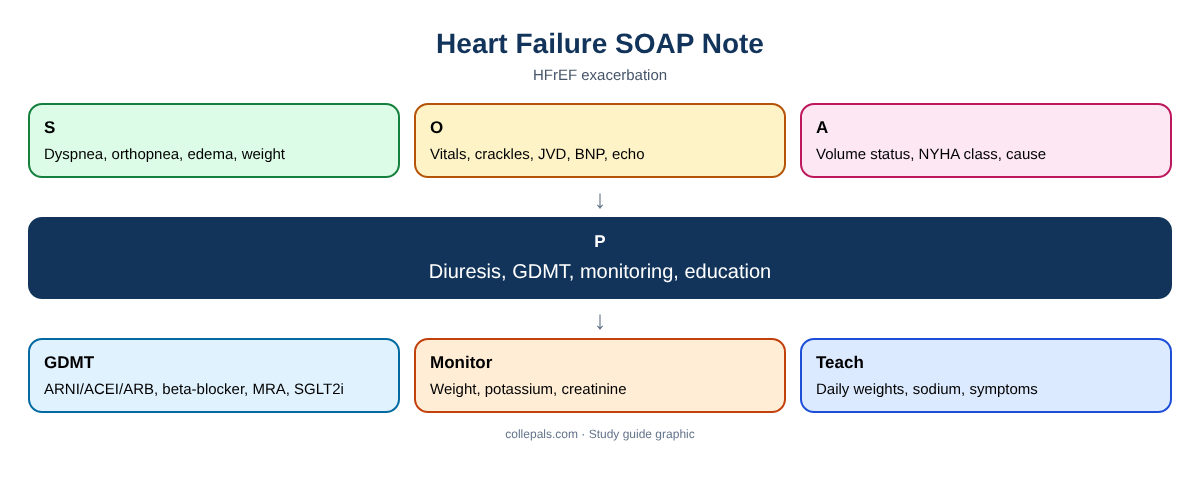
A heart failure SOAP note documents dyspnea, orthopnea, edema, weight change and adherence (S); vital signs, daily weight, lung sounds, jugular venous distension, edema, BNP, electrolytes, kidney function and ejection fraction (O); type, stage or class and volume status (A); and diuresis, guideline-directed medical therapy, monitoring and education (P).
Patients in these examples are fictional and are used for study purposes only. Treatments and doses are illustrative; follow current guidelines, your facility’s protocols and your scope of practice. This article is educational and is not medical advice.
SOAP note: acute decompensated HFrEF (fictional)
S: 68-year-old male with HFrEF (EF 30%) reports 5 days of increasing shortness of breath, now with minimal exertion, sleeping on 3 pillows, and swollen ankles. Weight up 3 kg in 1 week by home scale. Ate restaurant meals at a family event; ran out of furosemide 4 days ago. Denies chest pain.
O: T 36.7 °C, HR 102, RR 24, BP 142/88, SpO2 90% on room air. Weight 92 kg. JVD to the angle of the jaw; crackles in bilateral lower lung fields; 2+ pitting edema to mid-shin. BNP elevated; potassium 3.9 mmol/L; creatinine 1.3 mg/dL (baseline 1.1). Chest X-ray: pulmonary vascular congestion.
A: Acute decompensated heart failure with reduced ejection fraction, volume overloaded, NYHA class IV symptoms on admission; precipitants: dietary sodium and missed diuretic. Mild rise in creatinine.
P: IV loop diuretic as ordered; oxygen to maintain target saturation; strict intake and output; daily weights; monitor potassium, magnesium and creatinine daily; resume and optimize guideline-directed medical therapy when stable: ARNI, ACE inhibitor or ARB; evidence-based beta-blocker; mineralocorticoid receptor antagonist; and SGLT2 inhibitor (American Heart Association [AHA], 2022); sodium and fluid teaching; daily weight teaching with call threshold; follow-up within 7 days of discharge.
What to Monitor and Document
| Area | Key findings |
|---|---|
| Volume | Daily weight, intake and output, edema, JVD, lung sounds |
| Respiratory | Respiratory rate, SpO2, orthopnea |
| Labs | Potassium, magnesium, creatinine, BNP |
| Perfusion | Blood pressure, mental status, urine output, skin temperature |
| Medications | Diuretic response; GDMT tolerance (hypotension, hyperkalemia) |
Nursing Diagnoses (Prelicensure Version)
- Excess fluid volume related to compromised regulatory mechanisms, as evidenced by 3 kg weight gain, edema and crackles.
- Activity intolerance related to imbalance between oxygen supply and demand.
- Deficient knowledge related to sodium restriction and medication management.
Use your program’s preferred labels (Herdman et al., 2024).
Discharge Teaching
Teach daily weights at the same time each morning, sodium reduction, medication purposes and side effects and when to call the provider, using teach-back to confirm understanding (Talevski et al., 2020).
Frequently Asked Questions
What are the four pillars of HFrEF therapy?
ARNI, ACE inhibitor or ARB; an evidence-based beta-blocker; a mineralocorticoid receptor antagonist; and an SGLT2 inhibitor, per the 2022 guideline.
Why are daily weights important?
Rapid weight gain often reflects fluid retention before symptoms become severe.
Where does NYHA class go?
In the assessment, describing functional status.
Get Help With Your Heart Failure SOAP Note at Collepals
SOAP notes are a weekly assignment in many nursing and nurse practitioner programs. Collepals.com helps nursing students write accurate, well-organized SOAP notes. Our nursing-focused writers and tutors can:
- Show you how to organize case data into subjective, objective, assessment and plan sections.
- Help you build differential diagnoses and evidence-based plans tied to current guidelines.
- Provide model SOAP notes you can study for structure and depth.
- Find current references and format them in APA 7, and edit or proofread your drafts.
Browse our free model assignments or learn more about our nursing assignment writing service.
Use Collepals examples as study guides and follow your school’s academic integrity and AI policies when you submit your own work.
More SOAP note guides
Collepals is an independent study resource. Course templates and rubrics vary; always follow your instructor’s format and your facility’s documentation policies.
References
American Heart Association. (2022). 2022 AHA/ACC/HFSA guideline for the management of heart failure [Guideline highlights]. https://professional.heart.org/en/science-news/2022-guideline-for-the-management-of-heart-failure
Herdman, T. H., Kamitsuru, S., & Lopes, C. T. (Eds.). (2024). NANDA-I international nursing diagnoses: Definitions and classification, 2024–2026 (13th ed.). Thieme.
Talevski, J., Wong Shee, A., Rasmussen, B., Kemp, G., & Beauchamp, A. (2020). Teach-back: A systematic review of implementation and impacts. PLOS ONE, 15(4), Article e0231350. https://doi.org/10.1371/journal.pone.0231350
Get a plagiarism-free answer to this question
Send us your instructions and we’ll match you with the best writer in your subject.
- 100% human-written, zero AI
- Turnitin report included
- Confidential — we never share your data
- Free revisions & refunds