Psychiatric SOAP Notes: A Complete Guide for PMHNP Students
Need help with this assignment?Get an original answer from a qualified tutor — from $10/page.
Get it written →Psychiatric SOAP notes follow the familiar four-part structure but require additional elements, including a mental status examination, standardized rating scales, a risk assessment and DSM-5-TR diagnoses. This complete guide for psychiatric-mental health nurse practitioner (PMHNP) students explains what each section of a psychiatric SOAP note contains and how to write it well.
Quick answer
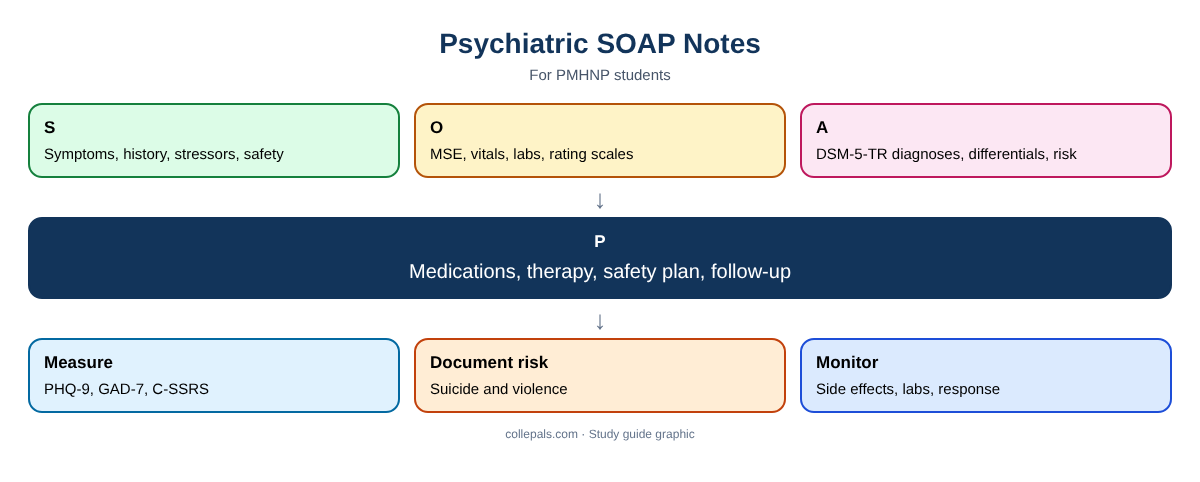
In a psychiatric SOAP note, S covers symptoms, history, stressors, substance use and patient-reported safety concerns; O includes the mental status examination, vital signs, labs and rating scale scores; A gives DSM-5-TR diagnoses, differentials and risk level; and P addresses medications, psychotherapy, safety planning, labs, education and follow-up, using measurement-based care.
Subjective
- Chief complaint in the patient’s words.
- Interval history (follow-up) or full HPI (initial visit): mood, sleep, appetite, energy, concentration, anxiety, psychosis, mania.
- Medication adherence, side effects and response.
- Substance use, stressors and supports.
- Patient-reported suicidal or homicidal thoughts.
Objective
- Mental status examination: appearance, behavior, speech, mood, affect, thought process, thought content, perception, cognition, insight and judgment.
- Vital signs and weight, especially for medications with metabolic or cardiovascular effects.
- Labs: such as lithium levels or metabolic monitoring.
- Rating scales: PHQ-9 for depression (Kroenke et al., 2001), GAD-7 for anxiety (Spitzer et al., 2006) and the C-SSRS for suicide risk (Posner et al., 2011).
Assessment
List DSM-5-TR diagnoses with specifiers (American Psychiatric Association, 2022), differentials when the diagnosis is uncertain, current status (for example, “partial response”) and risk level with rationale.
Plan
- Medications: start, continue, adjust or stop, with dose and rationale.
- Psychotherapy and referrals.
- Safety plan and crisis resources, including the 988 Suicide & Crisis Lifeline.
- Labs and monitoring.
- Education and coordination with primary care, family or therapists (with consent).
- Follow-up timing and the measures you will repeat.
Repeating rating scales at each visit supports measurement-based care, which improves outcomes compared with usual care (Fortney et al., 2017).
Initial Evaluation vs. Follow-Up Note
| Element | Initial evaluation | Follow-up note |
|---|---|---|
| History | Full psychiatric, medical, family and social history | Interval changes since last visit |
| MSE | Complete | Complete but focused on changes |
| Assessment | Diagnoses and differentials | Status of each diagnosis |
| Plan | Initial treatment plan | Adjustments and monitoring |
The APA (2016) guideline describes the elements of a full initial psychiatric evaluation. See PMHNP SOAP note examples and how to write a SOAP note for a mental health patient.
Frequently Asked Questions
Where does the MSE go in a psychiatric SOAP note?
In the objective section, because it records the clinician’s observations.
Do psychiatric SOAP notes need differentials?
For initial evaluations and uncertain presentations, yes; follow-up notes focus on the status of established diagnoses.
Should every psychiatric note include a risk assessment?
Yes. Document suicide and violence risk at every visit.
Get Help With Psychiatric SOAP Notes at Collepals
SOAP notes are a weekly assignment in many nursing and nurse practitioner programs. Collepals.com helps nursing students write accurate, well-organized SOAP notes. Our nursing-focused writers and tutors can:
- Show you how to organize case data into subjective, objective, assessment and plan sections.
- Help you build differential diagnoses and evidence-based plans tied to current guidelines.
- Provide model SOAP notes you can study for structure and depth.
- Find current references and format them in APA 7, and edit or proofread your drafts.
Browse our free model assignments or learn more about our nursing assignment writing service.
Use Collepals examples as study guides and follow your school’s academic integrity and AI policies when you submit your own work.
More SOAP note guides
Collepals is an independent study resource. Course templates and rubrics vary; always follow your instructor’s format and your facility’s documentation policies.
References
American Psychiatric Association. (2016). The American Psychiatric Association practice guidelines for the psychiatric evaluation of adults (3rd ed.). https://doi.org/10.1176/appi.books.9780890426760
American Psychiatric Association. (2022). Diagnostic and statistical manual of mental disorders (5th ed., text rev.). https://doi.org/10.1176/appi.books.9780890425787
Fortney, J. C., Unützer, J., Wrenn, G., Pyne, J. M., Smith, G. R., Schoenbaum, M., & Harbin, H. T. (2017). A tipping point for measurement-based care. Psychiatric Services, 68(2), 179–188. https://doi.org/10.1176/appi.ps.201500439
Kroenke, K., Spitzer, R. L., & Williams, J. B. W. (2001). The PHQ-9: Validity of a brief depression severity measure. Journal of General Internal Medicine, 16(9), 606–613. https://doi.org/10.1046/j.1525-1497.2001.016009606.x
Posner, K., Brown, G. K., Stanley, B., Brent, D. A., Yershova, K. V., Oquendo, M. A., Currier, G. W., Melvin, G. A., Greenhill, L., Shen, S., & Mann, J. J. (2011). The Columbia–Suicide Severity Rating Scale: Initial validity and internal consistency findings from three multisite studies with adolescents and adults. American Journal of Psychiatry, 168(12), 1266–1277. https://doi.org/10.1176/appi.ajp.2011.10111704
Spitzer, R. L., Kroenke, K., Williams, J. B. W., & Löwe, B. (2006). A brief measure for assessing generalized anxiety disorder: The GAD-7. Archives of Internal Medicine, 166(10), 1092–1097. https://doi.org/10.1001/archinte.166.10.1092
Get a plagiarism-free answer to this question
Send us your instructions and we’ll match you with the best writer in your subject.
- 100% human-written, zero AI
- Turnitin report included
- Confidential — we never share your data
- Free revisions & refunds