Child Development Concept Map From a Student Perspective: Comparing Teacher and Professor Maps
Need help with this assignment?Get an original answer from a qualified tutor — from $10/page.
Get it written →Activity Assignment: Concept Map of Child Development From a Student’s Perspective (Teacher vs. Professor Maps)
In learning expository material, concept maps (diagrams of the connections among ideas) are a helpful visual strategy. Exhibit 9.6.1 shows two maps of “child development,” one by a classroom teacher, emphasizing practical concerns such as classroom learning and child abuse, and one by a university psychology professor, emphasizing theory such as Erikson and Piaget (Seifert, 1991). The differences suggest the two may mean different things by the same term.
Activity: Examine the similarities and differences between the two maps, think about what is missing or needed and create your own concept map from a student perspective using Canva, Word/PowerPoint, Pages/Keynote or Google Docs/Slides. Submit it as a picture or PDF, with APA citations.
Classroom learning, behavior, abuse
Piaget, Erikson, theory
Student voice, mental health, technology
Eight linked branches
Download the concept map (PDF)
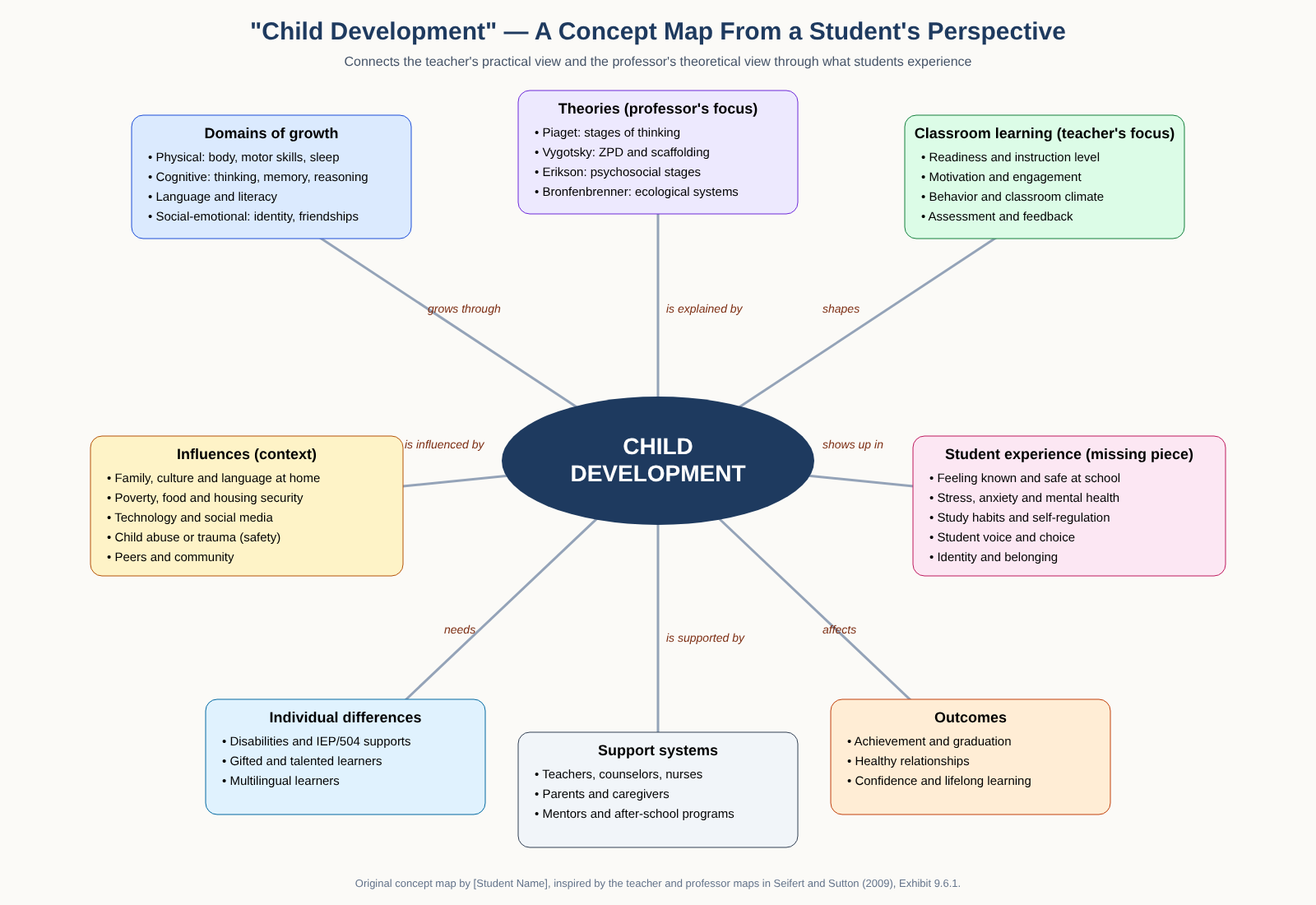
Model explanation to submit with the map
Original example for study purposes (about 290 words). The assignment asks you to create your own map. Use this one as inspiration and build yours in Canva, PowerPoint or Google Slides.
Similarities and differences. Both maps place child development at the center and connect it to learning, showing that the teacher and the professor agree that development and education are linked. The differences lie in emphasis. The teacher’s map highlights practical, day-to-day concerns, such as classroom learning and child abuse, reflecting the responsibility of managing real children in real classrooms. The professor’s map highlights theorists and frameworks, such as Erikson and Piaget, reflecting a role focused on explaining development in general terms (Seifert & Sutton, 2009). Each map is incomplete without the other: theories help teachers interpret what they see, and classroom realities show professors how theory plays out.
What is missing. Neither map fully represents the student’s own experience: how it feels to learn, stress and mental health, belonging and identity, self-regulation and study habits, and the role of technology and social media in children’s lives today. Neither map gives much attention to individual differences, such as disabilities, giftedness and multilingual learners, or to the support systems around a child.
My concept map. My map places child development at the center and links it to eight branches with connecting phrases: development “grows through” domains of growth, “is explained by” theories, “shapes” classroom learning, “is influenced by” context, “shows up in” student experience, “needs” attention to individual differences, “is supported by” families, educators and mentors and “affects” long-term outcomes. By adding the student-experience branch and connecting the teacher’s and professor’s perspectives, the map shows that development is not only something adults study or manage, but something students live every day. As a student, I learned that making the map forced me to see relationships among ideas rather than memorizing separate terms, which is the purpose of concept mapping.
References
Seifert, K., & Sutton, R. (2009). Educational psychology (2nd ed.). Global Text Project.
[Course textbook, in APA format, if different.]
Tip: concept maps are graded on connections. Label every line with a linking phrase (for example, “is influenced by”), and keep each box to a few words.
Frequently asked questions
What is a concept map?
A diagram that shows concepts as nodes and the relationships between them as labeled links, helping learners organize and connect ideas.
What tools can I use to make a concept map?
Canva, PowerPoint, Google Slides, Keynote, Word SmartArt or free tools such as diagrams.net.
More model assignments posted today
Get a plagiarism-free answer to this question
Send us your instructions and we’ll match you with the best writer in your subject.
- 100% human-written, zero AI
- Turnitin report included
- Confidential — we never share your data
- Free revisions & refunds