Business Model Canvas Assignment Using the Mission Model Canvas: Cover Page, Sticky-Note Canvas and Memo
Need help with this assignment?Get an original answer from a qualified tutor — from $10/page.
Get it written →Business Model Canvas Assignment Using the Mission Model Canvas: Cover Page, Sticky-Note Canvas and Memo (Example)
Using Osterwalder and Pigneur’s Business Model Canvas and other course resources, create a business model canvas of the organization where you work, showing as much detail as possible and demonstrating synthesis of the process. (Military students may use the Mission Model Canvas.) Submit:
- A cover page describing the organization: name, date of origination or incorporation, location, purpose, your relationship and role and other relevant details.
- The business (or mission) model canvas with Post-it notes.
- A memo describing what you learned about your organization from creating the canvas.
Who gains from the mission
What we offer each group
Who must approve; how it reaches people
How the mission runs
Costs versus measurable impact
Download the Word document (.docx) Download the canvas (PDF, 17 × 11 in)
Model assignment: cover page, canvas and memo
Original example for study purposes (about 580 words). Bayview Veterans Transition Center is fictional. The assignment asks for your own workplace, so replace every detail; use discretion for sensitive military information.
1. Cover Page: Organization Description
- Name of the organization: Bayview Veterans Transition Center [fictional; replace with your organization]
- Date of origination: Incorporated as a 501(c)(3) nonprofit in 2014
- Location: A mid-sized coastal city near a large military installation, with outreach to three rural counties
- Purpose: To help transitioning service members, veterans and their families move successfully into civilian life by connecting them with benefits, employment, housing and a supportive veteran community.
- My relationship and role: Program coordinator for employment services. I supervise two job coaches, run monthly workshops at the installation’s Transition Assistance Program (TAP) classes and track employment outcomes for grant reports.
- Other details: About 18 staff and 60 volunteers serve roughly 1,200 veterans and family members a year. Funding comes from state grants, a federal workforce grant, foundations and individual donors.
2. Mission Model Canvas
Because Bayview is a mission-driven nonprofit, I used the Mission Model Canvas, which Steve Blank adapted from Osterwalder and Pigneur’s Business Model Canvas for organizations whose success is measured by impact rather than revenue (Blank, 2016). It replaces customer segments with beneficiaries, channels with deployment, customer relationships with buy-in and support, cost structure with mission budget/cost and revenue streams with mission achievement (Blank, 2016). The canvas appears in Figure 1.
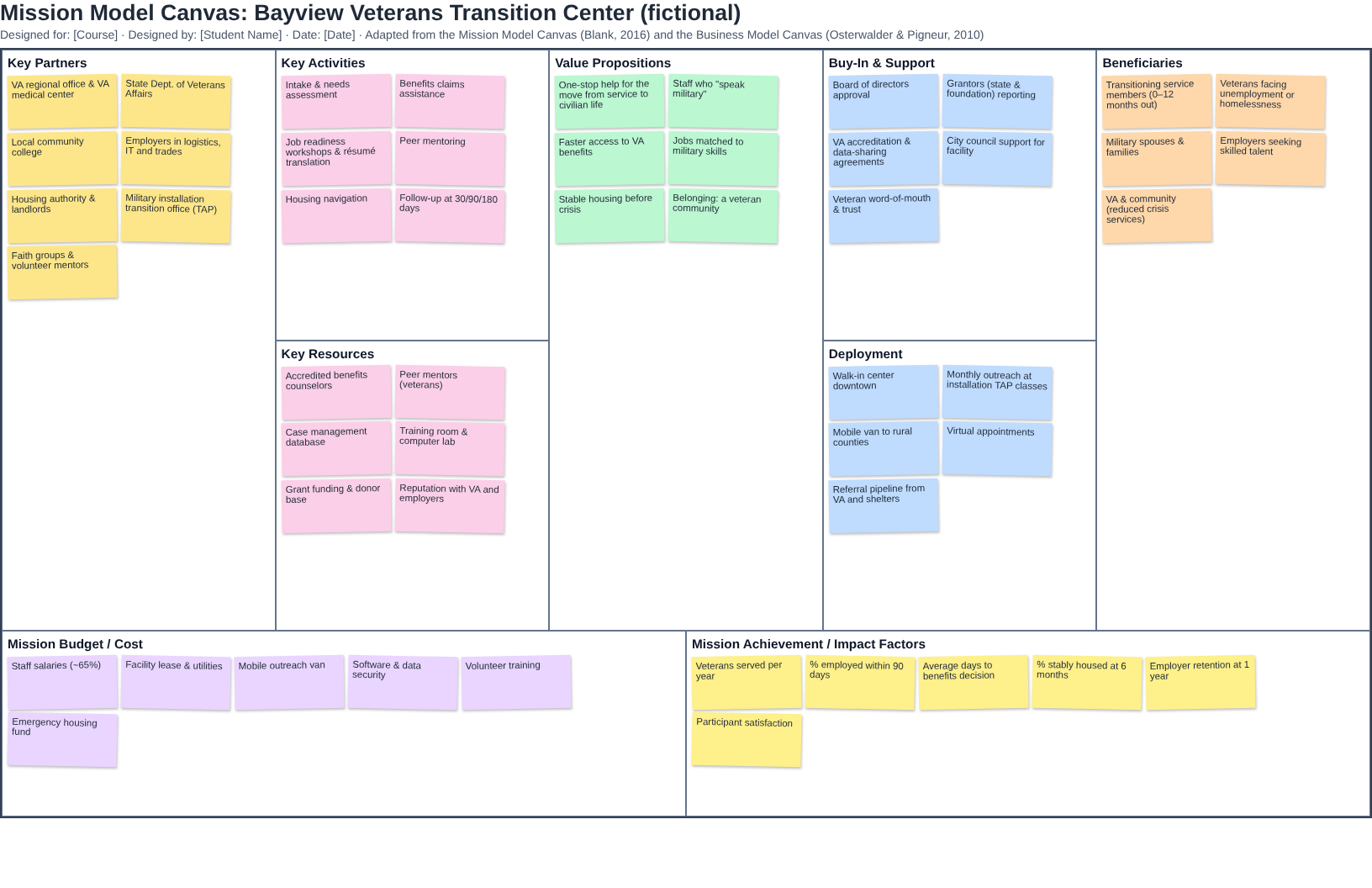
Figure 1. Mission Model Canvas for Bayview Veterans Transition Center.
3. Memo: What I Learned From Creating the Canvas
To: Executive Director, Bayview Veterans Transition Center
From: [Student Name], Program Coordinator, Employment Services
Date: [Date]
Subject: Lessons from mapping our organization on the Mission Model Canvas
Mapping Bayview on a single page showed me how our programs connect and where our model is strong or fragile. I want to share five lessons.
1. We serve more beneficiaries than we plan for. I had always thought of “the veteran” as our customer. The canvas made me list spouses, families, employers and even the VA, which benefits when we prevent crises. Employers in particular are both partners and beneficiaries, yet we have no formal value proposition for them. A simple employer services package, such as pre-screened candidates and training on military skills translation, could strengthen that relationship.
2. Buy-in is as important as delivery. In a business, customers decide whether a product succeeds. For us, success also depends on the board, grantors, the VA and city officials. Our grant reports are a form of “customer relationship” with funders, so better outcome data directly protects our funding.
3. Our impact measures need to match our value propositions. We promise faster access to benefits and stable housing, but we mainly report the number of people served. The canvas pushed me to propose tracking outcomes such as the percentage employed within 90 days, days to a benefits decision and housing stability at six months.
4. Deployment to rural areas is our biggest gap. Most services happen at our downtown center. The mobile van and virtual appointments are underused, which suggests that rural veterans, who often face the greatest isolation, are underserved.
5. Key resources are concentrated in people. About two-thirds of our budget is staff, and our reputation depends on a few accredited benefits counselors. Cross-training and documenting our processes would reduce the risk if key staff leave.
Recommendation. I recommend that the leadership team review this canvas at our next strategic planning retreat, adopt three outcome measures for the coming year and pilot an employer partnership package. Revisiting the canvas annually would help us see how changes in one block affect the rest of our mission.
References
Blank, S. (2016, February 23). The mission model canvas: An adapted business model canvas for mission-driven organizations. https://steveblank.com/2016/02/23/the-mission-model-canvas-an-adapted-business-model-canvas-for-mission-driven-organizations/
Osterwalder, A., & Pigneur, Y. (2010). Business model generation: A handbook for visionaries, game changers, and challengers. John Wiley & Sons.
Tip: real Post-it notes photographed on a printed canvas are fine, but a digital version (Canva, Miro, PowerPoint or the Strategyzer template) is easier to read. Keep each note to one short idea.
Frequently asked questions
How is the Mission Model Canvas different from the Business Model Canvas?
It replaces customer segments with beneficiaries, channels with deployment, customer relationships with buy-in and support, cost structure with mission budget/cost and revenue streams with mission achievement.
Who created the Mission Model Canvas?
Steve Blank, working with Alexander Osterwalder, in 2016, for government and mission-driven organizations.
More model assignments posted today
Get a plagiarism-free answer to this question
Send us your instructions and we’ll match you with the best writer in your subject.
- 100% human-written, zero AI
- Turnitin report included
- Confidential — we never share your data
- Free revisions & refunds