What the Bureaucracy Does for You: FEMA and USPS Assessment Example
Need help with this assignment?Get an original answer from a qualified tutor — from $10/page.
Get it written →What the Bureaucracy Does for You Assessment
The bureaucracy implements and carries out the laws created by Congress by administering regulations. Select two bureaucratic organizations (Cabinet departments or subordinate agencies, Executive Office of the President offices or independent agencies). Research each using its own website and respond in a complete paragraph to each prompt:
- What does this organization do? Include at least one image that represents its responsibilities and explain how the image represents them.
- How does this organization help fulfill the duties of the executive branch under the Constitution?
- Summarize a news event related to this office or agency from within the last year.
- How does this organization affect your life and community? Include two specific examples.
A creative format such as a slideshow is encouraged. Cite all sources in MLA style.
This model covers: the Federal Emergency Management Agency (FEMA), part of the Department of Homeland Security, and the United States Postal Service (USPS), an independent agency. News events are from November 2025 to October 2026. Verify the details on each agency’s website before you submit, and replace the “my community” examples with your own.
Model assessment
Original example for study purposes.
Organization 1: Federal Emergency Management Agency (FEMA)
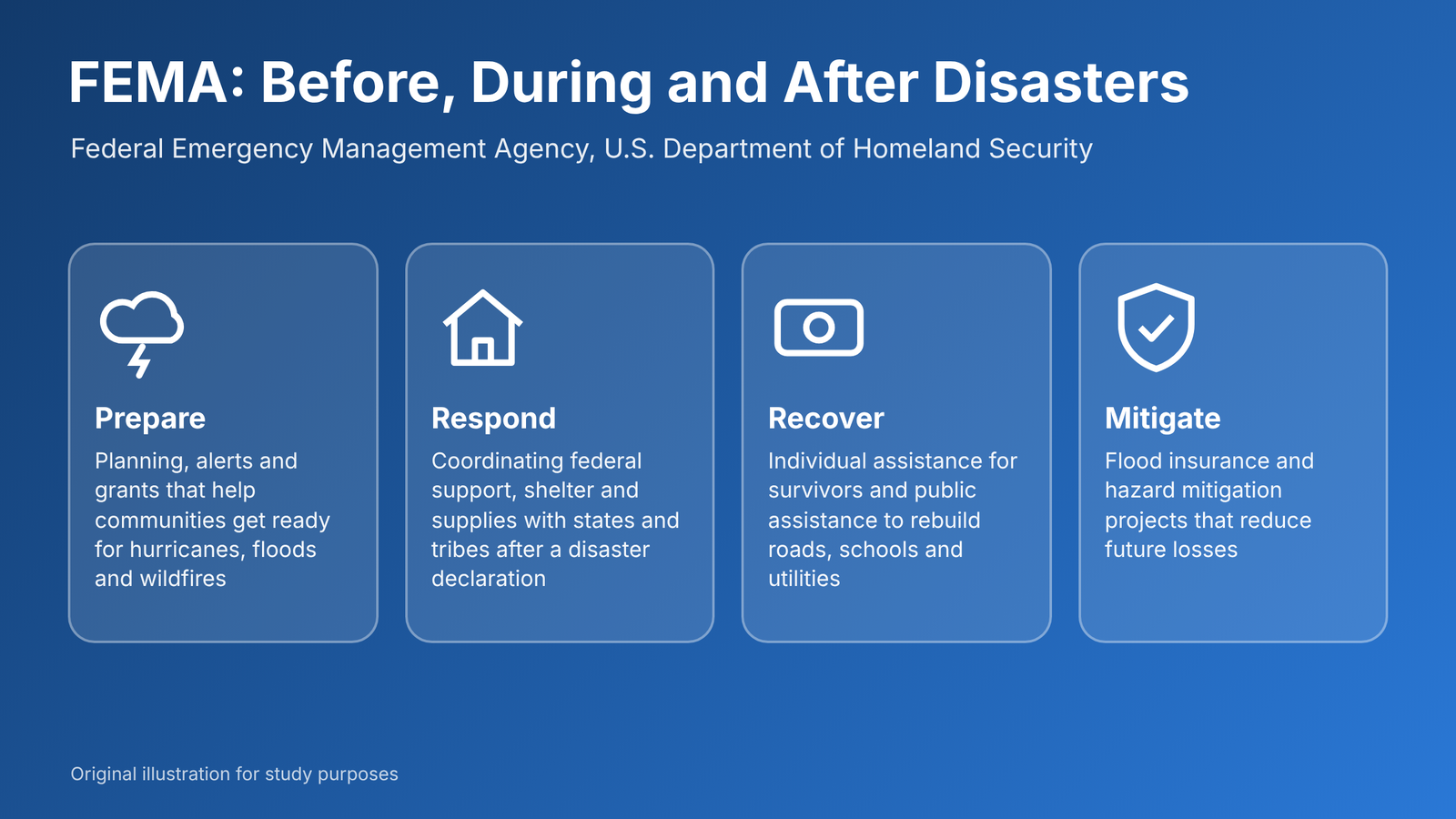
What it does. FEMA, part of the Department of Homeland Security, leads the federal government’s efforts to help people before, during and after disasters. It supports states, tribes and local governments in preparing for emergencies, coordinates federal response when the president declares a disaster, provides individual assistance to survivors for temporary housing and repairs, funds public assistance to rebuild roads, schools and utilities and manages the National Flood Insurance Program and hazard mitigation grants that reduce future losses. The image above represents these four responsibilities: the storm cloud stands for preparing for hazards, the house for responding with shelter and support, the money for recovery funding and the shield for mitigation that protects communities from future disasters.
Executive branch duties. Article II of the Constitution gives the president executive power and charges him to “take Care that the Laws be faithfully executed.” FEMA helps fulfill this duty by carrying out laws passed by Congress, especially the Robert T. Stafford Disaster Relief and Emergency Assistance Act, which authorizes the president to declare major disasters and direct federal aid. FEMA turns these presidential declarations and congressional appropriations into action on the ground.
Recent news. In May 2026, a 12-member FEMA Review Council appointed by President Trump approved a report recommending major changes to the agency. The council proposed raising the damage threshold for federal disaster declarations by more than 50%, giving states lump-sum payments and more control over recovery funds, simplifying aid for survivors and shrinking the National Flood Insurance Program by shifting some policies to private insurers. The report estimated that 29% of disasters declared from 2012 to 2025 would not have qualified under the higher threshold, meaning states would carry more recovery costs. Some changes require Congress, and FEMA has been led by temporary administrators since early 2025 (Sommer and Hersher).
Effects on my life and community. First, if a hurricane, flood or tornado damages homes in my area, FEMA individual assistance could help my family or neighbors pay for temporary housing and essential repairs, and public assistance could rebuild damaged roads and schools. Second, my community’s flood risk maps and flood insurance options come from FEMA’s flood programs, which affect whether homeowners must buy flood insurance and how much it costs. If the council’s proposals are adopted, my state and local government may have to pay more of the cost of future disasters.
Organization 2: United States Postal Service (USPS)
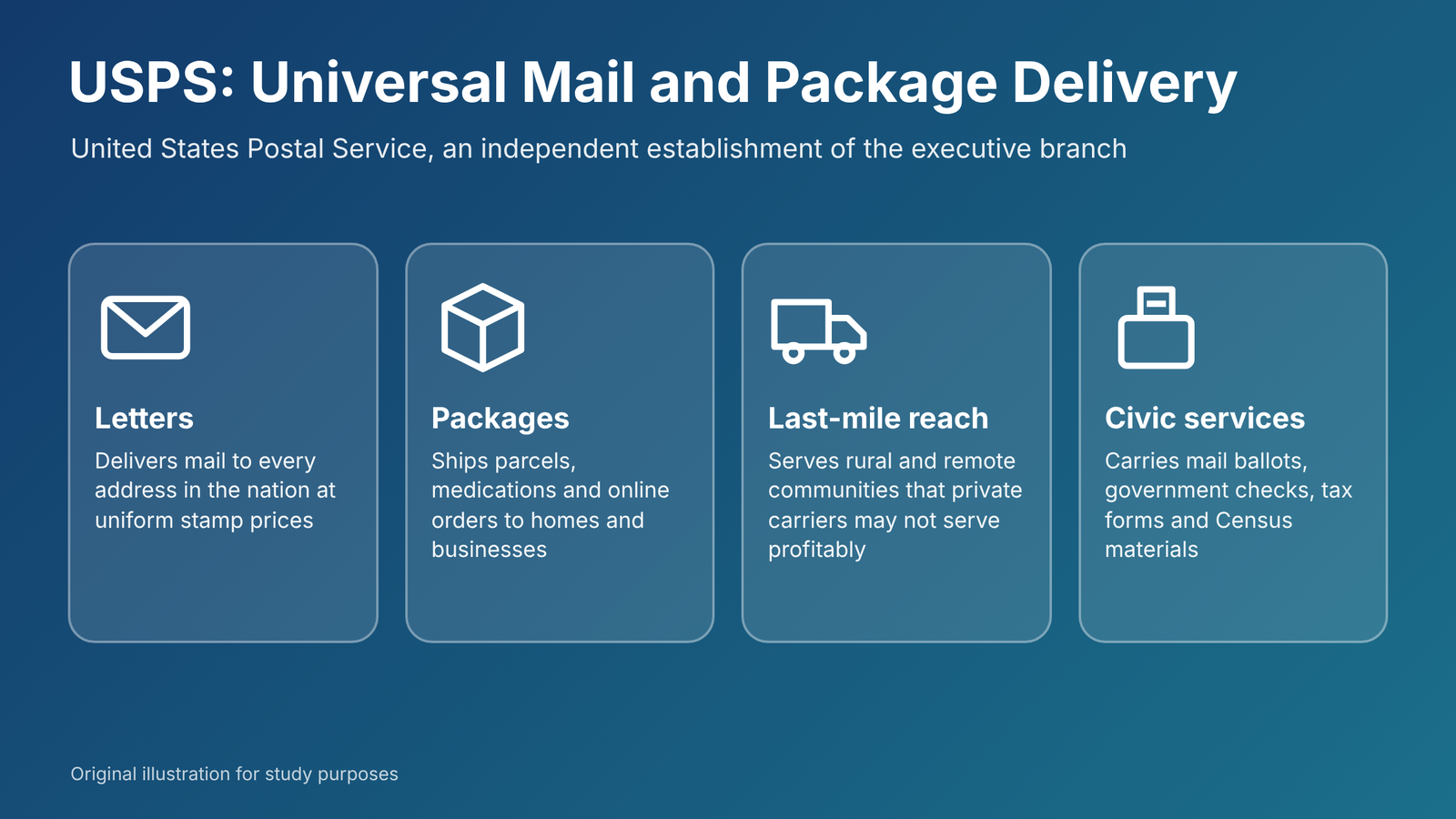
What it does. The USPS is an independent establishment of the executive branch that provides mail and package delivery to every address in the United States. It processes and delivers letters, packages and medications six days a week, serves rural and remote communities at uniform prices and operates post offices nationwide. It is expected to fund its operations mainly through postage and product sales rather than tax dollars. The image represents its responsibilities: the envelope for letter mail, the box for packages, the truck for “last-mile” delivery to every community and the ballot box for civic services such as delivering mail ballots, tax documents and government checks.
Executive branch duties. Article I of the Constitution gives Congress the power “To establish Post Offices and post Roads,” and Congress created the modern USPS through the Postal Reorganization Act of 1970. As part of the executive branch, the USPS carries out this law by running the postal system day to day. Its Board of Governors is appointed by the president with Senate confirmation, and its prices are reviewed by the independent Postal Regulatory Commission, showing how executive agencies implement laws under constitutional checks.
Recent news. In March 2026, Postmaster General David Steiner told Congress that the USPS lost $9 billion in 2025, warned that it could run out of cash in less than a year and said first-class stamps may need to rise to 90 to 95 cents (Alvarado). After the Postal Regulatory Commission approved a smaller increase in May, the price of a Forever stamp rose from 78 to 82 cents on July 12, 2026, and postcard and international letter prices also increased (Hall).
Effects on my life and community. First, I rely on the USPS to receive packages and prescriptions and to mail bills and documents, so higher postage directly affects my household budget. Second, my community depends on the USPS for civic services: many voters use mail ballots, and older residents in rural areas receive Social Security checks and medications by mail. If the USPS reduced service to cut costs, these neighbors would be affected most.
Works Cited
Alvarado, Amanda. “USPS Wants to Raise the Price of a Stamp to Almost $1.” WTAP, 19 Mar. 2026, www.wtap.com/2026/03/19/usps-wants-raise-price-stamp-almost-1/.
Federal Emergency Management Agency. About Us. U.S. Department of Homeland Security, www.fema.gov/about.
Hall, Liliana. “Buy Those Forever Stamps Now: USPS Prices Increase Next Week.” Money, 9 July 2026, money.com/stamp-price-increase-july-2026/.
Sommer, Lauren, and Rebecca Hersher. “A Trump Council Recommends Overhauling FEMA. Here Are 3 Key Changes.” NPR, 7 May 2026, www.wfae.org/united-states-world/2026-05-07/a-trump-council-recommends-overhauling-fema-here-are-3-key-changes.
United States Postal Service. About USPS. about.usps.com.
The Constitution of the United States. National Archives, www.archives.gov/founding-docs/constitution-transcript.
Tips: use each agency’s official website as your main source, as the assignment requires; check the exact title of each news article for your Works Cited; and if you build a slideshow, give each prompt its own slide with the image on the “What it does” slide.
Related reading: understanding the EEOC, the legislative branch assignment and global homeland security cooperation.
More model assignments posted today
Get a plagiarism-free answer to this question
Send us your instructions and we’ll match you with the best writer in your subject.
- 100% human-written, zero AI
- Turnitin report included
- Confidential — we never share your data
- Free revisions & refunds