Unemployment Insurance Policy Analysis Report: Market Failure, Impacts, Data Trends, Expert Views and AI Forecast
Need help with this assignment?Get an original answer from a qualified tutor — from $10/page.
Get it written →Assignment: Evidence-based policy analysis report on a government intervention program
You are an economic policy advisor for a think tank that evaluates how government programs affect businesses, consumers, and the overall economy. Produce an evidence-based policy analysis report on a single government intervention program, explaining the economic theory behind it, its real-world effects, and how AI tools can improve program evaluation, forecasting, or administration. Choose one program (countercyclical fiscal policy, support for lower-income families, health care programs or social insurance such as OASDI, Medicare or unemployment insurance).
Write an 875- to 1,050-word report with these sections:
- Introduction: the program, the market failure it addresses and why government acted instead of relying on markets.
- Program Impacts: who benefited, who was unintentionally disadvantaged and unintended consequences.
- Trends and Data Research: cost, participation or other metrics over time, with at least 2 labeled and cited charts from credible government data; what the data reveal about economic cycles.
- Expert Perspectives: at least 2 named economists, institutes or academic sources with different opinions, each with a direct quote and APA citation.
- AI Integration: an AI-based forecast using your dataset: the tool, inputs, output, evaluation and how it supports decision-making.
- Policy Recommendation, Personal Reflection, Conclusion and an Appendix with AI inputs and outputs. Cite all sources, including AI.
Layoffs rise, incomes fall
Replace part of lost wages automatically
Households keep buying, cushioning demand
Claims and costs fall as hiring returns
About the AI section: this model’s forecast was actually produced with an AI tool (Claude, by Anthropic) using the BLS data shown in Figures 1 and 2. Your course requires you to run your own AI analysis, so use your own tool, prompts and outputs, and follow your school’s AI citation guidance.
Model policy analysis report
Original example for study purposes (about 1,050 words, excluding figures, references and appendix).
Policy Analysis Report: The U.S. Unemployment Insurance Program
Introduction
Unemployment insurance (UI), created by the Social Security Act of 1935, is a federal–state social insurance program that temporarily replaces part of the wages of workers who lose their jobs through no fault of their own. States set eligibility, benefit amounts and duration, typically up to 26 weeks, and fund benefits through employer payroll taxes, while the federal government funds administration and extended benefits during downturns. UI addresses a market failure in private insurance. Private insurers rarely sell unemployment coverage because of adverse selection (workers most likely to be laid off are most eager to buy it), moral hazard (insured workers may search less intensively) and correlated risk (recessions cause millions of simultaneous claims that could bankrupt an insurer). Government intervention solves these problems through mandatory, pooled coverage and its ability to borrow during recessions. UI also acts as an automatic stabilizer: benefits rise when unemployment rises, supporting consumer spending without new legislation.
Program Impacts
Beneficiaries include laid-off workers and their families, who maintain basic consumption and can search for better-matched jobs; businesses, especially retailers in hard-hit communities, which keep customers; and the broader economy, which experiences shallower recessions. During the COVID-19 pandemic, federal expansions under the CARES Act and the American Rescue Plan Act extended UI to gig and self-employed workers and added weekly supplements, paying about $794 billion from March 2020 through July 2021 (CNBC, 2021).
Unintentionally disadvantaged groups include unemployed workers who receive nothing. Fewer than one-third of unemployed workers receive UI, and recipiency ranged from 55% in Minnesota to just 10% in Kentucky in 2023 (Council of Economic Advisers [CEA], 2024). Low-wage, part-time and gig workers, new entrants and workers in states with short benefit durations are often excluded. Unintended consequences include possible reductions in job-search effort, especially when benefits are generous; pandemic-era fraud that cost taxpayers billions; and long-term fiscal strain on state trust funds, many of which borrowed from the federal government in 2009 and 2020, leading to higher employer taxes afterward.
Trends and Data Research
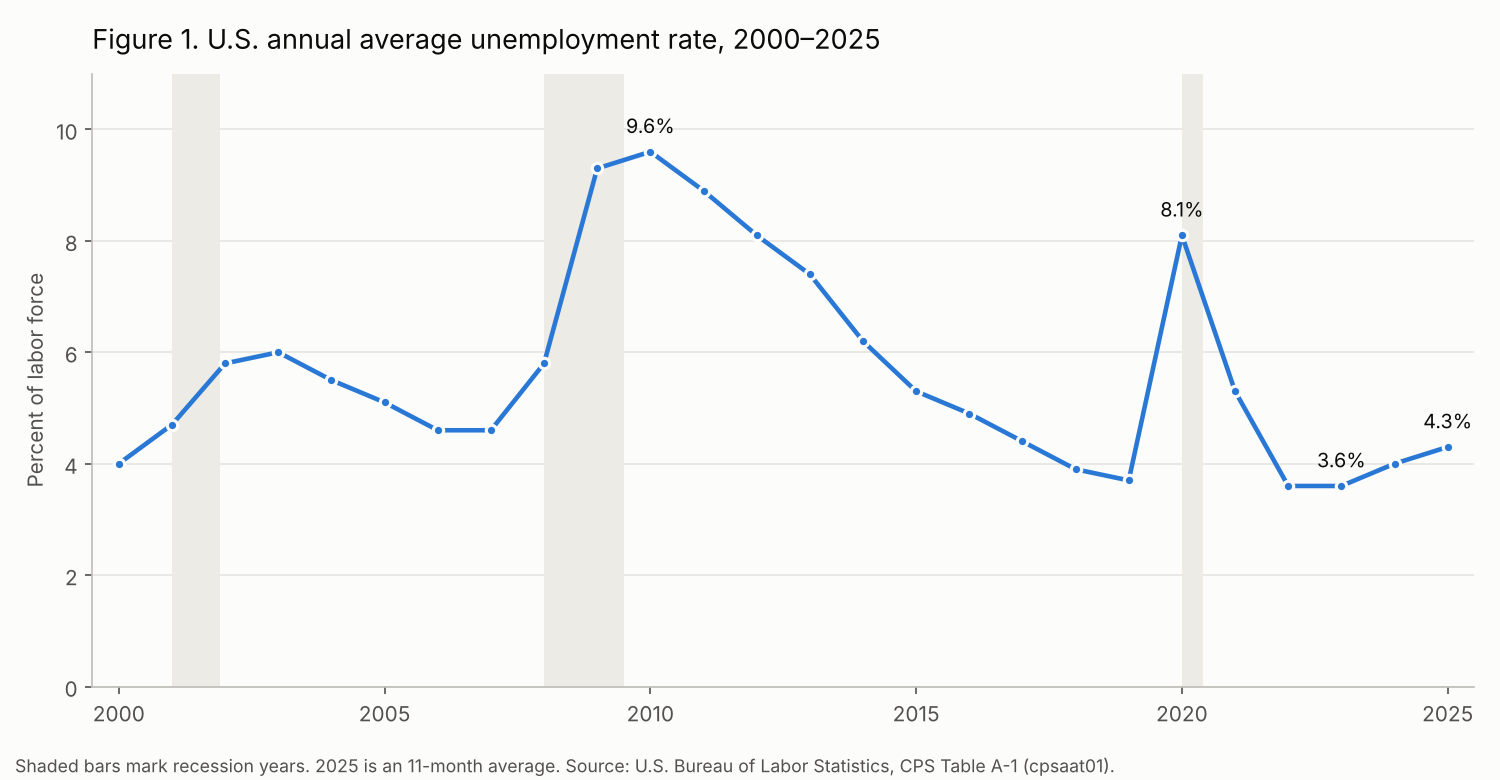
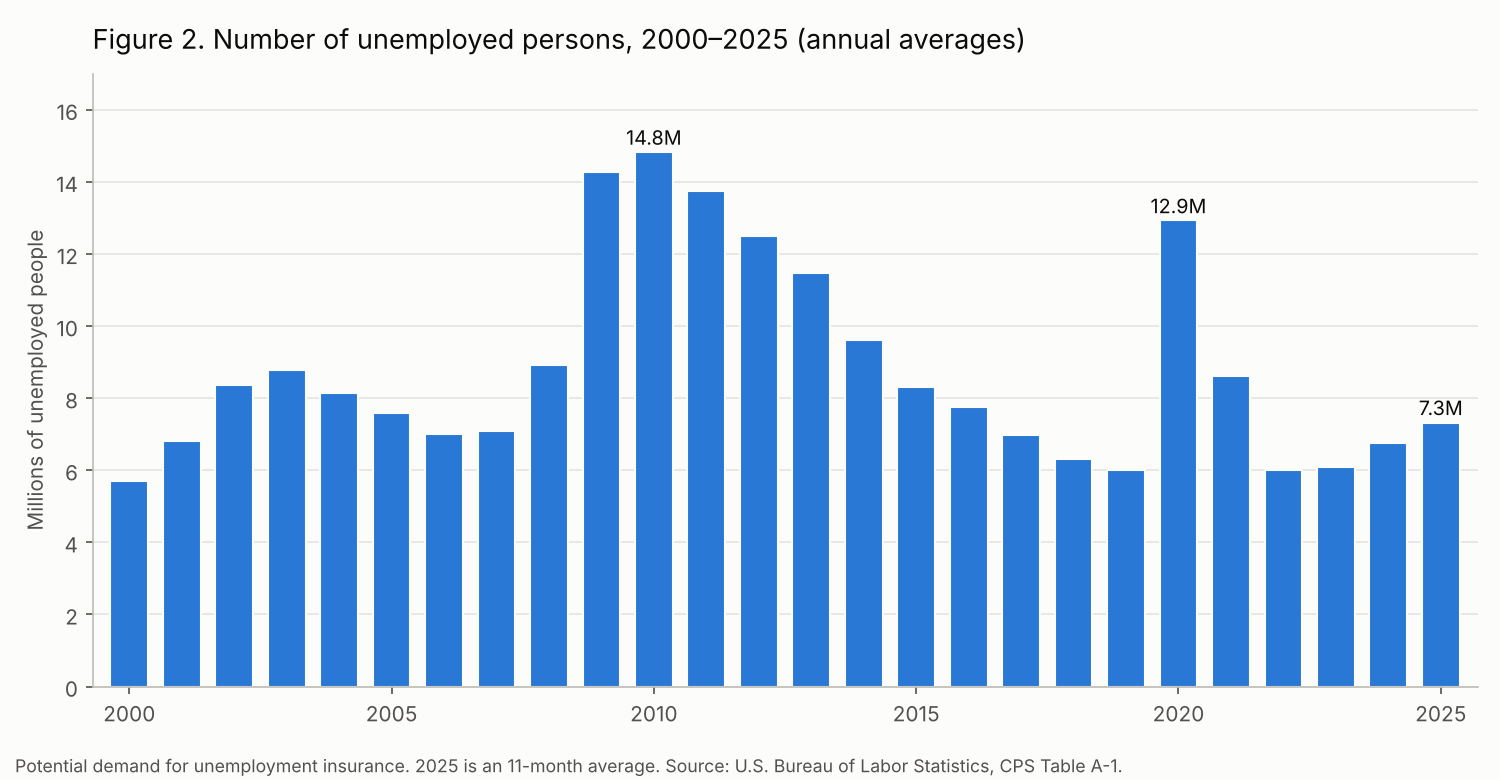
Figures 1 and 2 show that demand for UI is strongly countercyclical. The unemployment rate rose from 4.6% in 2007 to 9.6% in 2010 during the Great Recession, and the number of unemployed people more than doubled, from 7.1 million to 14.8 million. The pandemic produced a sharper but shorter spike, with an annual rate of 8.1% in 2020 before falling to 3.6% in 2022 (U.S. Bureau of Labor Statistics [BLS], 2026). UI spending follows these cycles: it expands rapidly during recessions and contracts during recoveries. The data also reveal that recoveries after the Great Recession were slow, which led Congress to extend benefits for up to 99 weeks in some states, while the pandemic recovery was much faster. In 2025, unemployment averaged 4.3%, with about 7.3 million unemployed people, slightly above the 2022–2023 lows.
Expert Perspectives
Experts disagree on how generous UI should be. The Congressional Budget Office warned that pandemic supplements could weaken work incentives, noting that “the additional $600 per week in benefits decreases the incentive to work more for people who expect to have lower earnings than it does for people who expect to have higher earnings” (Congressional Budget Office, 2020, as cited in Boehm, 2020). In contrast, economist Ioana Marinescu of the University of Pennsylvania found that job losses reflected fewer available jobs rather than reduced willingness to work, concluding that “our findings help explain the absence of an association between more generous unemployment insurance and employment” (Marinescu, 2020). A third view emphasizes access: the CEA (2024) argued that the system is too restrictive, observing that “less than a third of unemployed workers in the U.S. receive UI benefits.”
AI Integration
I used Claude, a large language model developed by Anthropic, to perform a basic forecasting analysis. The inputs were the BLS annual unemployment rates and numbers of unemployed persons for 2000–2025 (Figures 1 and 2), along with assumptions of 0.7% annual labor force growth and a 30% UI recipiency rate based on CEA (2024). Claude fit a simple mean-reverting time-series model (AR[1]) and produced two scenarios. The baseline projects unemployment near 4.3% through 2028, implying about 7.4 million unemployed and roughly 2.2 million UI recipients per year. A mild recession scenario, modeled as a 2.5-percentage-point rise, peaks at 6.8% in 2027, implying about 11.8 million unemployed and 3.5 million recipients, a 59% increase in claims (Figure 3, Appendix).
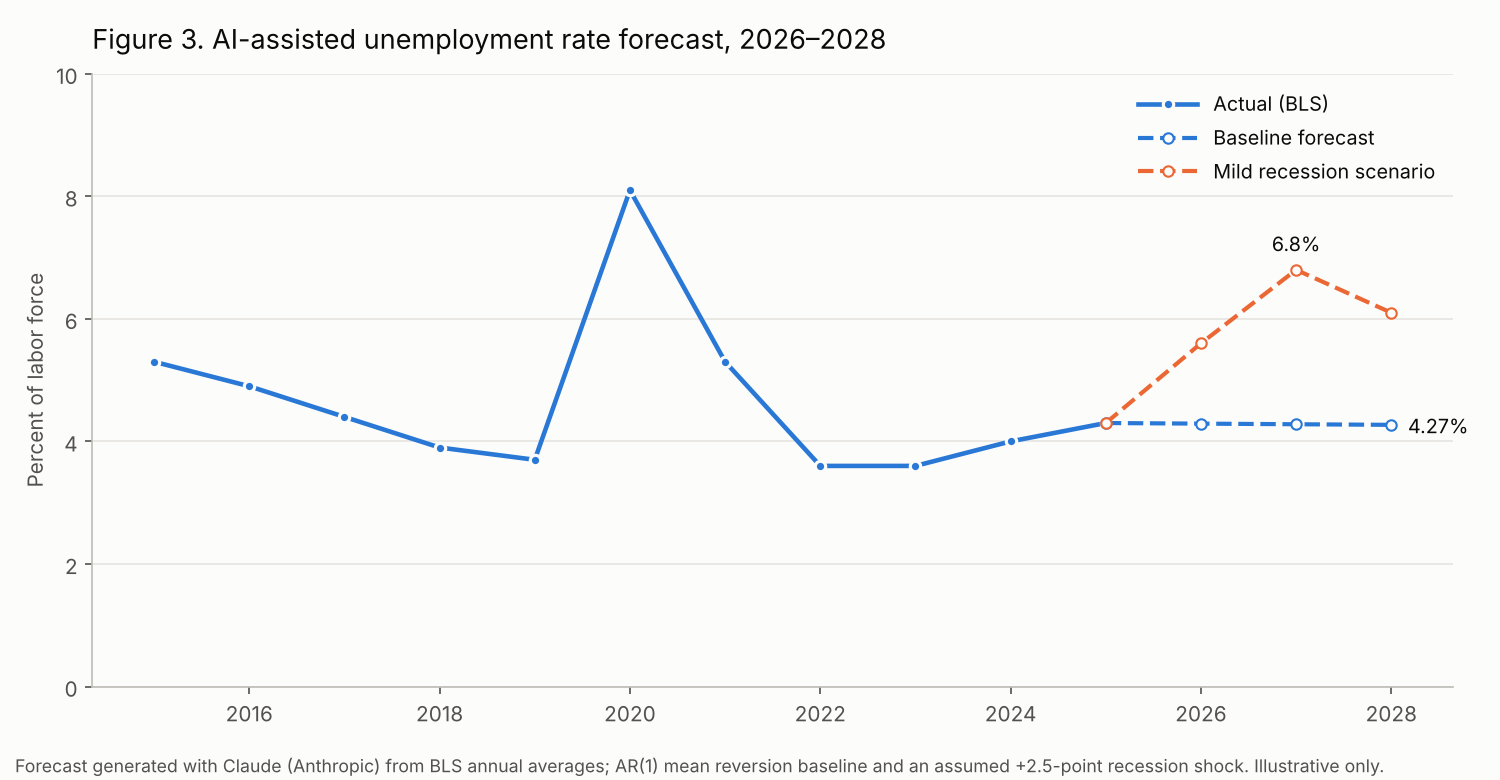
The output is useful for scenario planning: it shows how quickly claims and costs could rise and helps states assess trust fund solvency. However, its accuracy is limited. Annual data hide monthly turning points, the model cannot predict when recessions occur, recipiency varies by state and over time and the AI did not estimate benefit amounts or tax revenue. Agencies could improve such forecasts with weekly claims data and state-level models, and AI could also help detect fraud and speed claim processing.
Policy Recommendation
I recommend that UI continue but be modified. Economic theory supports public UI because private markets cannot insure correlated unemployment risk, and the data show its role as an automatic stabilizer. However, expert evidence and recipiency data show gaps. Congress should set minimum federal standards, such as at least 26 weeks of benefits and modernized eligibility for part-time and gig workers; automatically trigger extended benefits based on unemployment rates rather than requiring new legislation in each recession; and fund modern, secure IT systems with identity verification to reduce fraud. Linking benefits to job-search assistance would address work-incentive concerns.
Personal Reflection
UI affects me directly. If my employer downsized during a recession, UI would help me pay rent and bills while I searched for a job that matches my skills, rather than accepting the first available position. As a future manager, I would also pay the payroll taxes that fund the system, so its efficiency and fairness matter to me as both a worker and an employer.
Conclusion
UI corrects a clear market failure and stabilizes the economy during downturns, as the countercyclical patterns in BLS data show. Experts disagree about its work incentives and reach, and an AI-assisted forecast suggests that even a mild recession could increase claims by more than half. The program should continue with reforms that broaden access, automate extensions and strengthen administration.
References
Anthropic. (2026). Claude [Large language model]. https://claude.ai
Boehm, E. (2020, June 5). The COVID-19 recovery is starting. Extending “bonus” unemployment benefits will slow it. Reason. https://reason.com/2020/06/05/the-covid-19-recovery-is-starting-extending-bonus-unemployment-benefits-will-slow-it/
CNBC. (2021, September 2). The pandemic’s $794 billion in unemployment benefits were historic. Here’s why. https://www.cnbc.com/2021/09/02/pandemics-794-billion-unemployment-benefits-were-historic-heres-why.html
Council of Economic Advisers. (2024, December 19). Improving access to unemployment insurance. The White House. https://bidenwhitehouse.archives.gov/cea/written-materials/2024/12/19/improving-access-to-unemployment-insurance/
Marinescu, I. (2020, August 11). Have enhanced unemployment benefits discouraged work? EconoFact. https://econofact.org/have-enhanced-unemployment-benefits-discouraged-work
U.S. Bureau of Labor Statistics. (2026). Employment status of the civilian noninstitutional population, 1955 to date (Current Population Survey, Table A-1). https://www.bls.gov/cps/cpsaat01.htm
Appendix: AI Tool Inputs and Outputs
Tool: Claude (Anthropic), used with Python code it generated and ran to fit the model and draw Figure 3.
Prompt (summarized): “Using these BLS annual unemployment rates for 2000–2025 and the number unemployed in 2025 (7.314 million, labor force 170.807 million), forecast the unemployment rate for 2026–2028 with a simple mean-reverting model, add a mild recession scenario with a 2.5-point rise, convert both to numbers of unemployed people assuming 0.7% labor force growth and estimate UI recipients at a 30% recipiency rate.”
| Output | 2026 | 2027 | 2028 |
|---|---|---|---|
| Baseline unemployment rate | 4.29% | 4.28% | 4.27% |
| Baseline unemployed (millions) | 7.38 | 7.41 | 7.45 |
| Baseline UI recipients (millions) | 2.21 | 2.22 | 2.23 |
| Recession scenario unemployment rate | 5.6% | 6.8% | 6.1% |
| Recession unemployed (millions) | 9.63 | 11.78 | 10.64 |
| Recession UI recipients (millions) | 2.89 | 3.53 | 3.19 |
Model notes from the AI: long-run mean of 4.19% (2015–2019 and 2022–2025 averages); persistence coefficient 0.91 estimated from 2010–2019; recession path assumed, not estimated. The AI noted that results are illustrative and should not be used for budgeting without monthly claims data and state-level analysis.
Tips for your report
- Pull your own data from FRED (for example, UNRATE and ICSA), BLS or the Department of Labor, and label each chart with a figure number, title and source.
- Choose experts who disagree and quote them exactly, with page or paragraph numbers if available.
- Document your AI use fully: tool, prompts, inputs, outputs and your evaluation.
- Stay within 875–1,050 words for the body; the appendix and references do not count in most courses.
Related reading: SNAP and food insecurity policy analysis, how economic conditions influence wages and fiscal condition analysis with Excel.
More model assignments posted today
Get a plagiarism-free answer to this question
Send us your instructions and we’ll match you with the best writer in your subject.
- 100% human-written, zero AI
- Turnitin report included
- Confidential — we never share your data
- Free revisions & refunds