The Data-to-Wisdom Continuum in Nursing
Need help with this assignment?Get an original answer from a qualified tutor — from $10/page.
Get it written →The data-to-wisdom continuum, often called DIKW, explains how nurses turn raw data into information, knowledge and finally wise action. It is a foundation of NURS 6051: Transforming Nursing and Healthcare Through Technology and nursing informatics. This guide defines each level with a clinical example and shows how to use DIKW in assignments. Data to wisdom continuum nursing assignments ask you to trace one clinical example through all four levels.
Quick answer
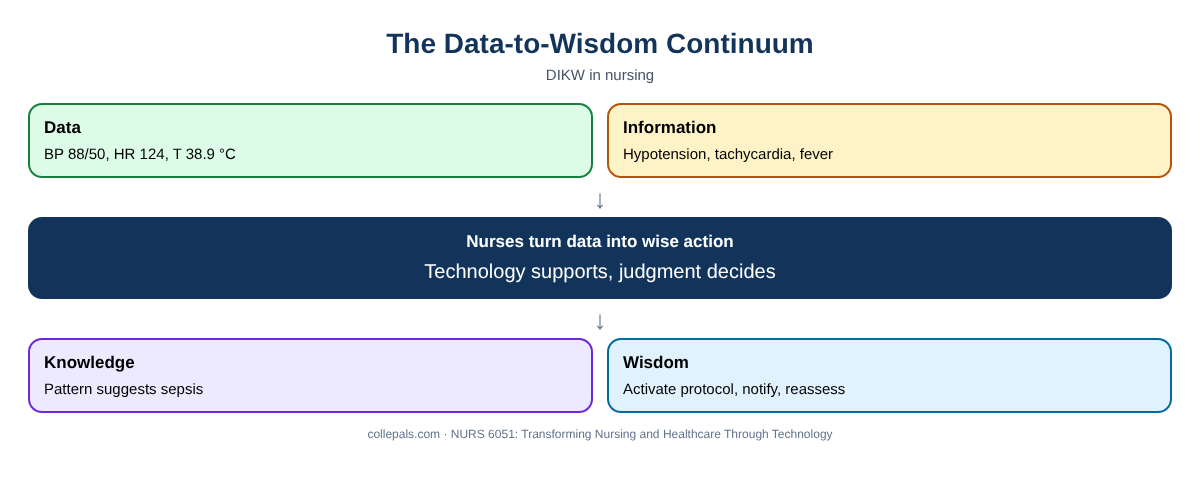
The data to wisdom continuum in nursing moves from data (raw facts such as vital signs) to information (organized data with meaning), knowledge (information combined with evidence and patterns) and wisdom (applying knowledge with judgment to act). In NURS 6051: Transforming Nursing and Healthcare Through Technology, students use DIKW to explain how nurses turn documentation into safer decisions.
Examples, cases, patients and organizations on this page are fictional unless cited and written by Collepals for study purposes. NURS 6051: Transforming Nursing and Healthcare Through Technology is a Walden University course; assignments vary by term, so follow your own syllabus and rubric. Technology rules and figures were current when written; check for later changes. This content is educational, not clinical or legal advice. Collepals is not affiliated with Walden University.
Sample document: a DIKW worksheet with a clinical example (Word).
The Four Levels
| Level | Definition | Clinical example |
|---|---|---|
| Data | Raw, uninterpreted facts | BP 88/50, HR 124, temperature 38.9 °C |
| Information | Data organized and given meaning | Hypotension, tachycardia and fever in a post-op patient |
| Knowledge | Information combined with evidence and patterns | This pattern suggests possible sepsis |
| Wisdom | Knowledge applied with judgment and ethics | Activate the sepsis protocol, notify the provider and reassess |
The continuum appears in nursing informatics texts such as McGonigle and Mastrian (2022) and Nelson and Staggers (2018).
Where Technology Helps
- Data: devices and EHR flowsheets capture data accurately.
- Information: dashboards and trends organize it.
- Knowledge: decision support links it to evidence.
- Wisdom: remains a human skill, supported but not replaced by technology.
Using DIKW in an Assignment
- Pick a clinical scenario, such as falls, sepsis or pressure injuries.
- Name the data collected and how.
- Show how it becomes information and knowledge.
- Explain the wise action and the nurse’s role.
Example: Using the DIKW continuum, Week 4 assignment. Related: Big Data in Healthcare: Risks, Rewards and Nursing Implications and NURS 6051 Infographic Assignment: Complete Guide.
Frequently Asked Questions
What does DIKW stand for?
Data, information, knowledge and wisdom.
Can computers reach wisdom?
Most authors argue that wisdom involves human judgment, values and context, which technology supports but does not replace.
Why does DIKW matter for nurses?
It shows how documentation becomes knowledge that improves care.
Get Help With DIKW Assignments
Informatics assignments demand current evidence, clear explanations of technology and strong APA writing. Collepals.com helps students in NURS 6051: Transforming Nursing and Healthcare Through Technology and other nursing informatics courses:
- Explain EHRs, telehealth, AI and other technologies in plain, accurate terms.
- Write discussion posts, peer responses and reflections.
- Build project proposals, annotated bibliographies, infographics and fact sheets.
- Find current evidence, cite in APA 7 and get drafts edited and proofread.
Browse our free model assignments or learn more about our nursing assignment writing service.
Use Collepals examples as study guides and follow your school’s academic integrity and AI policies.
More NURS 6051: Transforming Nursing and Healthcare Through Technology guides
- NURS 6051: Transforming Nursing and Healthcare Through Technology – Complete Course Guide
- Big Data in Healthcare: Risks, Rewards and Nursing Implications
- NURS 6051 Infographic Assignment: Complete Guide
- Nursing Informatics: Complete Guide for Graduate Nursing Students
- Clinical Decision Support Systems: Nursing Assignment Guide
Collepals is an independent study resource. Follow your program’s instructions and rubric and write your own work.
References
McGonigle, D., & Mastrian, K. G. (2022). Nursing informatics and the foundation of knowledge (5th ed.). Jones & Bartlett Learning.
Nelson, R., & Staggers, N. (2018). Health informatics: An interprofessional approach (2nd ed.). Elsevier.
Get a plagiarism-free answer to this question
Send us your instructions and we’ll match you with the best writer in your subject.
- 100% human-written, zero AI
- Turnitin report included
- Confidential — we never share your data
- Free revisions & refunds