Clinical Decision Support Systems: Nursing Assignment Guide
Need help with this assignment?Get an original answer from a qualified tutor — from $10/page.
Get it written →Clinical decision support systems (CDSS) give clinicians knowledge and patient-specific information at the right time to improve decisions. CDSS assignments are common in NURS 6051: Transforming Nursing and Healthcare Through Technology. This guide covers CDSS types, the “five rights,” benefits, risks and recent transparency rules.
Quick answer
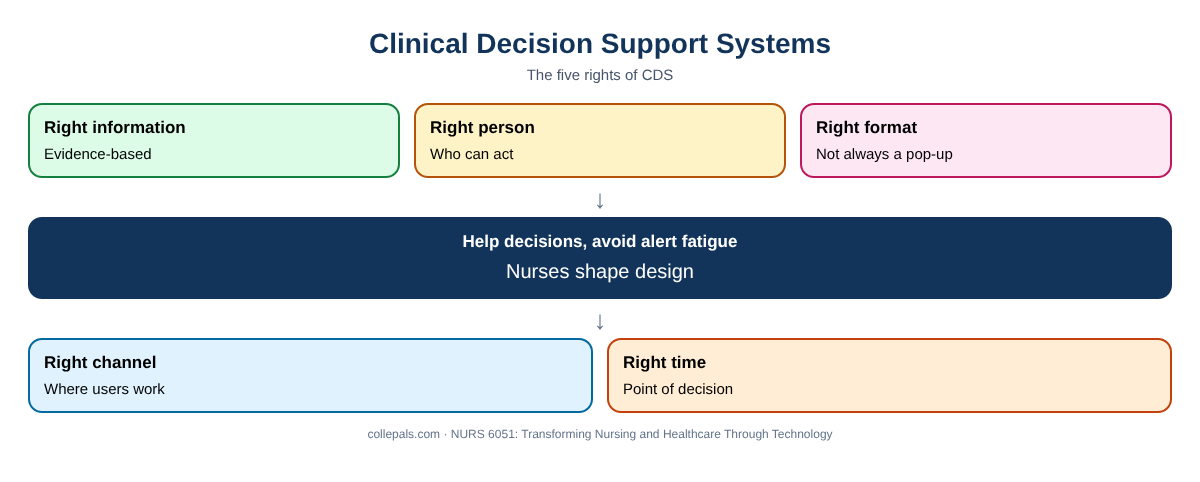
Clinical decision support systems deliver knowledge and patient-specific information to improve decisions. They include alerts, reminders, order sets, documentation templates and predictive models. Effective CDS follows the five rights: right information, person, format, channel and time. Risks include alert fatigue and biased algorithms. In NURS 6051: Transforming Nursing and Healthcare Through Technology, students evaluate a CDSS and the nursing role in its design.
Examples, cases, patients and organizations on this page are fictional unless cited and written by Collepals for study purposes. NURS 6051: Transforming Nursing and Healthcare Through Technology is a Walden University course; assignments vary by term, so follow your own syllabus and rubric. Technology rules and figures were current when written; check for later changes. This content is educational, not clinical or legal advice. Collepals is not affiliated with Walden University.
Sample document: a CDSS evaluation worksheet using the five rights (Word).
Types of CDS
- Alerts and reminders, such as drug interaction or sepsis alerts
- Order sets and protocols
- Documentation templates
- Dashboards and early-warning scores
- Predictive and AI-based models
The Five Rights of CDS
| Right | Meaning | Example |
|---|---|---|
| Right information | Evidence-based, relevant content | Current guideline |
| Right person | Delivered to the person who can act | Nurse vs. provider vs. pharmacist |
| Right format | Alert, order set, reminder, dashboard | Not always a pop-up |
| Right channel | EHR, mobile, patient portal | Where the user works |
| Right time | At the point of decision in the workflow | When ordering, not after |
Framework from Osheroff et al. (2012).
Benefits and Risks
| Benefits | Risks |
|---|---|
| Fewer medication errors | Alert fatigue and overrides |
| Guideline adherence | Workflow interruptions |
| Earlier detection of deterioration | Algorithm bias or poor accuracy |
Transparency Rules
ONC’s HTI-1 final rule (2024) replaced the older CDS certification criterion with “decision support interventions.” It requires certified health IT to make information, called source attributes, available about evidence-based and predictive tools (Office of the National Coordinator for Health Information Technology, 2024). Later rulemaking has proposed changes to certification requirements, so check current status.
Example: role of CDSS in evidence-based practice. Related: Artificial Intelligence in Nursing: Benefits, Risks and Ethical Issues and Healthcare Technology and Patient Safety.
Frequently Asked Questions
What is an example of a CDSS in nursing?
A sepsis screening alert or a fall-risk tool that prompts interventions.
What is alert fatigue?
Desensitization to frequent alerts, which leads clinicians to ignore or override them, including important ones.
How can nurses improve CDS?
By giving design feedback, reporting problems and joining optimization teams.
Get Help With Clinical Decision Support Assignments
Informatics assignments demand current evidence, clear explanations of technology and strong APA writing. Collepals.com helps students in NURS 6051: Transforming Nursing and Healthcare Through Technology and other nursing informatics courses:
- Explain EHRs, telehealth, AI and other technologies in plain, accurate terms.
- Write discussion posts, peer responses and reflections.
- Build project proposals, annotated bibliographies, infographics and fact sheets.
- Find current evidence, cite in APA 7 and get drafts edited and proofread.
Browse our free model assignments or learn more about our nursing assignment writing service.
Use Collepals examples as study guides and follow your school’s academic integrity and AI policies.
More NURS 6051: Transforming Nursing and Healthcare Through Technology guides
- NURS 6051: Transforming Nursing and Healthcare Through Technology – Complete Course Guide
- Artificial Intelligence in Nursing: Benefits, Risks and Ethical Issues
- Healthcare Technology and Patient Safety
- How to Write a NURS 6051 Technology Project Proposal
- Electronic Health Records: A Nursing Assignment Guide
Collepals is an independent study resource. Follow your program’s instructions and rubric and write your own work.
References
McGonigle, D., & Mastrian, K. G. (2022). Nursing informatics and the foundation of knowledge (5th ed.). Jones & Bartlett Learning.
Office of the National Coordinator for Health Information Technology. (2024). Health data, technology, and interoperability: Certification program updates, algorithm transparency, and information sharing (HTI-1). Federal Register, 89(6), 1192. https://www.federalregister.gov/documents/2024/01/09/2023-28857/
Osheroff, J. A., Teich, J. M., Levick, D., Saldana, L., Velasco, F. T., Sittig, D. F., Rogers, K. M., & Jenders, R. A. (2012). Improving outcomes with clinical decision support: An implementer’s guide (2nd ed.). HIMSS.
Get a plagiarism-free answer to this question
Send us your instructions and we’ll match you with the best writer in your subject.
- 100% human-written, zero AI
- Turnitin report included
- Confidential — we never share your data
- Free revisions & refunds