How to Write a Nursing Philosophy Reflection Essay
Need help with this assignment?Get an original answer from a qualified tutor — from $10/page.
Get it written →A nursing philosophy reflection essay asks you to examine how your beliefs about nursing formed or changed through experience. This guide shows how to use a reflective model such as Gibbs’ cycle, how to link reflection to your philosophy and a sample reflection.
Quick answer
To write a nursing philosophy reflection essay, choose a meaningful experience, describe it, explore your feelings, evaluate and analyze it using a reflective model such as Gibbs’ cycle, link what you learned to your values and a nursing theory and explain how the experience shaped or changed your philosophy of nursing and future practice.
Examples on this page are written by Collepals for study purposes. A philosophy of nursing must reflect your own beliefs and experiences, so use them to understand structure and tone, then write your own.
Sample document: a nursing philosophy reflection essay sample using Gibbs’ cycle (Word).
Using Gibbs’ Reflective Cycle
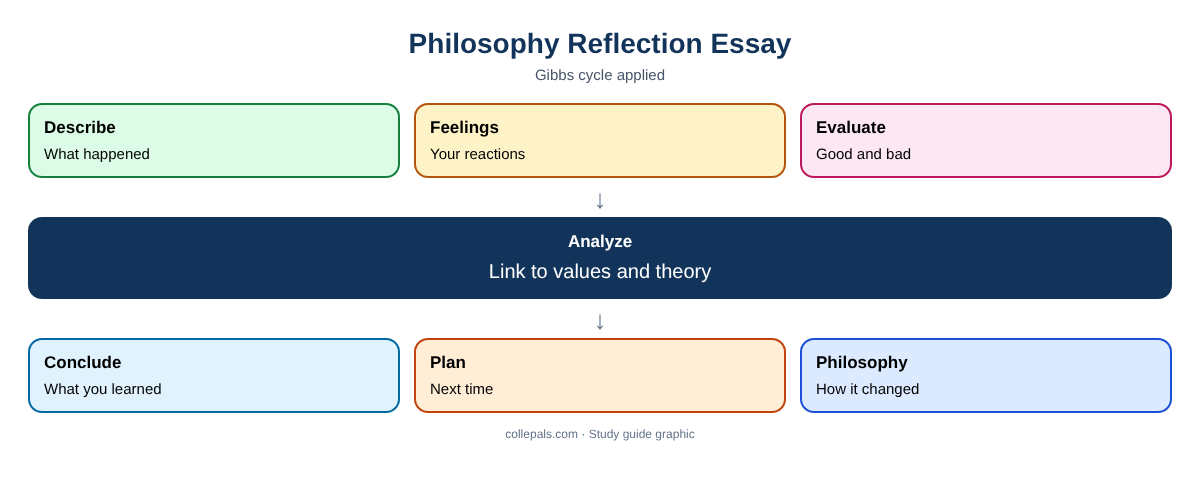
Gibbs (1988) proposed six stages of reflection. Applied to a philosophy reflection:
| Stage | Question | Example |
|---|---|---|
| Description | What happened? | During my first clinical, a patient cried after receiving a cancer diagnosis while I was taking vital signs. |
| Feelings | What were you thinking and feeling? | I felt helpless and worried I would say the wrong thing. |
| Evaluation | What was good and bad? | I stayed and listened, but I almost left to finish my tasks. |
| Analysis | What sense can you make of it? | Watson’s idea of authentic presence explains why staying mattered more than words. |
| Conclusion | What else could you have done? | I could have asked whether she wanted me to call a family member or chaplain. |
| Action plan | What will you do next time? | Pause tasks, sit down, ask open questions and offer support resources. |
Linking Reflection to Your Philosophy
Reflection becomes philosophy when you state what the experience taught you about nursing. Schön (1983) distinguished reflection-in-action (during an event) from reflection-on-action (afterward); philosophy essays mostly use reflection-on-action.
Example conclusion
This experience reshaped my philosophy. I once saw nursing as completing tasks safely; now I believe presence is itself a nursing intervention. I will protect time to be with patients in moments of distress.
Tips
- Choose a specific moment, not a whole rotation.
- Be honest about mistakes; growth is the point.
- Keep patient details de-identified.
- Balance description (about one third) with analysis (about two thirds).
Related: How to Write a Nursing Philosophy Essay Step by Step and How to Write a Meaningful Nursing Philosophy Essay Conclusion.
Frequently Asked Questions
Which reflective model should I use?
Gibbs is common; others include Kolb, Johns and Driscoll’s What? So what? Now what? Use what your course requires.
Should a reflection essay include sources?
Usually yes, especially in the analysis stage.
Can I write about a mistake?
Yes, if handled professionally; reflection on mistakes shows accountability.
Get Help With Your Nursing Philosophy Reflection Essay
A strong philosophy of nursing paper takes reflection, theory and careful writing. Collepals.com helps BSN, MSN and nurse practitioner students:
- Turn your values and clinical experiences into a clear thesis.
- Connect your beliefs to nursing theory, the metaparadigm and the ANA Code of Ethics.
- Outline, structure and cite your paper in APA 7.
- Study model papers and get your draft edited and proofread.
Browse our free model assignments or learn more about our nursing assignment writing service.
Use Collepals examples as study guides and follow your school’s academic integrity and AI policies.
More nursing philosophy guides
Collepals is an independent study resource. Follow your program’s instructions and rubric and write your own work.
References
Gibbs, G. (1988). Learning by doing: A guide to teaching and learning methods. Further Education Unit, Oxford Polytechnic.
Schön, D. A. (1983). The reflective practitioner: How professionals think in action. Basic Books.
Watson, J. (2008). Nursing: The philosophy and science of caring (Rev. ed.). University Press of Colorado.
Get a plagiarism-free answer to this question
Send us your instructions and we’ll match you with the best writer in your subject.
- 100% human-written, zero AI
- Turnitin report included
- Confidential — we never share your data
- Free revisions & refunds