How Compassion and Empathy Shape Your Nursing Philosophy
Need help with this assignment?Get an original answer from a qualified tutor — from $10/page.
Get it written →Compassion in nursing is more than kindness; it is noticing suffering and acting to relieve it. For many students, compassion and empathy are the heart of their nursing philosophy. This guide defines both, shows how to write about them convincingly and addresses compassion fatigue.
Quick answer
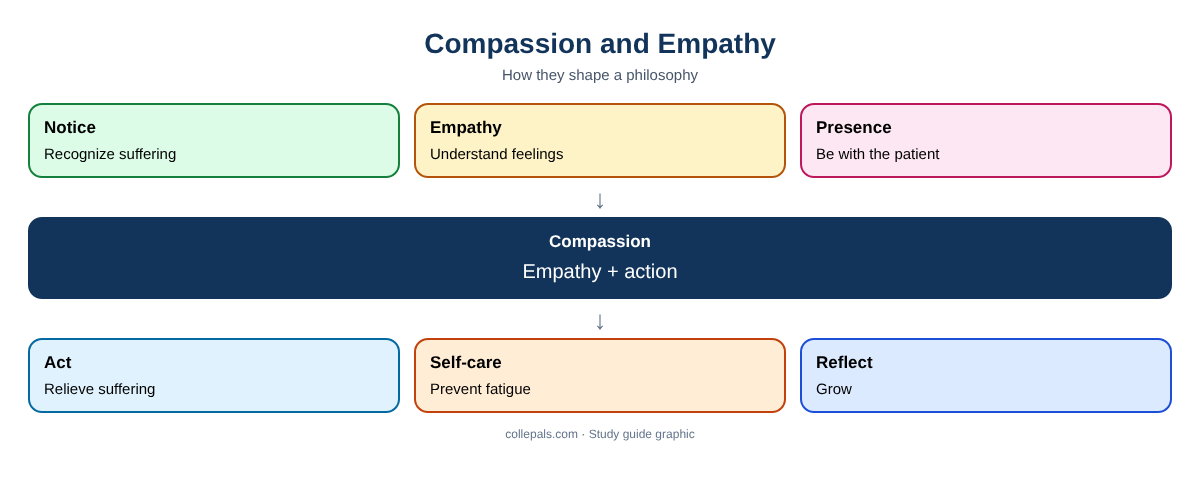
Compassion in nursing combines recognizing a patient’s suffering, understanding it through empathy and taking action to relieve it. In a personal philosophy, show compassion and empathy through specific clinical moments, link them to a caring theory and the ANA Code of Ethics and include self-care as protection against compassion fatigue.
Examples on this page are written by Collepals for study purposes. A philosophy of nursing must reflect your own beliefs and experiences, so use them to understand structure and tone, then write your own.
Sample document: a compassion and empathy reflection worksheet (Word).
Compassion vs. Empathy vs. Sympathy
| Term | Meaning | Example |
|---|---|---|
| Sympathy | Feeling sorry for someone | “I’m so sorry this happened.” |
| Empathy | Understanding another’s feelings from their perspective | Recognizing a patient’s fear of losing independence |
| Compassion | Empathy plus action to relieve suffering | Arranging a family visit for a frightened patient |
A scoping review found that patients describe compassion as a virtuous response that seeks to address suffering and needs through relational understanding and action (Sinclair et al., 2016).
Writing About Compassion in Nursing
- Describe a specific moment, not a general claim.
- Show what you noticed, what you felt and what you did.
- Connect to Watson’s caring theory or Peplau’s interpersonal theory.
- Link to the Code of Ethics’ emphasis on respect for persons (American Nurses Association, 2025).
- Include AACN’s concept of compassionate care if writing for a curriculum-based rubric (American Association of Colleges of Nursing, 2021).
Example paragraph
Compassion shapes my philosophy because I have learned that suffering is not always physical. A patient recovering from a hip fracture kept refusing physical therapy. When I sat down and asked what worried her, she admitted she was terrified of falling again. Together with the therapist, we started with sitting exercises and she walked to the door two days later. Compassion meant hearing the fear behind the refusal.
Compassion Fatigue and Self-Care
Repeated exposure to suffering can lead to compassion fatigue. The 2025 ANA Code states that self-care and patient care are inseparable, so a mature philosophy includes how you will sustain compassion through rest, peer support and boundaries.
See also Personal Philosophy of Nursing Based on Jean Watson’s Theory and Patient-Centered Care and Your Personal Nursing Philosophy.
Frequently Asked Questions
Can compassion be learned?
Yes. Reflection, role modeling and communication training help nurses build compassionate practice.
How do I show empathy in writing?
Describe the patient’s perspective in their terms and explain how it changed your actions.
Why include self-care?
Sustainable compassion depends on nurses’ own well-being.
Get Help Writing About Compassion in Your Nursing Philosophy
A strong philosophy of nursing paper takes reflection, theory and careful writing. Collepals.com helps BSN, MSN and nurse practitioner students:
- Turn your values and clinical experiences into a clear thesis.
- Connect your beliefs to nursing theory, the metaparadigm and the ANA Code of Ethics.
- Outline, structure and cite your paper in APA 7.
- Study model papers and get your draft edited and proofread.
Browse our free model assignments or learn more about our nursing assignment writing service.
Use Collepals examples as study guides and follow your school’s academic integrity and AI policies.
More nursing philosophy guides
Collepals is an independent study resource. Follow your program’s instructions and rubric and write your own work.
References
American Association of Colleges of Nursing. (2021). The essentials: Core competencies for professional nursing education. https://www.aacnnursing.org/essentials
American Nurses Association. (2025). Code of ethics for nurses. https://codeofethics.ana.org
Sinclair, S., Norris, J. M., McConnell, S. J., Chochinov, H. M., Hack, T. F., Hagen, N. A., McClement, S., & Bouchal, S. R. (2016). Compassion: A scoping review of the healthcare literature. BMC Palliative Care, 15, Article 6. https://doi.org/10.1186/s12904-016-0080-0
Watson, J. (2008). Nursing: The philosophy and science of caring (Rev. ed.). University Press of Colorado.
Get a plagiarism-free answer to this question
Send us your instructions and we’ll match you with the best writer in your subject.
- 100% human-written, zero AI
- Turnitin report included
- Confidential — we never share your data
- Free revisions & refunds