How to Develop Your Personal Nursing Values and Beliefs
Need help with this assignment?Get an original answer from a qualified tutor — from $10/page.
Get it written →Your personal nursing values guide decisions long after graduation. Developing them takes deliberate reflection, not just choosing words from a list. This guide walks through a five-step process, reflection questions and a downloadable values self-assessment.
Quick answer
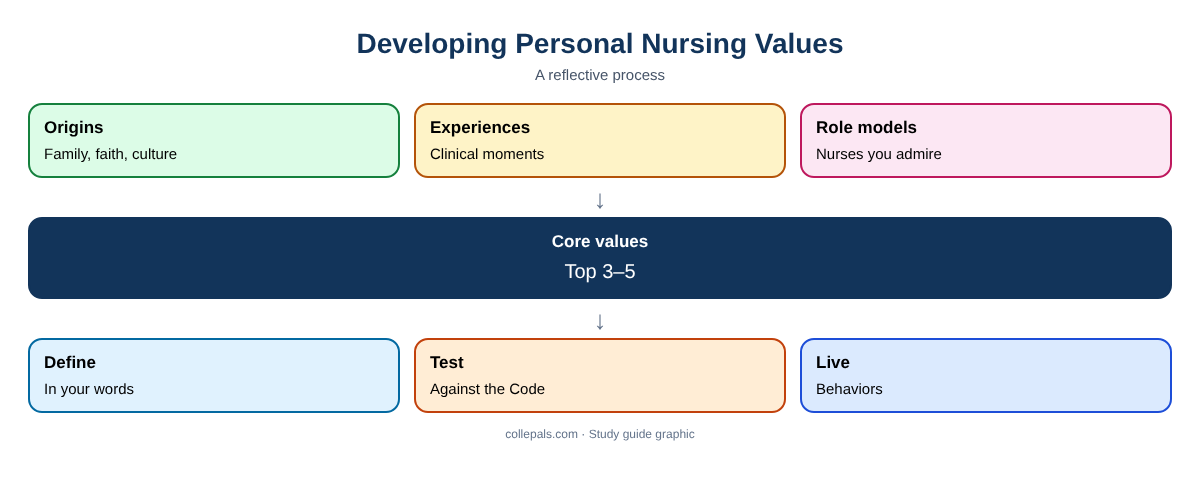
To develop your personal nursing values, reflect on where your values come from, review meaningful clinical and life experiences, identify role models, narrow your list to three to five core values, define each in your own words, test them against the ANA Code of Ethics and translate each into observable behaviors you can practice and evaluate.
Examples on this page are written by Collepals for study purposes. A philosophy of nursing must reflect your own beliefs and experiences, so use them to understand structure and tone, then write your own.
Sample document: a personal nursing values self-assessment worksheet (Word).
5 Steps to Develop Personal Nursing Values
- Explore origins. Family, culture, faith and life events shape what you value.
- Mine your experiences. Carper (1978) described personal knowing as one of nursing’s patterns of knowing; reflecting on encounters builds it.
- Narrow your list. Pick three to five values you can explain with examples.
- Define and test. Write your own definition and compare it with the ANA Code of Ethics (American Nurses Association, 2025).
- Translate into behaviors. For each value, list two actions you will take on every shift.
Reflection Questions
| Area | Question |
|---|---|
| Origins | Which values did my family, culture or faith teach me? |
| Experiences | Which patient or caregiving moment moved me most, and why? |
| Role models | Which nurse do I admire? What did they do? |
| Frustrations | What practices have bothered me? What value was violated? |
| Strengths | What do patients or peers thank me for? |
| Future | What do I want patients to say about me? |
From Value to Behavior
| Value | My definition | Behaviors |
|---|---|---|
| Respect | Every person has worth regardless of choices | Ask preferred names; knock before entering |
| Advocacy | Protecting patients’ voice | Escalate concerns with SBAR; request interpreters |
| Growth | Learning from every shift | Weekly reflection; read one guideline monthly |
When Values Conflict
Values sometimes clash, such as respecting autonomy while wanting to prevent harm. Naming the conflict, consulting the Code of Ethics and talking with colleagues or ethics resources helps. See How to Incorporate Ethics Into Your Nursing Philosophy.
Next, use your values in How to Write a Personal Philosophy of Nursing: Complete Guide. For value ideas, see Examples of Nursing Beliefs, Values and Professional Philosophy.
Frequently Asked Questions
Can my nursing values differ from my personal values?
They usually overlap, but professional values must align with nursing’s ethical obligations even when personal beliefs differ.
How often should I revisit my values?
At major transitions such as graduation, a new role or graduate school.
What if my values conflict with my workplace?
Use professional channels, the Code of Ethics and ethics consultation to address moral distress.
Get Help Developing Your Nursing Values and Philosophy
A strong philosophy of nursing paper takes reflection, theory and careful writing. Collepals.com helps BSN, MSN and nurse practitioner students:
- Turn your values and clinical experiences into a clear thesis.
- Connect your beliefs to nursing theory, the metaparadigm and the ANA Code of Ethics.
- Outline, structure and cite your paper in APA 7.
- Study model papers and get your draft edited and proofread.
Browse our free model assignments or learn more about our nursing assignment writing service.
Use Collepals examples as study guides and follow your school’s academic integrity and AI policies.
More nursing philosophy guides
Collepals is an independent study resource. Follow your program’s instructions and rubric and write your own work.
References
American Nurses Association. (2025). Code of ethics for nurses. https://codeofethics.ana.org
Carper, B. A. (1978). Fundamental patterns of knowing in nursing. Advances in Nursing Science, 1(1), 13–23. https://doi.org/10.1097/00012272-197810000-00004
Get a plagiarism-free answer to this question
Send us your instructions and we’ll match you with the best writer in your subject.
- 100% human-written, zero AI
- Turnitin report included
- Confidential — we never share your data
- Free revisions & refunds