Hand-Drawn Family Genogram Assignment: Three-Generation Example, Symbols and Three Observations
Need help with this assignment?Get an original answer from a qualified tutor — from $10/page.
Get it written →Hand-Drawn Family Genogram (Three Generations) and Three Observations
Part 1: Create a hand-drawn genogram of at least three generations: your grandparents, your parent(s) or guardian(s) and you, with siblings where applicable (spouses, children, step- and half-relatives are optional). Use pencil, pen, colored pencils or markers. For each person include, when known and when you are comfortable, first name or initials, age or approximate age, age at death if applicable and relationships. Write “Unknown” or “Not included” for missing or private details; do not contact family to fill gaps. Use the genogram symbols from this week’s readings. You do not have to disclose sensitive information such as diagnoses, substance use, abuse, medical conditions, conflict, trauma or legal involvement.
Part 2: In 1–3 sentences each, describe (1) one family pattern, (2) one family strength and (3) one thing the genogram helped you notice.
Square male, circle female, X for deceased
Marriage, divorce, parent-child
Initials, ages, Unknown
Pattern, strength, new insight
Your genogram must be drawn by hand, so this page shows how to lay it out using a fictional family. Use it as a guide to symbols and placement, then draw your own.
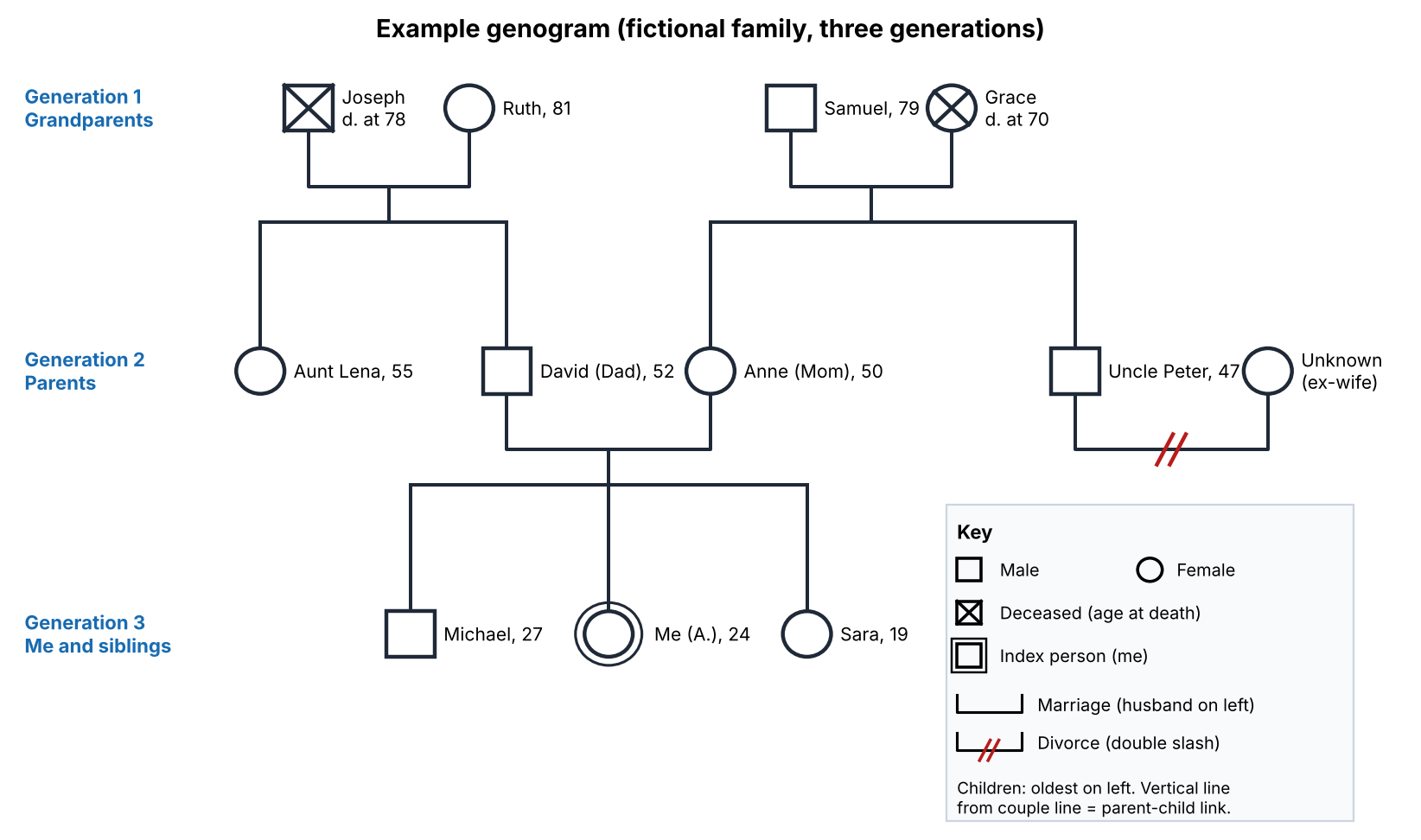
How to draw it by hand
- Turn the paper sideways and lightly pencil three horizontal rows: grandparents at the top, parents in the middle and you and your siblings at the bottom.
- Draw each person as a square (male) or circle (female); use the symbols your course taught for other identities. Mark yourself (the index person) with a double outline.
- Connect couples with a line that drops down and across, traditionally with the husband or male partner on the left. Mark divorce with two slashes and separation with one.
- Draw a vertical line down from the couple line to a horizontal sibling line, then a short line to each child, oldest on the left.
- Put an X through the symbol of anyone who has died and write the age at death.
- Write initials or first names and ages beside each symbol, and “Unknown” or “Not included” where needed.
- Add a small key so a reader can interpret your symbols, then ink over the pencil.
Model Part 2: Three observations (for the fictional family)
Original example for study purposes (about 170 words). These observations describe the fictional example family above; write yours about your own genogram.
1. One family pattern I notice. Both sets of grandparents had two children, and my parents’ generation stayed within the same region, so most of the family lives within a few hours of each other. Seeing it on paper showed how consistent family size and geographic closeness have been across generations.
2. One family strength I notice. Long marriages appear in both grandparents’ generation and my parents’ generation, which reflects commitment and stability. I also notice that my grandmother Ruth, now 81, is surrounded by children and grandchildren nearby, which suggests a strong caregiving network.
3. One thing the genogram helped me notice. I had not realized that each of my parents has lost one parent, my father’s father and my mother’s mother, which may explain why both of them stay so close to their surviving parent. I also saw that I know less about my uncle’s former spouse than about anyone else in the family. The genogram made the gaps in my family knowledge as visible as the connections.
Tip: clarity matters more than art. Use a ruler for lines, leave enough space between generations for labels, and include a key.
Frequently asked questions
Do I have to include medical or mental health information?
No. This assignment lets you leave out sensitive information. Write “Not included” where you prefer not to share.
Which symbol marks a deceased person?
Draw an X through the square or circle and note the age at death.
How do I show divorce?
Draw two short slashes across the line connecting the couple; one slash usually means separation.
More model assignments posted today
- Barbara's Bouquets decision-making method
- Benefits of project management
- Microsoft Project Unit 1 tutorial
- SPSS chi-square test of significance
- Employment laws and organizational culture
- Mindfulness and neuroleadership
- Emotional intelligence in diverse settings
- Personal identity and communication
- Criticisms of Freud's dream theory
- Food safety quiz and family survey
- Probability rules for everyday decisions
- Climate change and emergency management
- Terrorism response and the Stafford Act
- Emotional intelligence case study
- APS, CRM and ERP comparison
- Hofstede power distance discussion
- Adolescent psychiatric assessment (Marissa)
- Nursing informatics and project management
- Crittenden County community health assessment
Get a plagiarism-free answer to this question
Send us your instructions and we’ll match you with the best writer in your subject.
- 100% human-written, zero AI
- Turnitin report included
- Confidential — we never share your data
- Free revisions & refunds