Healthcare Cybersecurity: Patient Privacy and Nursing Responsibilities
Need help with this assignment?Get an original answer from a qualified tutor — from $10/page.
Get it written →Healthcare cybersecurity protects patient data and the systems care depends on. Ransomware can shut down EHRs and delay care, so security is a nursing issue too. NURS 6051: Transforming Nursing and Healthcare Through Technology covers privacy and security. This guide explains threats, recent events, rules and nursing responsibilities. Healthcare cybersecurity nursing assignments usually ask what individual nurses can do, and this guide answers that.
Quick answer
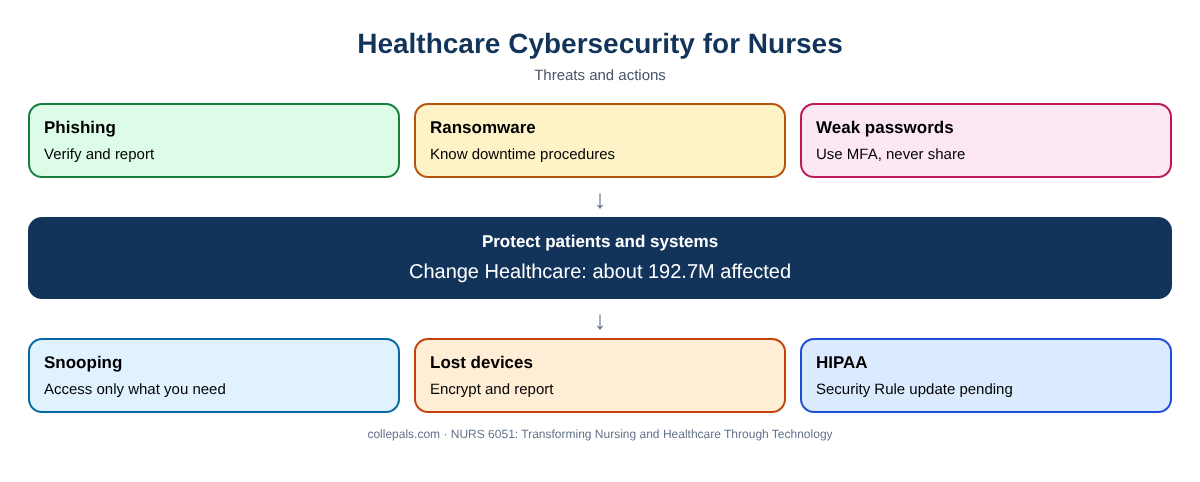
Healthcare cybersecurity for nurses means protecting patient information and systems from threats such as phishing, ransomware, weak passwords, insider snooping and lost devices. The 2024 Change Healthcare attack affected about 192.7 million people. HIPAA’s Security Rule applies now, and an update proposed in December 2024 is still pending. In NURS 6051: Transforming Nursing and Healthcare Through Technology, students explain nurses’ privacy and security duties.
Examples, cases, patients and organizations on this page are fictional unless cited and written by Collepals for study purposes. NURS 6051: Transforming Nursing and Healthcare Through Technology is a Walden University course; assignments vary by term, so follow your own syllabus and rubric. Technology rules and figures were current when written; check for later changes. This content is educational, not clinical or legal advice. Collepals is not affiliated with Walden University.
Sample document: a cybersecurity and privacy checklist for nurses (Word).
Common Threats and Nursing Actions
| Threat | What it is | Nursing action |
|---|---|---|
| Phishing | Fake emails that steal credentials | Verify senders; report suspicious emails |
| Ransomware | Malware that locks systems for payment | Downtime procedures; backups |
| Weak authentication | Stolen or shared passwords | Multi-factor authentication; never share logins |
| Insider snooping | Viewing records without a work need | Access only what you need; audits |
| Lost devices | Unencrypted laptops and phones | Encryption; report losses |
Recent Example: Change Healthcare
In February 2024, a ransomware attack on Change Healthcare disrupted claims and pharmacy processing nationwide. The final estimate of people affected was about 192.7 million, the largest healthcare data breach reported to federal regulators (Becker’s Hospital Review, 2025). Attackers reportedly used stolen credentials on a remote access portal that lacked multi-factor authentication.
Rules
The HIPAA Privacy and Security Rules require safeguards for protected health information. In December 2024, HHS proposed a major Security Rule update, including stronger requirements such as multi-factor authentication and encryption. As of 2026, the final rule has been pushed back, so the current rule remains in force (U.S. Department of Health and Human Services, Office for Civil Rights, 2024).
Nursing Responsibilities
- Log off and lock screens.
- Use only your own credentials.
- Access records only for care.
- Know downtime procedures.
- Report incidents quickly.
Related: Healthcare Technology Ethics: A Nursing Assignment Guide, Healthcare Technology Regulations: A Nursing Student’s Guide and EHR privacy and security.
Frequently Asked Questions
Why is cybersecurity a nursing issue?
Attacks can shut down EHRs and delay care, and nurses handle large amounts of protected health information.
What is the biggest cyber threat to hospitals?
Ransomware, often starting with phishing or stolen credentials.
Has the HIPAA Security Rule changed?
An update was proposed in December 2024, but as of 2026 it is not final. The existing rule still applies.
Get Help With Healthcare Cybersecurity Assignments
Informatics assignments demand current evidence, clear explanations of technology and strong APA writing. Collepals.com helps students in NURS 6051: Transforming Nursing and Healthcare Through Technology and other nursing informatics courses:
- Explain EHRs, telehealth, AI and other technologies in plain, accurate terms.
- Write discussion posts, peer responses and reflections.
- Build project proposals, annotated bibliographies, infographics and fact sheets.
- Find current evidence, cite in APA 7 and get drafts edited and proofread.
Browse our free model assignments or learn more about our nursing assignment writing service.
Use Collepals examples as study guides and follow your school’s academic integrity and AI policies.
More NURS 6051: Transforming Nursing and Healthcare Through Technology guides
- NURS 6051: Transforming Nursing and Healthcare Through Technology – Complete Course Guide
- Healthcare Technology Ethics: A Nursing Assignment Guide
- Healthcare Technology Regulations: A Nursing Student’s Guide
- Big Data in Healthcare: Risks, Rewards and Nursing Implications
- Electronic Health Records: A Nursing Assignment Guide
Collepals is an independent study resource. Follow your program’s instructions and rubric and write your own work.
References
Becker’s Hospital Review. (2025). Change Healthcare data breach toll reaches 192.7 million. https://www.beckershospitalreview.com/healthcare-information-technology/cybersecurity/change-healthcare-data-breach-toll-reaches-192-7-million
McGonigle, D., & Mastrian, K. G. (2022). Nursing informatics and the foundation of knowledge (5th ed.). Jones & Bartlett Learning.
U.S. Department of Health and Human Services, Office for Civil Rights. (2024). HIPAA Security Rule notice of proposed rulemaking to strengthen cybersecurity for electronic protected health information [Fact sheet]. https://www.hhs.gov/hipaa/for-professionals/security/hipaa-security-rule-nprm/factsheet/index.html
Get a plagiarism-free answer to this question
Send us your instructions and we’ll match you with the best writer in your subject.
- 100% human-written, zero AI
- Turnitin report included
- Confidential — we never share your data
- Free revisions & refunds