How to Write Discussion Posts, Responses and Assignments in Nursing School
Need help with this assignment?Get an original answer from a qualified tutor — from $10/page.
Get it written →Nursing school asks you to write constantly: weekly discussion posts, replies to classmates and instructors, care plans, reflections and evidence-based papers. Each type has its own expectations, and many students lose points not because their nursing knowledge is weak but because their writing doesn’t match what the rubric asks for. This guide explains how to write discussion posts, responses to classmates and tutors, and assignments in nursing school, with structures, examples and a checklist you can use every week.
Quick answer
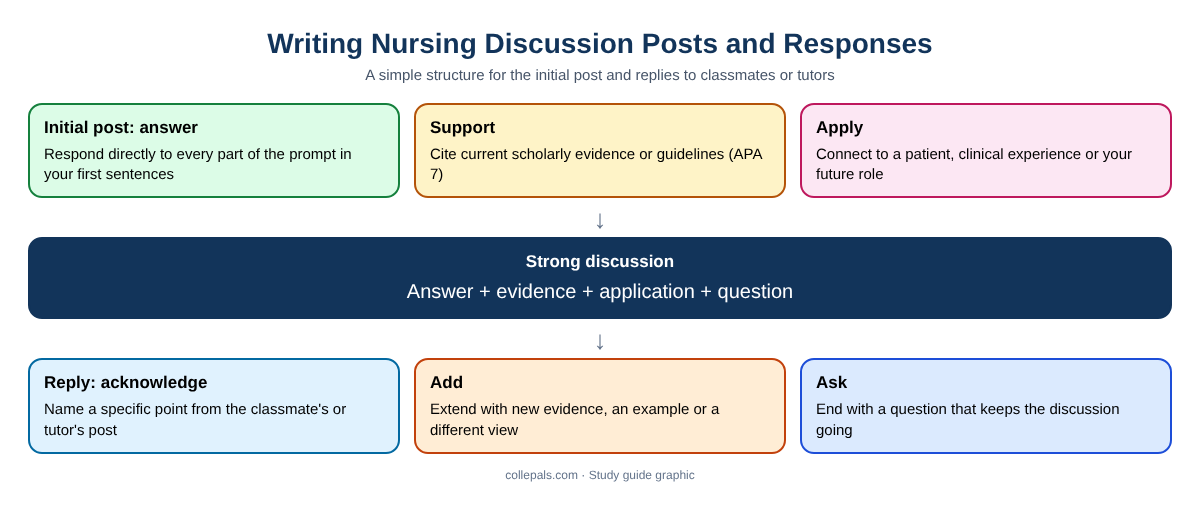
For an initial discussion post, answer every part of the prompt, support it with current scholarly evidence in APA format and apply it to nursing practice. For a response to a classmate or tutor, acknowledge a specific point, add something new (evidence, an example or a different view) and end with a question. For a formal assignment, follow the rubric section by section, use the required headings, cite current sources and proofread before submitting.
Why Writing Matters So Much in Nursing School
Writing is not a side skill in nursing. Nurses document care, write handoff reports, explain plans to patients and families and contribute to policies and quality projects. The American Association of Colleges of Nursing (AACN, 2021) includes communication, evidence-based practice and professionalism among the core competencies for nursing education, and discussion boards and papers are how many programs assess them. Your instructor reads your posts to see whether you can find credible evidence, apply it to patients and communicate clearly with colleagues, the same skills you will use in practice.
Part 1: How to Write a Nursing Discussion Post
An initial discussion post is a short, focused answer to a weekly prompt, usually 250 to 500 words with one to three scholarly sources. Most rubrics grade the same four things: whether you answered the question, the quality of your evidence, how well you applied it and your writing mechanics.
Step 1: Break down the prompt
Copy the prompt and number every question in it. Many prompts hide three or four questions in one paragraph, such as “describe,” “explain why” and “give an example.” Answer them in the same order so your instructor can find each one, and use short headings or bolded lead-ins if the post is long.
Step 2: Answer directly
Start with your answer, not background. Compare these openings:
- Weak: “Falls are a big problem in hospitals today and there are many things nurses can do.”
- Strong: “The most effective strategy for preventing falls on my medical-surgical unit would be individualized fall prevention plans developed with patients and families, because education is the intervention with the strongest evidence for reducing hospital falls.”
Step 3: Support it with current evidence
Use peer-reviewed articles, clinical practice guidelines and professional organization sources, usually published within the last five years unless your instructor says otherwise. Good starting points include CINAHL and PubMed through your school library, and organizations such as the Agency for Healthcare Research and Quality, the Centers for Disease Control and Prevention and specialty nursing associations. Avoid general websites, unattributed blogs and homework-help sites. Paraphrase rather than quote, and cite every source in APA 7 format (American Psychological Association [APA], 2020).
Step 4: Apply it to nursing practice
This is where most posts earn or lose points. Connect the evidence to a patient you cared for (without identifiers), a clinical experience, your current workplace or your future role. Ask yourself, “What would a nurse actually do differently because of this?”
Step 5: Proofread and post on time
Write your post in a word processor first so you can check spelling, grammar and length, then paste it into the discussion board. Post by the due date; many courses require the initial post by midweek so classmates have time to respond.
Part 2: How to Respond to Classmates and Tutors
Replies are often worth a third or more of the discussion grade, yet many students write one-line responses such as “Great post, I agree!” These rarely earn credit because they are not substantive. A substantive response adds to the conversation.
The acknowledge-add-ask structure
- Acknowledge: name a specific point your classmate made. This shows you read the post carefully.
- Add: extend it with new evidence, a clinical example, a related consideration or a respectful alternative view, with a citation.
- Ask: end with an open question that invites further discussion.
Example: weak versus strong response
| Weak response | Strong response |
|---|---|
| “Hi Maria, great post! I agree that hourly rounding is important. Thanks for sharing.” | “Hi Maria, I appreciated your point that hourly rounding reduced call-light use on your unit. One thing I’ve noticed is that rounding works best when it includes a toileting offer, since many falls happen when patients try to reach the bathroom alone. Pairing rounding with patient and family education might strengthen it further, because education has shown the most consistent benefit in hospital fall research. Did your unit track whether falls changed after rounding started?” |
Responding to your instructor or tutor
When an instructor, faculty facilitator or tutor replies to your post, treat it as a teaching moment, not just a comment. Answer every question they ask, ideally with an additional source; many rubrics require a response to the instructor for full participation credit. If they correct something, acknowledge it professionally (“Thank you for clarifying that the guideline recommends…”) and show how your thinking has changed. If you disagree, do so respectfully and support your view with evidence.
Tips for professional, collegial replies
- Address classmates by name and keep a respectful, supportive tone, as you would with colleagues on a unit.
- Avoid simply repeating your own post; respond to theirs.
- Vary the posts you respond to, including those with fewer replies.
- Check your course requirements for length (often 100 to 200 words) and citations per reply.
Part 3: How to Write Nursing Assignments
Formal assignments range from care plans and concept maps to reflective journals, evidence-based practice papers, PICOT questions, capstone projects and presentations. The process is similar for all of them.
1. Start with the rubric
Turn the rubric criteria into your outline and headings. If the rubric lists “Impact on patient safety” as a criterion, make it a heading. This ensures you do not miss required parts and makes grading easier for your instructor.
2. Know the assignment type
- Care plans and concept maps: base every nursing diagnosis on your patient’s actual cues, write SMART goals and include rationales. See our guides on how to create a nursing concept map for a patient and nursing concept map assignments.
- Evidence-based practice papers: build a clear PICOT question (population, intervention, comparison, outcome and time), then search for and appraise the evidence (Melnyk & Fineout-Overholt, 2023).
- Reflective assignments: use a reflection model, such as Gibbs’ cycle, if your program requires one, and balance description with analysis of what you learned and what you will do differently.
- Quality improvement and capstone papers: define a measurable problem, support it with local and national data and propose evidence-based changes. For a model, see our capstone QI paper on inpatient falls.
3. Use APA 7 correctly
Most nursing programs require APA style (APA, 2020). Common requirements include a title page, double spacing, a readable font such as Times New Roman 12 or Calibri 11, level 1 and level 2 headings, in-text citations with author and year and a reference list with hanging indents and DOIs where available. Student papers usually do not need a running head or abstract unless your instructor asks for one.
4. Plan your time
| When | Task |
|---|---|
| As soon as it’s assigned | Read the prompt and rubric; list the required sections. |
| First third of the time | Search for and read sources; take notes in your own words. |
| Middle third | Draft section by section using rubric headings. |
| Final third | Revise, check APA, run spell check and compare against the rubric. |
Common Mistakes to Avoid
- Answering only part of a multi-part prompt.
- Using outdated or non-scholarly sources.
- Writing general statements without applying them to nursing practice.
- One-line replies that don’t add anything to the discussion.
- Including patient names, dates or other identifiers.
- Forgetting in-text citations for paraphrased ideas.
- Submitting work that is not your own, or using AI tools in ways your program prohibits.
Academic Integrity and AI Tools
Nursing programs take academic integrity seriously because honesty is a core professional value. Read your course’s policy on generative AI: some allow it for brainstorming or grammar help with acknowledgment, while others prohibit it. Use examples and outside help to understand expectations and improve your own writing, then submit work written in your own words.
Frequently Asked Questions
How long should a nursing discussion post be?
Usually 250 to 500 words for an initial post and 100 to 200 words for each reply, but always follow your course requirements.
How many sources should a discussion post have?
Most courses require one to three scholarly sources for the initial post and one source for each reply, typically published within the last five years.
What makes a response “substantive”?
It refers to a specific point in the original post, adds new information or perspective supported by evidence and invites further discussion.
Can I use first person in nursing papers?
APA 7 allows first person when describing your own experiences or actions, and it is common in reflections and discussion posts. Follow your instructor’s preference for formal papers.
Get Expert Help With Your Nursing Writing at Collepals
Juggling clinicals, exams, work and weekly discussion deadlines is hard. Collepals.com helps nursing students write with confidence. Our nursing-focused writers and tutors can:
- Walk you through discussion prompts and show you how to build strong initial posts and substantive replies.
- Provide model papers, care plans and concept maps you can study to understand the structure.
- Help you find current scholarly sources and format citations and references in APA 7.
- Edit and proofread your drafts so your ideas come through clearly.
Browse our free nursing model assignments, or learn more about our nursing assignment writing service.
Use any model or example from Collepals as a study guide and follow your school’s academic integrity policy when you submit your own work.
References
American Association of Colleges of Nursing. (2021). The essentials: Core competencies for professional nursing education. https://www.aacnnursing.org/essentials
American Psychological Association. (2020). Publication manual of the American Psychological Association (7th ed.). https://doi.org/10.1037/0000165-000
Melnyk, B. M., & Fineout-Overholt, E. (2023). Evidence-based practice in nursing & healthcare: A guide to best practice (5th ed.). Wolters Kluwer.
Get a plagiarism-free answer to this question
Send us your instructions and we’ll match you with the best writer in your subject.
- 100% human-written, zero AI
- Turnitin report included
- Confidential — we never share your data
- Free revisions & refunds