Stroke (Cerebrovascular Accident) Concept Map: Pathophysiology, Diagnostics, Nursing Interventions and Education
Need help with this assignment?Get an original answer from a qualified tutor — from $10/page.
Get it written →Assignment: Concept map for stroke / cerebrovascular accident
Create a concept map for: Stroke/Cerebral Vascular Accident. The content of the concept map must include:
- pathophysiology
- definition
- etiology
- risk factors (genetic predisposition and environment factors if applicable)
- causative factors
- common signs and symptoms for the disease
- labs & diagnostic tests
- nursing interventions
- medical treatment
- complications of the disease
- patient & family education
- 4–6 references using APA 7th ed. format
Model concept map
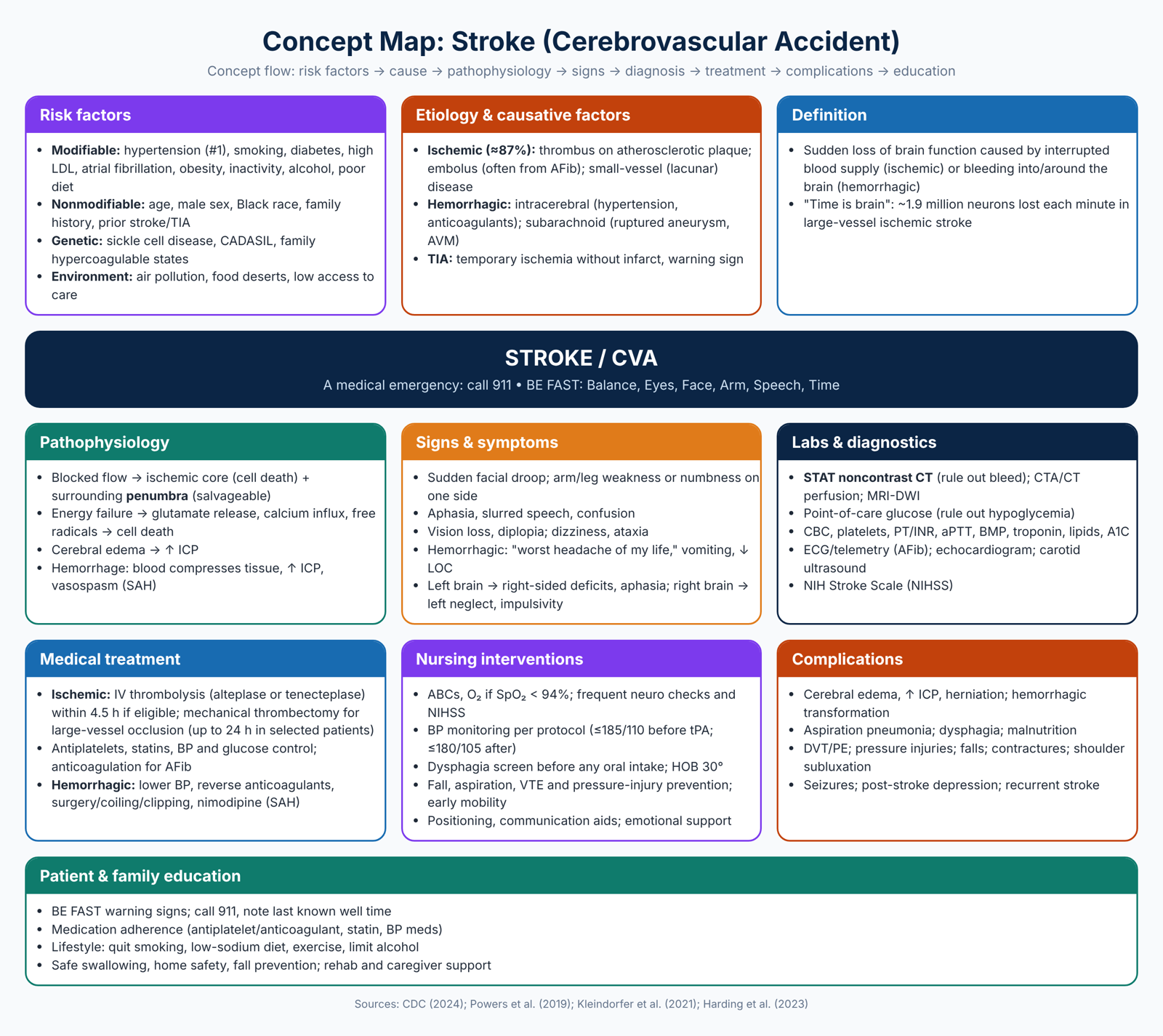
Concept map content explained
Definition
A stroke, or cerebrovascular accident (CVA), is the sudden loss of brain function caused by an interruption of blood supply to part of the brain (ischemic stroke) or by bleeding into or around the brain (hemorrhagic stroke). More than 795,000 Americans have a stroke each year, and stroke is a leading cause of death and serious long-term disability (Centers for Disease Control and Prevention [CDC], 2024).
Etiology and causative factors
- Ischemic stroke (about 87%) (CDC, 2024): thrombotic (clot forms on an atherosclerotic plaque in a cerebral artery), embolic (clot travels from elsewhere, most often the heart in atrial fibrillation) or lacunar (small-vessel disease from chronic hypertension and diabetes).
- Hemorrhagic stroke: intracerebral hemorrhage (often from uncontrolled hypertension, anticoagulants or amyloid angiopathy) or subarachnoid hemorrhage (usually a ruptured aneurysm or arteriovenous malformation).
- Transient ischemic attack (TIA): temporary ischemia without permanent infarction, a major warning sign of future stroke.
Risk factors
- Modifiable: hypertension (the most important), smoking, diabetes, high cholesterol, atrial fibrillation, obesity, physical inactivity, unhealthy diet, heavy alcohol use and drug use (Kleindorfer et al., 2021).
- Nonmodifiable: older age, family history, prior stroke or TIA, and race; non-Hispanic Black adults have nearly twice the risk of a first stroke compared with White adults (CDC, 2024).
- Genetic predisposition: sickle cell disease, inherited clotting disorders, familial hypercholesterolemia and rare conditions such as CADASIL.
- Environmental factors: air pollution, limited access to healthy food and health care, and chronic stress.
Pathophysiology
In ischemic stroke, blocked blood flow deprives brain cells of oxygen and glucose. An ischemic core of tissue dies within minutes, while a surrounding penumbra of underperfused tissue can survive if blood flow is restored quickly. Energy failure triggers an ischemic cascade, including glutamate release, calcium influx, free radical production and inflammation, that expands the injury. Cerebral edema can raise intracranial pressure (ICP). In hemorrhagic stroke, blood irritates and compresses brain tissue, raises ICP, and in subarachnoid hemorrhage can cause cerebral vasospasm days later (Harding et al., 2023).
Common signs and symptoms
Symptoms appear suddenly and are often remembered with BE FAST: Balance loss, Eye or vision changes, Facial droop, Arm or leg weakness, Speech difficulty and Time to call 911. Other signs include numbness on one side, confusion, aphasia, dysphagia, dizziness and, in hemorrhagic stroke, a sudden severe headache, vomiting and decreased consciousness. Deficits occur on the side of the body opposite the affected hemisphere: a left-hemisphere stroke often causes right-sided weakness and aphasia, while a right-hemisphere stroke often causes left-sided weakness, left neglect and impulsivity.
Labs and diagnostic tests
- Noncontrast head CT immediately to rule out hemorrhage before thrombolysis; CT angiography and perfusion to identify large-vessel occlusion; MRI with diffusion-weighted imaging for detail (Powers et al., 2019).
- Blood glucose before thrombolysis to rule out hypoglycemia, which can mimic stroke.
- CBC and platelets, PT/INR and aPTT, electrolytes and renal function, troponin, lipid panel and hemoglobin A1C.
- ECG and cardiac monitoring for atrial fibrillation; echocardiogram; carotid ultrasound.
- NIH Stroke Scale to measure severity and track changes.
Medical treatment
- Ischemic stroke: IV thrombolysis for eligible patients within 4.5 hours of last known well; tenecteplase, given as a single bolus, was FDA-approved for acute ischemic stroke in March 2025 as an alternative to alteplase (TCTMD, 2025). Mechanical thrombectomy for large-vessel occlusion, up to 24 hours in selected patients (Powers et al., 2019).
- Secondary prevention: antiplatelet therapy, high-intensity statins, blood pressure and diabetes control, and anticoagulation for atrial fibrillation (Kleindorfer et al., 2021).
- Hemorrhagic stroke: blood pressure lowering, reversal of anticoagulation, management of ICP, surgical evacuation, aneurysm clipping or coiling, and nimodipine to prevent vasospasm after subarachnoid hemorrhage.
Nursing interventions
- Maintain airway, breathing and circulation; give oxygen if SpO2 is below 94%.
- Perform frequent neurological checks and NIHSS assessments; report any decline immediately.
- Monitor blood pressure closely: below 185/110 before thrombolysis and at or below 180/105 for 24 hours afterward; watch for bleeding (Powers et al., 2019).
- Complete a dysphagia screen before any food, fluids or oral medications; keep the head of the bed elevated to prevent aspiration.
- Prevent falls, pressure injuries, contractures and VTE; begin early mobilization with physical, occupational and speech therapy.
- Support communication with aphasia aids, and address emotional needs and post-stroke depression.
Complications
Complications include cerebral edema, increased ICP and herniation; hemorrhagic transformation after thrombolysis; aspiration pneumonia from dysphagia; deep vein thrombosis and pulmonary embolism; pressure injuries; falls; shoulder subluxation and contractures; seizures; urinary tract infections; malnutrition; post-stroke depression; and recurrent stroke.
Patient and family education
- Recognize BE FAST signs and call 911 immediately; note the time symptoms started or the last time the person was known to be well.
- Take medications as prescribed, including antiplatelets or anticoagulants, statins and blood pressure medicines, and report bleeding.
- Make lifestyle changes: quit smoking, follow a low-sodium, heart-healthy diet, exercise as approved, limit alcohol and manage diabetes.
- Use safe swallowing techniques and modified diets as recommended by speech therapy.
- Make the home safe for mobility and fall prevention, continue rehabilitation and seek caregiver support and respite.
Tips for building your concept map
- Put the disease in the center and connect each required element with lines or arrows.
- Show relationships, such as hypertension → small-vessel disease → lacunar stroke, or dysphagia → aspiration pneumonia.
- Use color coding and short phrases; tools such as Canva, Lucidchart or PowerPoint work well.
- Include 4–6 APA references on a separate page or at the bottom of the map.
Related reading: neurological assessment guide, coronary artery disease and heart failure case study and fractured hip case study.
More model assignments posted today
- Advocating for the Nursing Role in Program Design and Implementation
- Leadership Styles in Nursing Mind Map
- Ed Beatty Case Study
- Reframing Reflection
- Stroke (Cerebrovascular Accident) Concept Map
- NR304 Health History and Physical Assessment Paper Example (Paragraph Format, Erikson, Reflection)
- Assessing and Diagnosing Substance-Related and Addictive Disorders
- NRNP 6635 Comprehensive Psychiatric Evaluation Template
References
Centers for Disease Control and Prevention. (2024, October 24). Stroke facts. https://www.cdc.gov/stroke/data-research/facts-stats/index.html
Harding, M. M., Kwong, J., Hagler, D., & Reinisch, C. (2023). Lewis’s medical-surgical nursing: Assessment and management of clinical problems (12th ed.). Elsevier.
Kleindorfer, D. O., Towfighi, A., Chaturvedi, S., Cockroft, K. M., Gutierrez, J., Lombardi-Hill, D., Kamel, H., Kernan, W. N., Kittner, S. J., Leira, E. C., Lennon, O., Meschia, J. F., Nguyen, T. N., Pollak, P. M., Santangeli, P., Sharrief, A. Z., Smith, S. C., Jr., Turan, T. N., & Williams, L. S. (2021). 2021 guideline for the prevention of stroke in patients with stroke and transient ischemic attack. Stroke, 52(7), e364–e467. https://doi.org/10.1161/STR.0000000000000375
Powers, W. J., Rabinstein, A. A., Ackerson, T., Adeoye, O. M., Bambakidis, N. C., Becker, K., Biller, J., Brown, M., Demaerschalk, B. M., Hoh, B., Jauch, E. C., Kidwell, C. S., Leslie-Mazwi, T. M., Ovbiagele, B., Scott, P. A., Sheth, K. N., Southerland, A. M., Summers, D. V., & Tirschwell, D. L. (2019). Guidelines for the early management of patients with acute ischemic stroke: 2019 update to the 2018 guidelines. Stroke, 50(12), e344–e418. https://doi.org/10.1161/STR.0000000000000211
TCTMD. (2025, March 3). FDA approves tenecteplase for acute ischemic stroke. https://www.tctmd.com/news/fda-approves-tenecteplase-acute-ischemic-stroke
Get a plagiarism-free answer to this question
Send us your instructions and we’ll match you with the best writer in your subject.
- 100% human-written, zero AI
- Turnitin report included
- Confidential — we never share your data
- Free revisions & refunds