Leadership Styles in Nursing Mind Map: Transformational, Democratic, Autocratic, Laissez-Faire and Servant (ANA)
Need help with this assignment?Get an original answer from a qualified tutor — from $10/page.
Get it written →Assignment: Leadership in nursing mind map
Review the American Nurses Association’s resource, “Leadership in Nursing: Qualities & Why It Matters.” As you develop the mind map, include:
- At least 4–5 leadership styles discussed in the ANA resource (e.g., transformational, democratic, autocratic, laissez-faire, servant). These should be the main branches of your mind map.
- For each style, include: key characteristics; when the style is most effective.
- Add a branch labeled “My Leadership Tendencies.” Identify 1 or 2 styles you feel most aligned with. Include brief notes on why they resonate with you.
- Use brief phrases (not long paragraphs) to show relationships between ideas.
- Incorporate examples relevant to nursing practice when possible.
- Use arrows, colors, or symbols to demonstrate how biologic, sociologic, and psychological factors influence one another in the aging process.
No citations/references are required for this assignment.
Note on the instructions: the last bullet, about biologic, sociologic and psychological factors in the aging process, appears to have been copied from a different assignment. The model below uses arrows, colors and symbols to show relationships between leadership styles. Ask your instructor whether they also want aging factors included.
Leadership styles in the ANA resource
The ANA resource describes seven leadership styles: transformational, autocratic, laissez-faire, democratic, servant, situational and transactional. It also highlights leadership qualities such as communication and collaboration, ethics, professionalism and compassion (American Nurses Association, n.d.). The mind map below uses five styles as its main branches, plus the required “My Leadership Tendencies” branch.
Model mind map
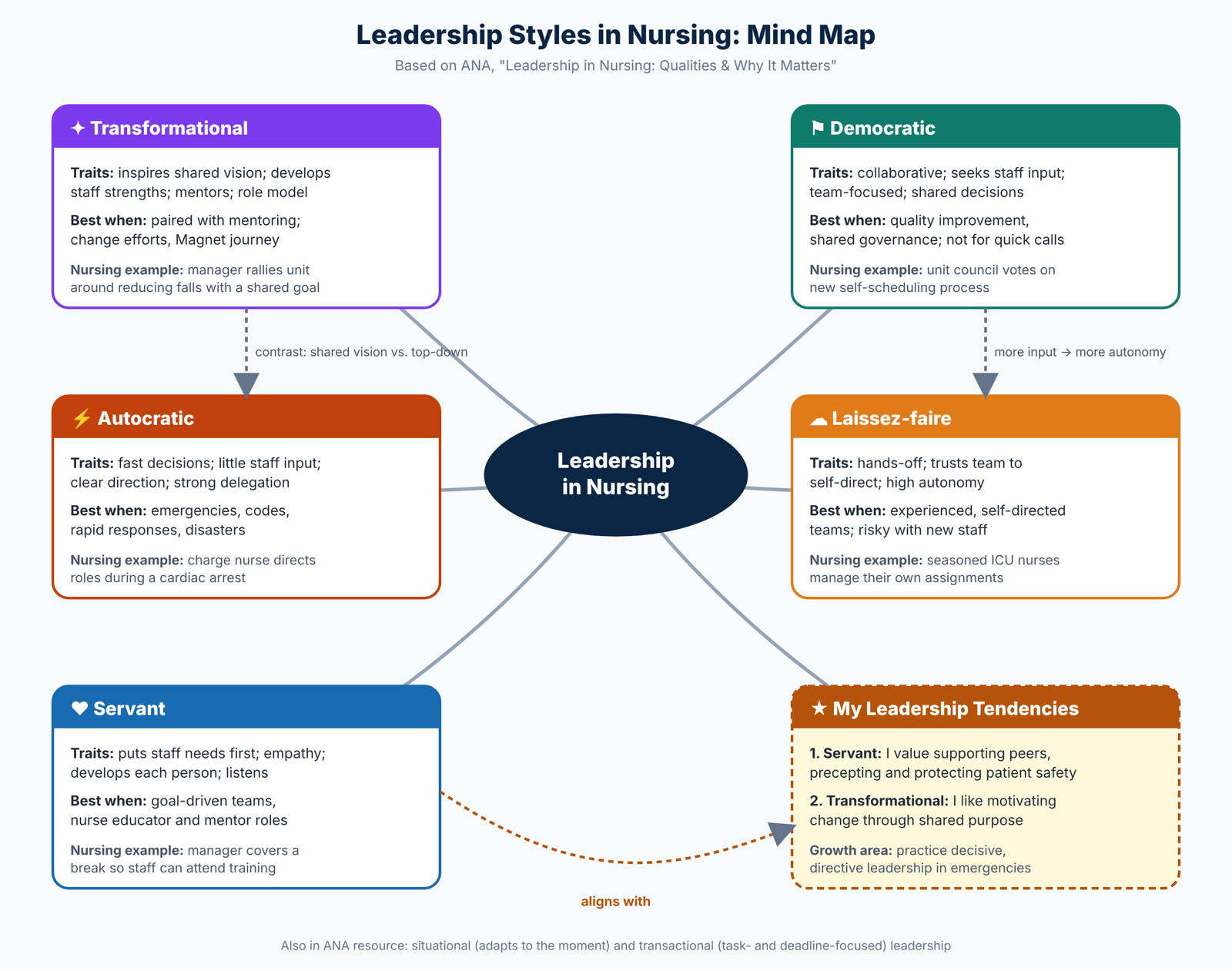
Mind map content in text form
| Branch | Key characteristics | Most effective when | Nursing example |
|---|---|---|---|
| ✦ Transformational | Inspires a shared vision; develops staff strengths; mentors; role model | Paired with mentoring; leading change | Manager rallies the unit around reducing falls |
| ⚑ Democratic | Collaborative; seeks input; shared decisions | Quality improvement and shared governance; less useful when quick decisions are needed | Unit council votes on a self-scheduling process |
| ⚡ Autocratic | Fast decisions; little staff input; clear direction and delegation | Emergencies, codes and disasters | Charge nurse assigns roles during a cardiac arrest |
| ☁ Laissez-faire | Hands-off; trusts the team to self-direct | Experienced, self-directed teams; risky with new staff | Seasoned ICU nurses manage their own assignments |
| ♥ Servant | Puts staff needs first; empathy; develops individuals | Goal-driven teams; nurse educator and preceptor roles | Manager covers a break so staff can attend training |
| ★ My Leadership Tendencies | Servant: I enjoy supporting peers, precepting students and advocating for safety. Transformational: I am motivated by a shared purpose and like encouraging others to grow. Growth area: becoming more decisive and directive in emergencies. | ||
Relationships shown with arrows and symbols
- Transformational ↔ autocratic: shared vision versus top-down direction; the same leader may need to switch between them during a code.
- Democratic → laissez-faire: as staff gain experience and input, leaders can give more autonomy.
- Servant → my tendencies: a dashed arrow shows the style that best matches personal values.
- Colors: each style has its own color; the personal branch uses a dashed border to stand out.
Tips for making your own mind map
- Tools: Canva, Lucidchart, MindMeister, Miro, PowerPoint SmartArt or hand-drawn and scanned.
- Keep phrases short, about three to eight words each; the assignment says no long paragraphs.
- Use a nursing example on every branch to show application.
- Be honest in your tendencies branch and add one growth area; it shows self-awareness.
Frequently asked questions
Which leadership style is best in nursing?
No single style is best. Effective nurse leaders adapt their style to the situation, which is the idea behind situational leadership: directive in emergencies, collaborative in quality improvement and supportive when developing staff.
What is the difference between transformational and transactional leadership?
Transformational leaders inspire people through vision and personal development. Transactional leaders focus on tasks, performance and rewards for meeting short-term goals.
Reference for this guide: American Nurses Association. (n.d.). Leadership in nursing: Qualities & why it matters. https://www.nursingworld.org/content-hub/resources/nursing-leadership/leadership-in-nursing
More model assignments posted today
- Advocating for the Nursing Role in Program Design and Implementation
- Leadership Styles in Nursing Mind Map
- Ed Beatty Case Study
- Reframing Reflection
- Stroke (Cerebrovascular Accident) Concept Map
- NR304 Health History and Physical Assessment Paper Example (Paragraph Format, Erikson, Reflection)
- Assessing and Diagnosing Substance-Related and Addictive Disorders
- NRNP 6635 Comprehensive Psychiatric Evaluation Template
Get a plagiarism-free answer to this question
Send us your instructions and we’ll match you with the best writer in your subject.
- 100% human-written, zero AI
- Turnitin report included
- Confidential — we never share your data
- Free revisions & refunds