How to Connect Nursing Theory to Your Personal Philosophy
Need help with this assignment?Get an original answer from a qualified tutor — from $10/page.
Get it written →Linking nursing theory and personal philosophy gives your beliefs academic grounding. This guide shows how to choose a theorist whose ideas match your values, how to explain the connection and how to avoid simply summarizing a theory.
Quick answer
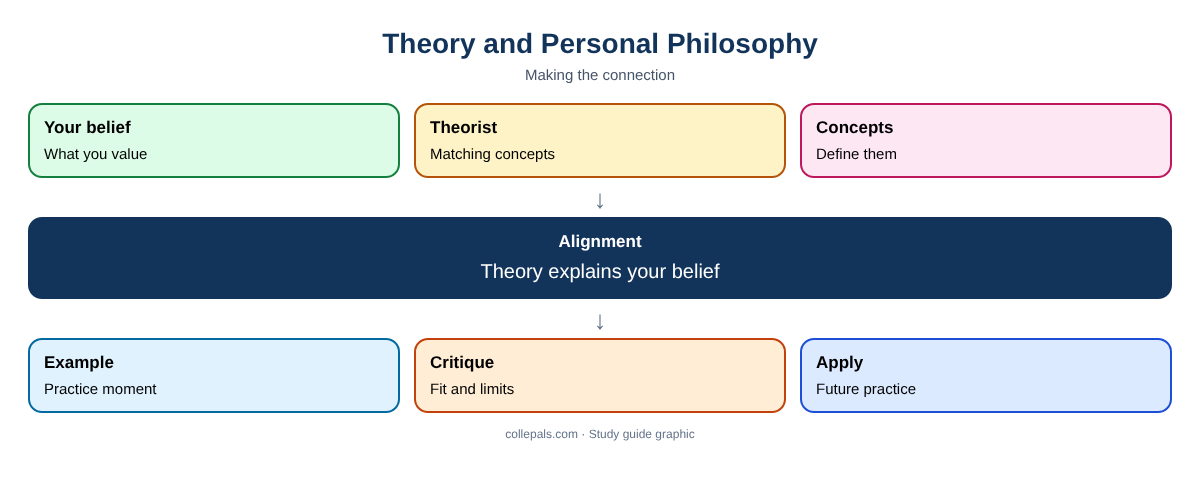
To connect nursing theory to your personal philosophy, identify your core belief, choose a theorist whose central concepts match it, define those concepts with citations, explain how they describe what you already believe or practice, give a clinical example and note any limits of fit or ways the theory will shape your future practice.
Examples on this page are written by Collepals for study purposes. A philosophy of nursing must reflect your own beliefs and experiences, so use them to understand structure and tone, then write your own.
Sample document: a nursing theory and personal philosophy alignment worksheet (Word).
Choosing a Theorist That Fits Your Philosophy
| Theorist | Focus | Key idea | Good fit if |
|---|---|---|---|
| Florence Nightingale | Environment | Clean, quiet, well-lit surroundings support healing | You value safe, healing environments |
| Hildegard Peplau | Interpersonal relations | Nurse-patient relationship moves through phases | You value therapeutic relationships |
| Dorothea Orem | Self-care deficit | Nurses support patients’ self-care abilities | You value independence and education |
| Jean Watson | Human caring | Caring relationships and Caritas Processes | You value presence and holism |
| Patricia Benner | Novice to expert | Clinical expertise grows through experience | You value growth and clinical judgment |
| Madeleine Leininger | Culture care | Culturally congruent care | You value cultural humility and equity |
How to Write the Connection
- State your belief.
- Introduce the theorist and one or two concepts, with citations.
- Explain the match: “This aligns with my belief because…”
- Illustrate with a practice example.
- Reflect on fit or limits.
Example paragraph
I believe the nurse-patient relationship is itself therapeutic. Peplau (1952) described this relationship as moving through orientation, working and resolution phases. During a psychiatric rotation, I spent the first day simply learning a patient’s routines and concerns; by the third day, she trusted me enough to practice coping skills. Peplau’s theory explains why that early investment mattered and will guide how I build relationships as a nurse.
Theory and the Metaparadigm
Most nursing theories define person, health, environment and nursing (Fawcett, 1984), so you can compare a theorist’s definitions with yours concept by concept. Benner’s (1984) novice-to-expert model also works well for describing how you expect your philosophy to grow.
See a full theory-based example in Personal Philosophy of Nursing Based on Jean Watson’s Theory.
Frequently Asked Questions
Do I need to choose a grand theory?
No. Grand, middle-range or practice theories can work; choose the best fit for your beliefs.
Can I use more than one theorist?
Yes, but explain each clearly; one well-developed connection is often stronger.
Can I critique a theory in my philosophy?
Yes. Noting limits shows critical thinking.
Get Help Connecting Theory to Your Nursing Philosophy
A strong philosophy of nursing paper takes reflection, theory and careful writing. Collepals.com helps BSN, MSN and nurse practitioner students:
- Turn your values and clinical experiences into a clear thesis.
- Connect your beliefs to nursing theory, the metaparadigm and the ANA Code of Ethics.
- Outline, structure and cite your paper in APA 7.
- Study model papers and get your draft edited and proofread.
Browse our free model assignments or learn more about our nursing assignment writing service.
Use Collepals examples as study guides and follow your school’s academic integrity and AI policies.
More nursing philosophy guides
Collepals is an independent study resource. Follow your program’s instructions and rubric and write your own work.
References
Benner, P. (1984). From novice to expert: Excellence and power in clinical nursing practice. Addison-Wesley.
Fawcett, J. (1984). The metaparadigm of nursing: Present status and future refinements. Image: Journal of Nursing Scholarship, 16(3), 84–87. https://doi.org/10.1111/j.1547-5069.1984.tb01393.x
Nightingale, F. (1860). Notes on nursing: What it is, and what it is not. D. Appleton.
Peplau, H. E. (1952). Interpersonal relations in nursing. G. P. Putnam’s Sons.
Watson, J. (2008). Nursing: The philosophy and science of caring (Rev. ed.). University Press of Colorado.
Get a plagiarism-free answer to this question
Send us your instructions and we’ll match you with the best writer in your subject.
- 100% human-written, zero AI
- Turnitin report included
- Confidential — we never share your data
- Free revisions & refunds