Professional Development Plan and Career Legacy Map for Nurses: Template Guide, Sample and Example Map
Need help with this assignment?Get an original answer from a qualified tutor — from $10/page.
Get it written →Assignment: Professional Development Plan and Career Legacy Map
“Living a career of purposefulness and intentionality can sustain long-term efforts in nursing directed at making a difference to benefit the lives of patients/recipients of the services” (O’Connor, 2019, p.93).
- Reflect upon the resources provided in your coursework and the foundational understanding of nursing leadership, policy, and advocacy in healthcare.
- Your prior efforts will support the development of a comprehensive Professional Development Plan that integrates these critical elements into your future practice.
- A Career Legacy Map assists in guiding you towards your career goals.
This assignment is two-parts:
- Complete the Professional Development Plan Template
- Develop a Career Legacy Map – add this to the last page of the Professional Development template provided below in the Assignment Resources.
Using the template provided below, construct your Professional Development Plan adding a visual illustration of your career goals (career legacy map). A Career Legacy Map assists in guiding you towards your career goals. Please refer to the Wilson et al. (2017), article for an example of a legacy map.
Legacy Map: Wilson, D. S., Rosemberg, M. S., Visovatti, M., Munro‐Kramer, M. L., & Feetham, S. (2017). Career Cartography: From Stories to Science and Scholarship. Journal of Nursing Scholarship, 49(3), 336-346. https://doi.org/10.1111/jnu.12289
About the template: The Professional Development Plan Template is provided inside your course’s Assignment Resources and is not publicly available, so this guide uses the sections most nursing PDP templates include. Match each section below to the headings in your own template, and place your Career Legacy Map on the last page as instructed.
What is a professional development plan?
A professional development plan (PDP) is a written roadmap that describes who you are as a nurse, where you want your career to go, and the concrete steps, resources and timelines that will get you there. In a graduate nursing program, the PDP connects your coursework in leadership, health policy and advocacy to your future practice, so your growth is purposeful and intentional rather than accidental. O’Connor (2019) describes a career legacy portfolio as a way for advanced practice nurses to link scholarship, practice and long-term impact.
What is a career legacy map?
A career legacy map is a one-page visual of your career destination and the milestones, activities and supports that lead to it. It comes from the idea of career cartography, a structured way for nurses to plan their careers so that research, practice and policy reinforce one another. Feetham and Doering (2015) describe four core elements: a destination statement, a career map, a supportive career team of mentors and colleagues, and communication and dissemination strategies that share work with diverse audiences, including policymakers. Wilson et al. (2017) build on this model by showing how nurses at different career stages used career cartography to turn their personal stories and interests into programs of science and scholarship.
A related approach asks nurses to declare their legacy, meaning what they want to be better in healthcare because of their efforts, and then map the steps toward it; nurses who declare a legacy tend to stay focused and find meaning in their work (Hinds et al., 2015).
The difference you want your career to make
Milestones and activities over time
Mentors, preceptors, peers, sponsors
Sharing work with peers, the public and policymakers
Professional Development Plan: section-by-section guide with a sample
The sample below follows an illustrative nurse, “Jordan,” a medical-surgical charge nurse in an MSN leadership program. Replace every detail with your own experience, goals and organization.
1. Professional profile and current role
What to include: your current position, years of experience, specialty, education, certifications and key strengths.
Sample: I am a registered nurse with eight years of experience on a 32-bed medical-surgical unit in a rural community hospital, where I have served as charge nurse for three years and precept new graduate nurses. I hold a BSN and am completing an MSN in nursing leadership. Many of our patients are older adults with heart failure who return to the hospital within weeks of discharge.
2. Mission, vision and legacy statement
What to include: your purpose as a nurse, the future you want to help create, and a one-sentence legacy statement answering “What do I want to be better in healthcare because of me?”
Sample legacy statement: Because of my work, older adults with heart failure in rural communities will stay home, safe and well after hospital discharge.
3. Self-assessment (SWOT)
| Strengths | Weaknesses |
|---|---|
| Clinical expertise in cardiac and medical-surgical care; precepting experience; strong rapport with patients and families | Limited experience with budgets, data analysis and formal policy work; public speaking |
| Opportunities | Threats |
| Hospital focus on reducing readmissions; telehealth expansion; mentorship from the CNO; state nurses association | Staffing shortages; competing priorities; limited rural resources; burnout |
4. Leadership development
What to include: your leadership style, the competencies you will build, and how. Link to a leadership theory (for example, transformational or servant leadership) and to the AACN Essentials, especially Domain 10, personal, professional and leadership development (American Association of Colleges of Nursing [AACN], 2021).
Sample: I practice transformational leadership by inspiring staff around a shared vision and supporting their growth. To build financial and data skills, I will complete a nurse manager fellowship, lead my unit’s heart failure quality improvement project and pursue the Certified Nurse Manager and Leader (CNML) credential within three years.
5. Health policy goals
What to include: the policies that affect your patients and practice, and how you will learn about and influence them at organizational, state and national levels.
Sample: I will learn how Medicare readmission penalties and telehealth reimbursement rules shape care for my patients, join my hospital’s policy and procedure committee, and, within five years, provide testimony to state legislators on funding for rural transitional care and remote monitoring.
6. Advocacy goals
What to include: how you will advocate for patients, the profession and communities, consistent with the ANA Code of Ethics (American Nurses Association [ANA], 2025) and the call for nurses to advance health equity (National Academies of Sciences, Engineering, and Medicine [NASEM], 2021).
Sample: I will join my state nurses association, start a monthly heart failure education class for patients and caregivers, and advocate for affordable scales and blood pressure monitors for low-income patients.
7. SMART goals and action plan
| Goal (SMART) | Actions | Resources and support | Timeline | Measure of success |
|---|---|---|---|---|
| Complete MSN in nursing leadership with a GPA of 3.5 or higher | Schedule study time around shifts; complete practicum project | Faculty mentor, preceptor, employer tuition support | 12 months | Degree conferred |
| Reduce 30-day heart failure readmissions on my unit by 15% | Lead teach-back and follow-up call QI project using PDSA cycles | Quality department data, interprofessional team, CNO sponsorship | 12–18 months | Readmission rate on unit dashboard |
| Earn CNML certification | Complete review course; apply for exam | Professional organization resources; employer support | 3 years | Certification earned |
| Present and publish QI results | Submit poster to regional conference; write manuscript | Mentor, librarian, conference funding | 2–3 years | Poster presented; article submitted |
| Influence state policy on rural transitional care | Join association policy committee; meet legislators; provide testimony | State nurses association, policy mentor | 5 years | Testimony provided; policy brief published |
8. Professional engagement and networking
List professional organizations, committees, conferences and networks you will join, for example a state nurses association, the American Organization for Nursing Leadership and a specialty organization such as a heart failure nursing society.
9. Mentors and support team
Identify mentors and supporters for each area of your plan, such as a faculty mentor, a nurse leader mentor, a policy mentor and peers. Career cartography emphasizes that a supportive team is essential to reaching your destination (Feetham & Doering, 2015).
10. Scholarship, dissemination and lifelong learning
Describe how you will contribute to nursing knowledge and share your work: evidence-based practice projects, posters, presentations, publications, continuing education and, if relevant, doctoral study.
11. Evaluation and revision
Explain how you will review your plan, for example every six months with a mentor, measuring progress against your SMART goals and updating your map as your career evolves.
Part 2: Career legacy map (last page of your template)
Your legacy map should fit on one page and show your destination, milestones over time and the main areas of development. The example below organizes activities by time (now, 1 year, 3 years, 5–10 years) and by “lanes”: leadership, policy, advocacy, scholarship and support team.
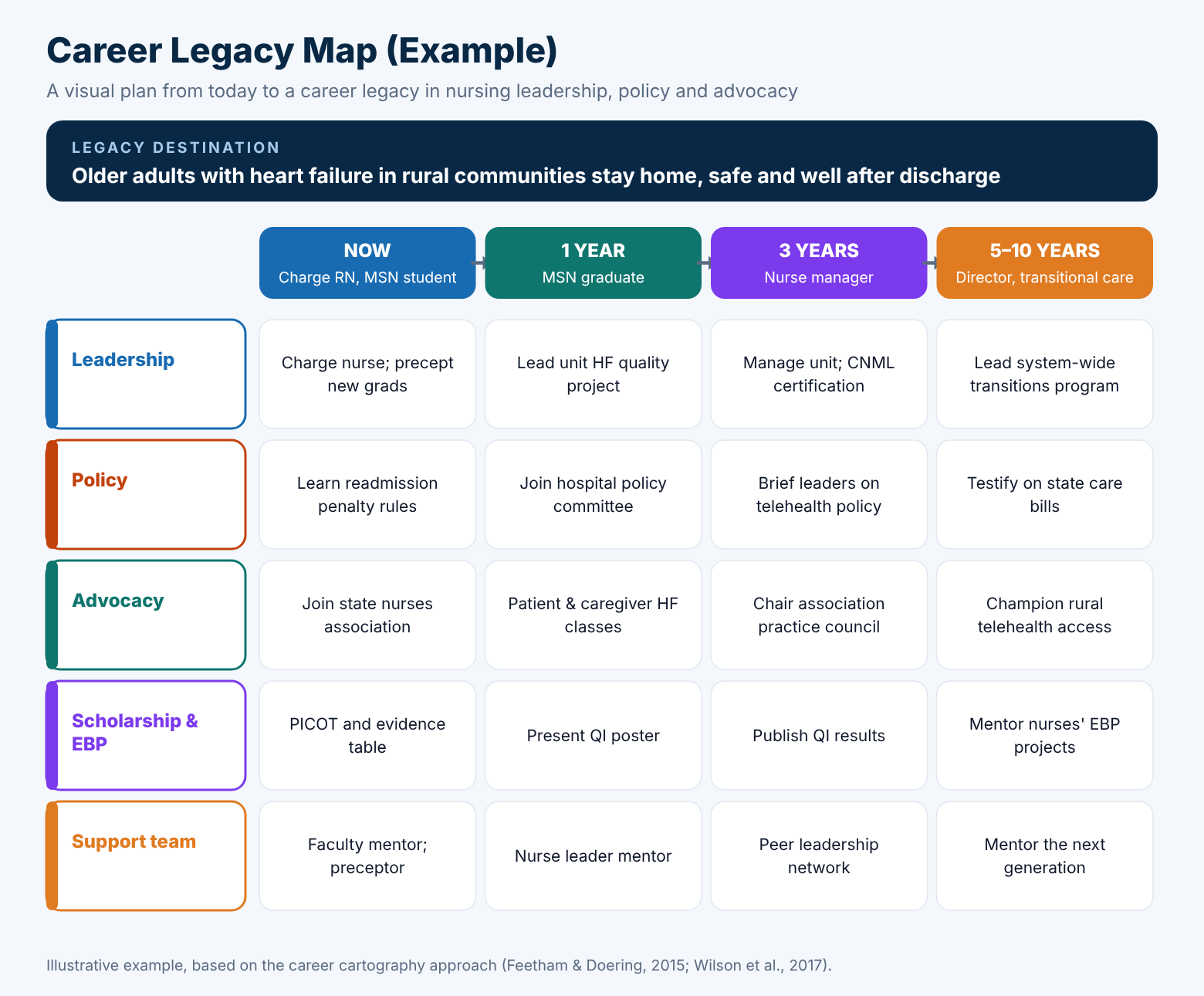
How to create your own legacy map
- Write your legacy (destination) statement at the top: the change you want to make for patients or communities.
- Mark your starting point: current role, education and strengths.
- Add milestones along a timeline (for example 1, 3, 5 and 10 years): degrees, roles, certifications, projects.
- Show the lanes that move you forward: leadership, policy, advocacy, scholarship and practice.
- Add your support team: mentors, sponsors, organizations and partners.
- Show dissemination: how you will share your work through presentations, publications, policy briefs or community education.
- Use visuals: a road, staircase, mountain or grid; color-code each lane; keep text short.
Tips for a high-scoring submission
- Use your template’s exact headings and complete every section.
- Make goals SMART and realistic, with clear timelines and measures.
- Explicitly connect your plan to leadership, policy and advocacy, the assignment’s core elements.
- Reference course resources and scholarly sources in APA 7, including Wilson et al. (2017) and O’Connor (2019).
- Make sure the legacy statement, goals and map all point to the same destination.
- Place the legacy map on the last page and make it readable when printed.
Related reading: Academic Success and Professional Development Plan (Walden), Philosophy of nursing practice, Florence Nightingale’s legacy and EBP and PDSA practice improvement plan.
See also: pros and cons of mandatory continuing nursing education.
Conclusion
A professional development plan turns intentions into a purposeful career by defining who you are, the legacy you want to leave, and the leadership, policy and advocacy steps needed to get there. Adding a career legacy map, based on the career cartography approach, gives you a one-page visual guide that keeps you focused, helps mentors support you, and shows how each milestone moves you closer to making a lasting difference for patients and communities.
References
American Association of Colleges of Nursing. (2021). The essentials: Core competencies for professional nursing education. https://www.aacnnursing.org/Portals/0/PDFs/Publications/Essentials-2021.pdf
American Nurses Association. (2025). Code of ethics for nurses. American Nurses Association.
Feetham, S., & Doering, J. J. (2015). Career cartography: A conceptualization of career development to advance health and policy. Journal of Nursing Scholarship, 47(1), 70–77. https://doi.org/10.1111/jnu.12103
Hinds, P. S., Britton, D. R., Coleman, L., Engh, E., Humbel, T. K., Keller, S., Kelly, K. P., Menard, J., Lee, M. A., Roberts-Turner, R., & Walczak, D. (2015). Creating a career legacy map to help assure meaningful work in nursing. Nursing Outlook, 63(2), 211–218. https://doi.org/10.1016/j.outlook.2014.08.002
National Academies of Sciences, Engineering, and Medicine. (2021). The future of nursing 2020–2030: Charting a path to achieve health equity. The National Academies Press. https://doi.org/10.17226/25982
O’Connor, L. (2019). Career legacy cartography portfolio for advanced practice nursing. In The nature of scholarship, a career legacy map and advanced practice: An important triad (pp. 93–138). Springer. https://doi.org/10.1007/978-3-319-91695-8
Wilson, D. S., Rosemberg, M. S., Visovatti, M., Munro-Kramer, M. L., & Feetham, S. (2017). Career cartography: From stories to science and scholarship. Journal of Nursing Scholarship, 49(3), 336–346. https://doi.org/10.1111/jnu.12289
Get a plagiarism-free answer to this question
Send us your instructions and we’ll match you with the best writer in your subject.
- 100% human-written, zero AI
- Turnitin report included
- Confidential — we never share your data
- Free revisions & refunds