Elements of the Recruitment Process,” describe five things listed in the reading that should be included in a job analysis questionnaire.
After reading the Learning Activity “Elements of the Recruitment Process,” describe five things listed in the reading that should be included in a job analysis questionnaire. Why is it important to ask employees to complete the questionnaire? What type of feedback should be taken into consideration when preparing the job analysis? Now, find an example on the Internet of one of the types of analysis questionnaires mentioned. Provide the link, and describe whether you think the questionnaire is effective and what you would add to improve it, if anything.
RECRUITING PROCESS
Elements of the Recruitment Process
The recruitment process is an important part of human resource management (HRM). It isn’t done without proper strategic planning. Recruitment is a process that provides the organization with a pool of qualified job candidates from which to choose. Before companies recruit, they must implement proper staffing plans and forecasting to determine how many people they will need. The basis of the forecast will be the annual budget of the organization and the short- to long-term plans of the organization—for example, the possibility of expansion. In addition to this, the organizational life cycle will be a factor. Forecasting is based on both internal and external factors.
Internal factors include the following:
- Budget constraints
- Expected or trend of employee separations
- Production levels
- Sales increases or decreases
- Global expansion plans
External factors might include the following:
- Changes in technology
- Changes in laws
- Unemployment rates
- Shifts in population
- Shifts in urban, suburban, and rural areas
- Competition
Once the forecasting data are gathered and analyzed, the HR professional can see where gaps exist and then begin to recruit individuals with the right skills, education, and backgrounds.
RECRUITMENT STRATEGY
Although it might seem easy, recruitment of the right talent at the right place and at the right time takes skill and practice, but more importantly, it takes strategic planning. An understanding of the labor market and the factors determining the relevant aspects of the labor market is key to being strategic about your recruiting processes.
Based on this information, when a job opening occurs, the HRM professional should be ready to fill that position. Here are the aspects of developing a recruitment strategy:
- Refer to a staffing plan.
- Confirm the job analysis is correct through questionnaires.
- Write the job description and job specifications.
- Have a bidding system to recruit and review internal candidate qualifications for possible promotions.
- Determine the best recruitment strategies for the position.
- Implement a recruiting strategy.
The first step in the recruitment process is acknowledgment of a job opening. At this time, the manager and/or the HRM look at the job description for the job opening (assuming it isn’t a new job).
Assuming the job analysis and job description are ready, an organization may decide to look at internal candidates’ qualifications first. Internal candidates are people who are already working for the company.
If an internal candidate meets the qualifications, this person might be encouraged to apply for the job, and the job opening may not be published. Many organizations have formal job posting procedures and bidding systems. For example, job postings may be sent to a listserv or other avenue so all employees have access to them. However, the advantage of publishing open positions to everyone in and outside the company is to ensure the organization is diverse.
Then the best recruiting strategies for the type of position are determined. For example, for a high-level executive position, it may be decided to hire an outside head-hunting firm. For an entry-level position, advertising on social networking websites might be the best strategy. Most organizations will use a variety of methods to obtain the best results.
Another consideration is how the recruiting process will be managed under constraining circumstances such as a short deadline or a low number of applications. In addition, establishing a protocol for how applications and résumés will be processed will save time later. For example, some HRM professionals may use software such as Microsoft Excel to communicate the timeline of the hiring process to key managers.
Once these tasks are accomplished, the hope is that you will have a diverse group of people to interview (called the selection process). Before this is done, though, it is important to have information to ensure the right people are recruited. This is where the job analysis and job description come in.
Job Analysis and Job Descriptions
The job analysis is a formal system developed to determine what tasks people actually perform in their jobs. The purpose of a job analysis is to ensure creation of the right fit between the job and the employee and to determine how employee performance will be assessed. A major part of the job analysis includes research, which may mean reviewing job responsibilities of current employees, researching job descriptions for similar jobs with competitors, and analyzing any new responsibilities that need to be accomplished by the person with the position. According to research by Hackman and Oldham (1976), a job diagnostic survey should be used to diagnose job characteristics prior to any redesign of a job.
To start writing a job analysis, data need to be gathered and analyzed, keeping in mind Hackman and Oldham’s model. Process for Writing the Job Analysis figure shows the process of writing a job analysis. Please note, though, that a job analysis is different from a job design. Job design refers to how a job can be modified or changed to be more effective—for example, changing tasks as new technology becomes available.
Figure 1.1 Process for Writing the Job Analysis
 Portolese Dias, L. (2011.) Human Resource Management. Flat World Knowledge, Inc.
The information gathered from the job analysis is used to develop both the job description and the job specifications. A job description is a list of tasks, duties, and responsibilities of a job. Job specifications, on the other hand, discuss the skills and abilities the person must have to perform the job. The two are tied together, as job descriptions are usually written to include job specifications. A job analysis must be performed first, and then based on that data, we can successfully write the job description and job specifications. Think of the analysis as “everything an employee is required and expected to do.”
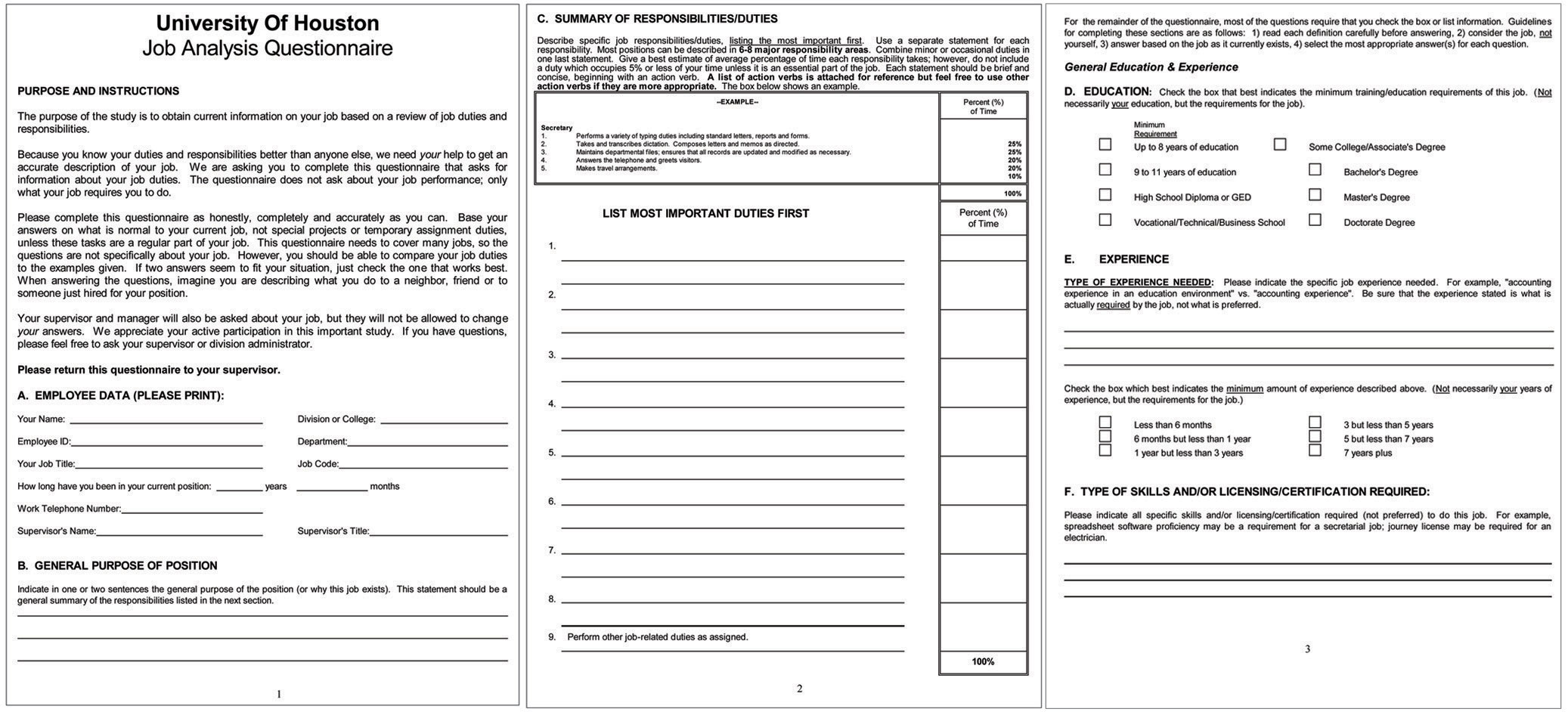
Figure 1.2
 University of Houston
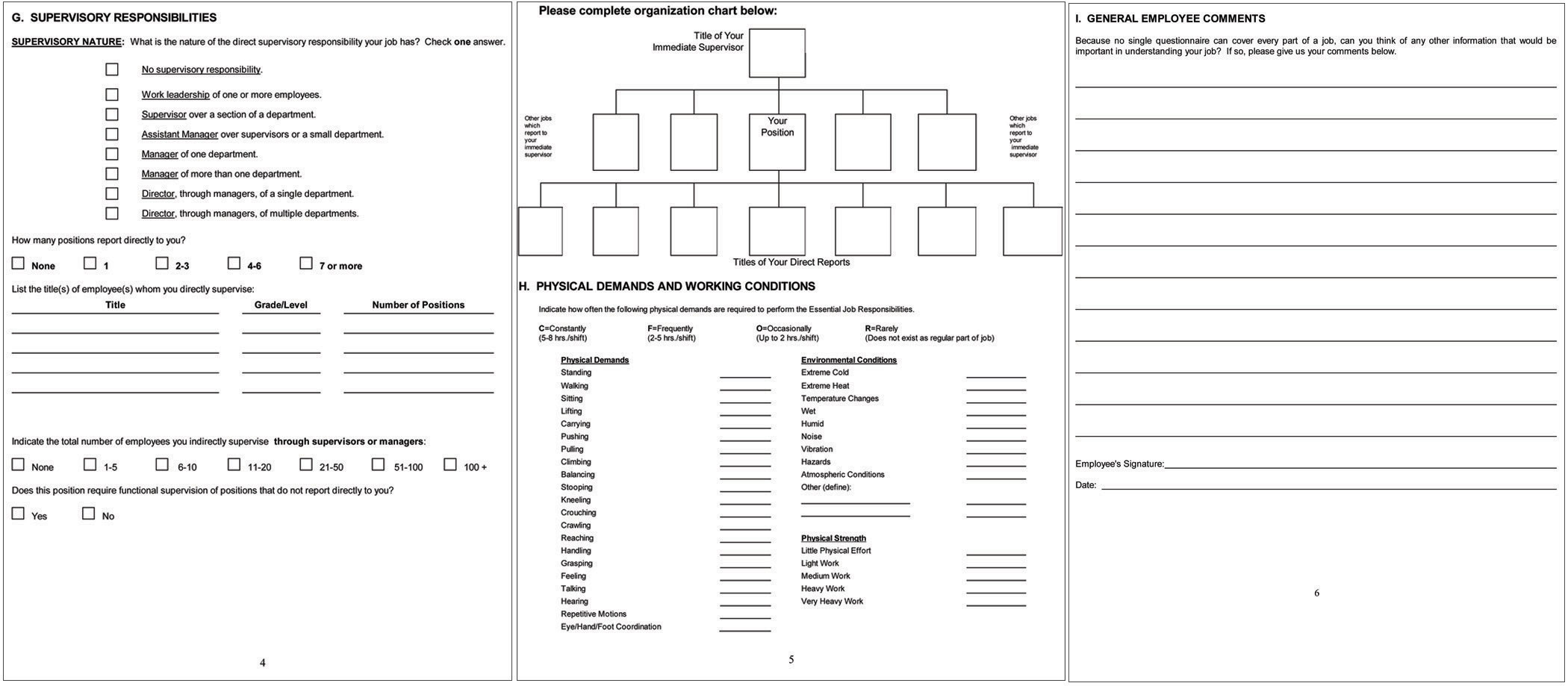
Figure 1.3
 University of Houston
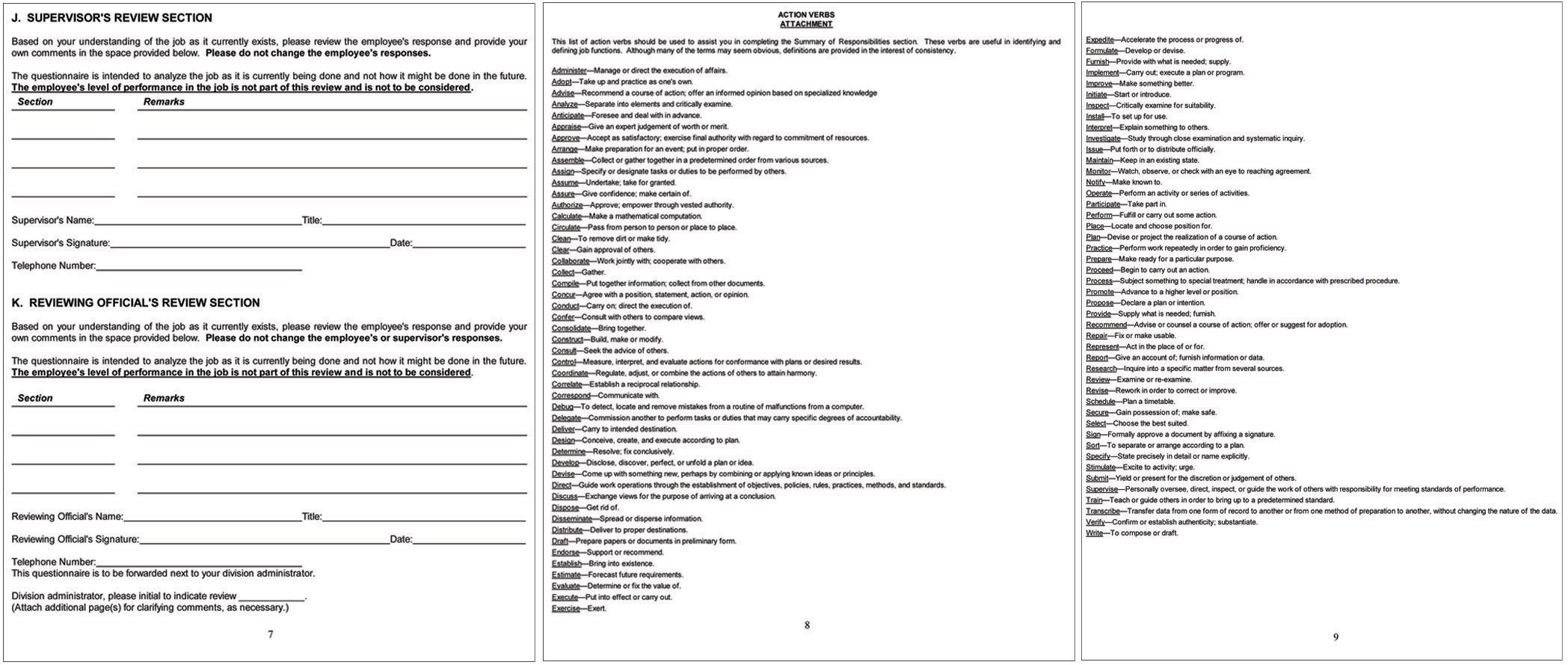
Figure 1.4
 University of Houston
The questionnaire in Figure 1.2 shows how an HR professional might gather data for a job analysis. Questionnaires can be completed on paper or online.
Two types of job analyses can be performed: a task-based analysis and a competency- or skills-based analysis. A task-based analysis focuses on the duties of the job, as opposed to a competency-based analysis, which focuses on the specific knowledge and abilities an employee must have to perform the job. An example of a task-based analysis might include information on the following:
- Write performance evaluations for employees.
- Prepare reports.
- Answer incoming phone calls.
- Assist customers with product questions.
- Cold-call three customers a day.
With task job analysis, the specific tasks are listed and it is clear. With competency based, it is less clear and more subjective. However, competency-based analysis might be more appropriate for specific, high-level positions. For example, a competency-based analysis might include the following:
- Able to utilize data analysis tools
- Able to work within teams
- Adaptable
- Innovative
You can clearly see the difference between the two. The focus of task-based analyses is the job duties required, while the focus of competency-based analyses is on how a person can apply their skills to perform the job. One is not better than the other but is simply used for different purposes and different types of jobs. For example, a task-based analysis might be used for a receptionist, while a competency-based analysis might be used for a vice president of sales position. Consider the legal implications, however, of which job analysis is used. Because a competency-based job analysis is more subjective, it might be more difficult to tell whether someone has met the criteria.
Once you have decided if a competency-based or task-based analysis is more appropriate for the job, you can prepare to write the job analysis. Of course, this isn’t something that should be done alone. Feedback from managers should be taken into consideration to make this task useful in all levels of the organization. Organization is a key component to preparing for your job analysis. For example, will you perform an analysis on all jobs in the organization or just focus on one department? Once you have determined how you will conduct the analysis, a tool to conduct the analysis should be chosen. Most organizations use questionnaires (online or hard copy) to determine the duties of each job title. Some organizations will use face-to-face interviews to perform this task, depending on time constraints and the size of the organization. A job analysis questionnaire usually includes the following types of questions, obviously depending on the type of industry:
- Employee information such as job title, how long in position, education level, how many years of experience in the industry
- Key tasks and responsibilities
- Decision making and problem solving: this section asks employees to list situations in which problems needed to be solved and the types of decisions made or solutions provided.
- Level of contact with colleagues, managers, outside vendors, and customers
- Physical demands of the job, such as the amount of heavy lifting or ability to see, hear, or walk
- Personal abilities required to do the job—that is, personal characteristics needed to perform well in this position
- Specific skills required to do the job—for example, the ability to run a particular computer program
- Certifications to perform the job
Once all employees (or the ones you have identified) have completed the questionnaire, you can organize the data, which is helpful in creating job descriptions. If there is more than one person completing a questionnaire for one job title, the data should be combined to create one job analysis for one job title. There are a number of software packages available to help human resources departments perform this task, such as AutoGOJA.
Once the job analysis has been completed, it is time to write the job description and specifications using the data you collected. Job descriptions should always include the following components:
- Job functions (the tasks the employee performs)
- Knowledge, skills, and abilities (what an employee is expected to know and be able to do, as well as personal attributes)
- Education and experience required
- Physical requirements of the job (ability to lift, see, or hear, for example)
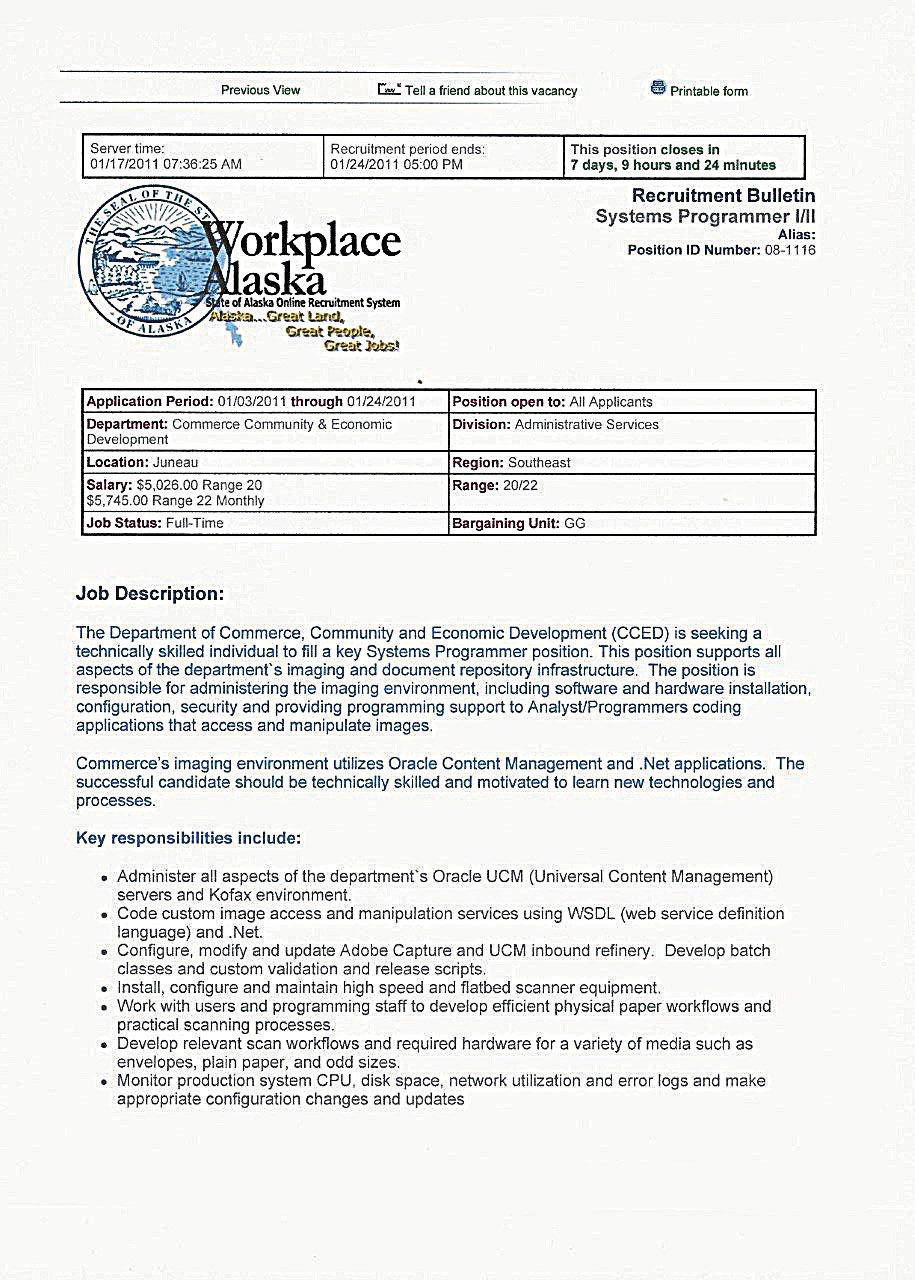
Figure 1.5 Sample Job Description
 Workplace Alaska
Notice how the job description in Sample Job Description figure includes the job function; knowledge, skills, and abilities required to do the job; education and experience required; and the physical requirements of the job.
Once the job description has been written, obtaining approval from the hiring manager is the next step. Then the HR professional can begin to recruit for the position. Before we discuss specific recruitment strategies, we should address the law and how it relates to hiring.
TIPS TO WRITING A GOOD JOB DESCRIPTION
- Be sure to include the pertinent information:
- Title
- Department
- Reports to
- Duties and responsibilities
- Terms of employment
- Qualifications needed
- Think of the job description as a snapshot of the job.
- Communicate clearly and concisely.
- Make sure the job description is interesting to the right candidate applying for the job.
- Avoid acronyms.
- Don’t try to fit all job aspects into the job description.
- Proofread the job description.
Writing a Job Description
For additional insight, watch this short video on how to write an effective job description.
(Easy Small Business HR.Com, 2011)
Note: Adapted from “The Recruitment Process,” by Portolese Dias, L., 2011, Human Resource Management, Chapter 4, Section 1. Copyright 2011 Flat World Knowledge, Inc.
-Post includes obvious and direct connections to competency content; May include direct/indirect quotes and references the content from the competency.Post is original and demonstrates an independent thought process that is creative and individualized.
-Post adds value by raising novel points or providing new perspectives.
-Post is concise and clearly written in an academic tone; Sentences are complete; spelling, grammar and punctuation are correct.
Collepals.com Plagiarism Free Papers
Are you looking for custom essay writing service or even dissertation writing services? Just request for our write my paper service, and we'll match you with the best essay writer in your subject! With an exceptional team of professional academic experts in a wide range of subjects, we can guarantee you an unrivaled quality of custom-written papers.
Get ZERO PLAGIARISM, HUMAN WRITTEN ESSAYS
Why Hire Collepals.com writers to do your paper?
Quality- We are experienced and have access to ample research materials.
We write plagiarism Free Content
Confidential- We never share or sell your personal information to third parties.
Support-Chat with us today! We are always waiting to answer all your questions.
