As you consider a personal leadership plan, which of the self-assessment inventories listed in the Learning Activity have you completed or would like to complete?
As you prepare to respond to this post, refer to the “Personal Leadership Plans” Learning Activity. As you consider a personal leadership plan, which of the self-assessment inventories listed in the Learning Activity have you completed or would like to complete? If you have not completed one of these assessments, research the one of interest further on the Internet. What about this assessment is appealing to you? What do you hope to learn about yourself from the assessment? If you have completed one of the assessments, which one was it? What did learn about yourself?
Personal Leadership Plans
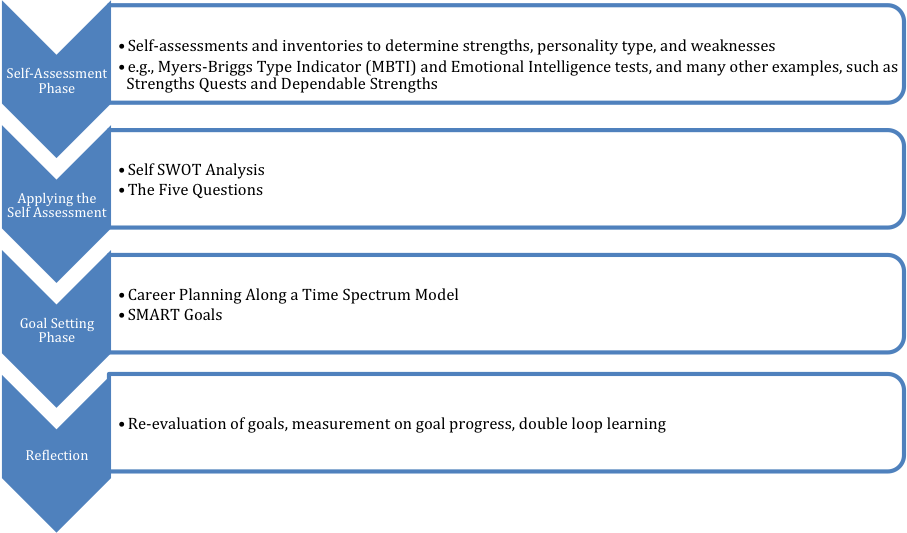
Creating a personal leadership development plan is necessary to continue your work as a leader or potential leader. As a leader, you can also use these models to help develop your employees. Creation of a personal leadership plan consists of four phases: self-assessment, applying the self-assessment, goal setting, and reflection. Within each of these phases, there are a few steps to take, as depicted in Figure 4.1.
Figure 4.1 Four-Phase Process in Leadership Planning
Phase 1: Self-Assessment

In this phase, consider the type of intrinsic and extrinsic rewards which would make you satisfied in your career. Examples of inventories you could take include:
- Myers-Briggs Type Indicator (MBTI) ©
- The Big Five Personality Inventory
- Emotional Intelligence Tests
Once you have taken a variety of inventories and have self-assessed, you can begin the application of self-assessment.
Phase 2: Application of Self-Assessment

Once you have completed the self-assessment, you can use this information to understand what the information means for your career path. The application of self-assessment allows you to take what you learn in the self-assessment phase and begin to narrow down career and job choices. First, consider the results of the various inventories taken in the first step. Next, perform a SWOT analysis on yourself. A SWOT analysis is a planning tool that asks for a list of strengths, weaknesses, opportunities, and threats. Ask yourself what your strengths, weaknesses, opportunities, and threats may be when it comes to future career goals. For example:
- Strengths: people person, good problem solver, able to move anywhere, excellent writer, networking, teamwork ability.
- Weaknesses: impatient, can be shortsighted on reaching goals, sometimes too direct in communication.
- Opportunities: ways to develop leadership skills and sales skills based on personality traits.
- Threats: major health situation with parents may require me to live close to them, potential spouse’s job location.
Next, you can take the information you learned from your various inventories and SWOT analysis. Then using the Five Questions Model (Courtesy of Angela Unruh), begin to focus on the right path for you, personally. The five questions include:
- What profession interests you? What skills and strengths can you bring to that profession? What is needed to be successful at that profession?
- What are your external limiting factors? These are things that put limits on the type of job you would accept. For example, geography, ideal job location, inability or unwillingness to travel, etc. If you prefer to live in a small town but want to work for a large advertising agency and are not willing to move to a large city, this could be an external limiting factor.
- What are your internal limiting factors? Consider your personality type. For example, perhaps you prefer to work alone, in which case a job working in teams would not suit you. Other examples might include the ability to work in teams, exceptional problem-solving ability, negotiation abilities, “people” skills, and a strong or weak writing ability.
- What is/will be most important to you in your work? (What values guide you?) Examples of guiding principles include things such as a work-life balance (in which case, some jobs may not provide this as well as others), a need to agree with the mission of the organization (for example, working for an oil company may not agree with your personal values on environmental concerns), and an ability to take risks (this helps direct the type of company you may want to work for).
- What requirements are necessary for you in a job? Examples might be a certain level of pay, flex time, on-site daycare, health insurance, chance for promotion, and living in a particular city or region.
Once you have performed a SWOT analysis and asked yourself these five questions, you can proceeed to the goal-setting phase, based on the self-assessment knowledge you gained.

Once you have a clear picture of your strengths, weakness, opportunities, and threats and have answered the five questions, this gives you a clearer picture of where you want to be in your career. By doing this, you can begin to develop long-range career plans, then short-term goals to help you reach those long-range career plans.
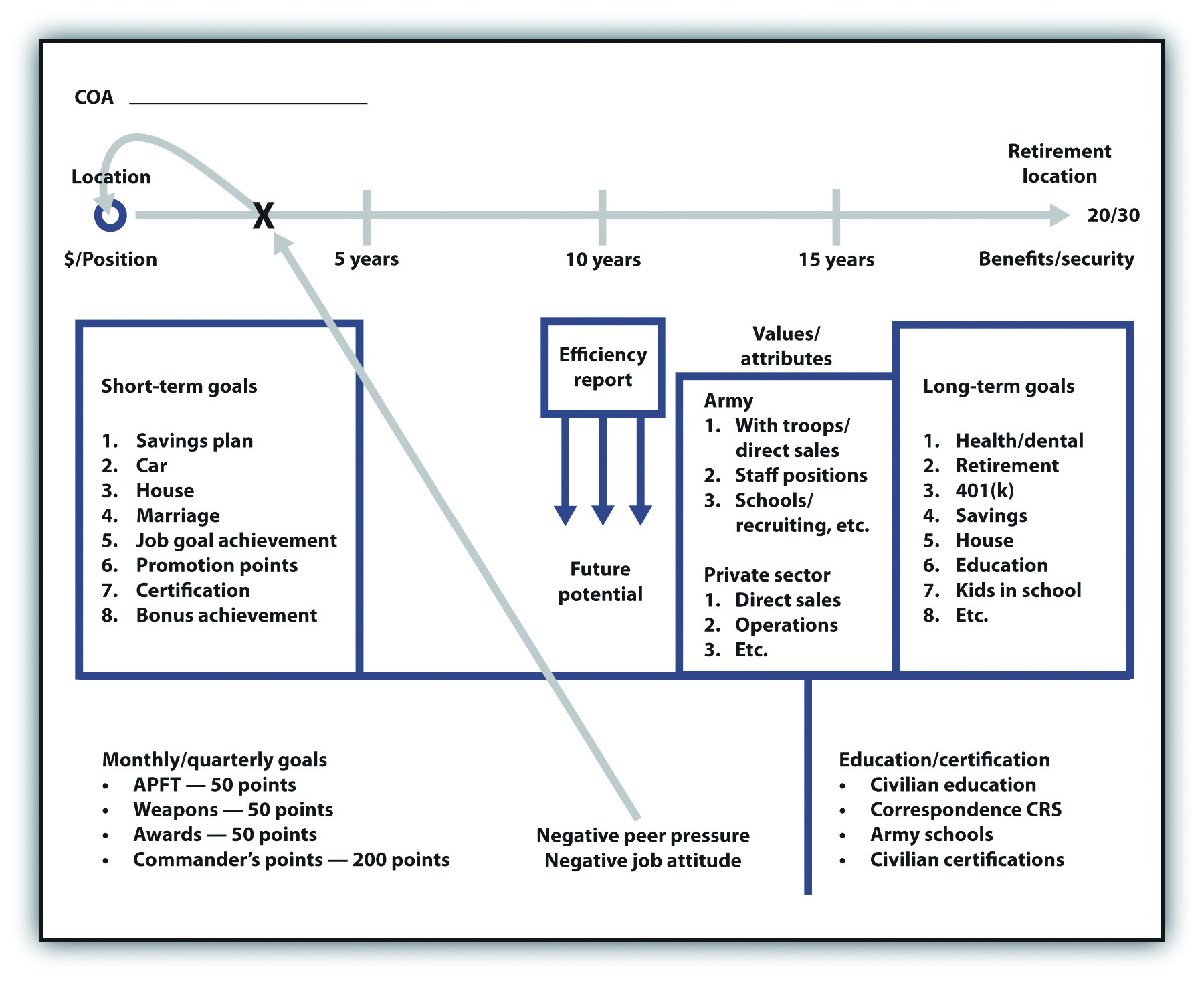
As a leader, it is likely you will begin in an entry-level position and eventually work your way up to mid-management. From there, you may desire executive-level management positions. No matter where you begin, the Career Planning Along a Time Spectrum model can be useful for each possible phase. Perhaps you decide you want to stop at mid-level management. In this scenario, you can still use the model to figure out how to serve both your employees and executive-level management. Either way, when you are setting career goals, you should know the next level of achievement you want so you can make plans to prepare yourself for the next level.
Figure 4.2 Career Planning Along a Time Spectrum
Use the following steps to complete this model:
- As you can see from the model, the line across the top represents time. This line demonstrates that you begin your career at one location, or your ideal location. Then you plan for where you want to end up — Chicago, IL, Tibet or Fiji. You should consider planning your retirement location at the beginning of your career as this is the time to start thinking about it.
- After entering location on the time horizon, the next step includes understanding the starting point for a career salary is 0. In this section, also write your ideal starting position, being realistic about the type of position you can earn once you graduate.
- Next, fill in the box labeled long-term goals. In this box, include goals upon retirement. In other words, at the end of your career, what do you want to have accomplished?
- Based on your long-term goals, what do you need to do in the shorter term? For example, if your long-term goal includes “retire as CEO of XYZ Corporation,” consider what you need to do to meet that end goal. Likely, you will have an entry-level job first, then move up to mid-level management in the organization, and perhaps gain additional education and training. In other words, your short-term goals should be in place to meet your long-term goals.
- Next, using the values and attributes section, include those things important within your organization to achieve your long-term goal. What attributes must you develop in order to be successful in your career path? Considering your SWOT analysis here and your weaknesses—how can you further develop these? Then, next to the attribute, discuss how you will measure it.
- Next, review the short-term goals. Define what you need to do in each five-year period to reach your shorter-term goals, making sure all of these goals tie to your ultimate long-term goals. Also discuss, in the education box, the education or certification you will need to reach your next level of goals.
- Once you have completed this for each five year period, you will want to develop quarterly or monthly goals that will help you reach your short-term goals. Note, the arrows connecting each of the boxes illustrate that all goals, attributes, education/certifications, and monthly/quarterly goals should tie together. In order to better understand how to reach our short-term goals, we can use the SMART goals approach to developing our leadership plan: Specific, Measurable, Attainable, Realistic, and Time oriented.
Specific: As part of a leadership development plan, goals need to be specific. Simply saying, “I want to become a better leader” is not specific enough. Using your self-assessments, create goals that allow you to improve your specific weaknesses. For example, “I want to improve my ability to interact and make small talk in social settings” is a specific goal.
Measurable: When we set goals, we need to be able to see, after a period of time, if we have made progress; therefore, we want goals to be measurable. In our goal, we might say: “I will measure my ability to make small talk in social settings by recording after each encounter what I said and rating how successful I was on a scale of 1 to 10. Once I score seven or above on three occasions, I will know I have met my goal.”
Attainable and Realistic: We all have complex personalities and experiences. Setting personal leadership goals, then, must coincide somewhat with our personalities and our willingness to do certain things in order to reach the goal. For example, if Dave wants to be the CEO of his organization but knows a bachelor’s degree is required for the position in his organization and he isn’t willing to attain one, then this goal may not be realistic for him.
Time-Oriented: If we give ourselves a timeline to reach our goal, it is more likely to happen. If we simply say, “I want to become CEO” but do not consider the steps to take to get there in a specific time-frame, it is less likely to happen. Keeping SMART goals in mind, we can use the leadership development model to create our short-term goals—which would be our monthly or quarterly goals.
Figure 4.3 Using the SMART Goals Model to Create Short-Term Goals
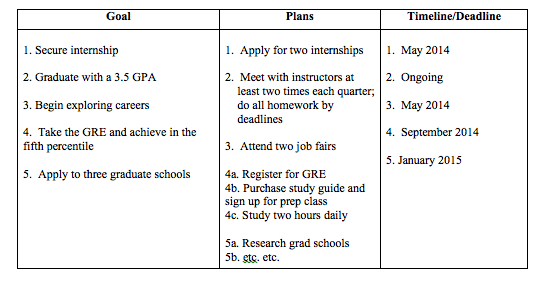
As you can see from the example, you will list short-term goals, then discuss your timeline for reaching the goal, as well as notes on how you will measure whether or not you met the goal. Of course, this should be done only after self-assessment and completing the first part of the Career Planning Along a Time Spectrum model.
You can also use this tool to assist your employees in self-development. After you have completed all three steps—self-assessment, planning, and goal setting—you can begin to think about some of the social skills needed in leadership. The next learning activity will discuss impression management, so that you can be sure to make the right impression to future employers, employees, and others you may come in contact with.
Phase 4: Reflection

Goals, timelines, and progress should be looked at and measured often. Simply having a plan or a goal doesn’t make you successful; continually seeing what works and what doesn’t can help you reflect and make changes to your goals as necessary. Double-loop learning is the goal—in other words, you need to reflect on challenges, changes, and your personality often, to make sure you are on the right path.
Note. Adapted from “The Leadership Development Process,” by Portolese Dias, L., 2014, Leadership and Supervision, Chapter 13. Copyright 2014 Flat World Knowledge, Inc.
-Post includes obvious and direct connections to competency content; May include direct/indirect quotes and references the content from the competency.
Post is original and demonstrates an independent thought process that is creative and individualized. Post adds value by raising novel points or providing new perspectives.
Post is concise and clearly written in an academic tone; Sentences are complete; spelling, grammar and punctuation are correct.
that’s all.
Collepals.com Plagiarism Free Papers
Are you looking for custom essay writing service or even dissertation writing services? Just request for our write my paper service, and we'll match you with the best essay writer in your subject! With an exceptional team of professional academic experts in a wide range of subjects, we can guarantee you an unrivaled quality of custom-written papers.
Get ZERO PLAGIARISM, HUMAN WRITTEN ESSAYS
Why Hire Collepals.com writers to do your paper?
Quality- We are experienced and have access to ample research materials.
We write plagiarism Free Content
Confidential- We never share or sell your personal information to third parties.
Support-Chat with us today! We are always waiting to answer all your questions.
