Pediatric SOAP Notes With Examples: Otitis Media, Pediatric Dermatology and Immunization Education
Need help with this assignment?Get an original answer from a qualified tutor — from $10/page.
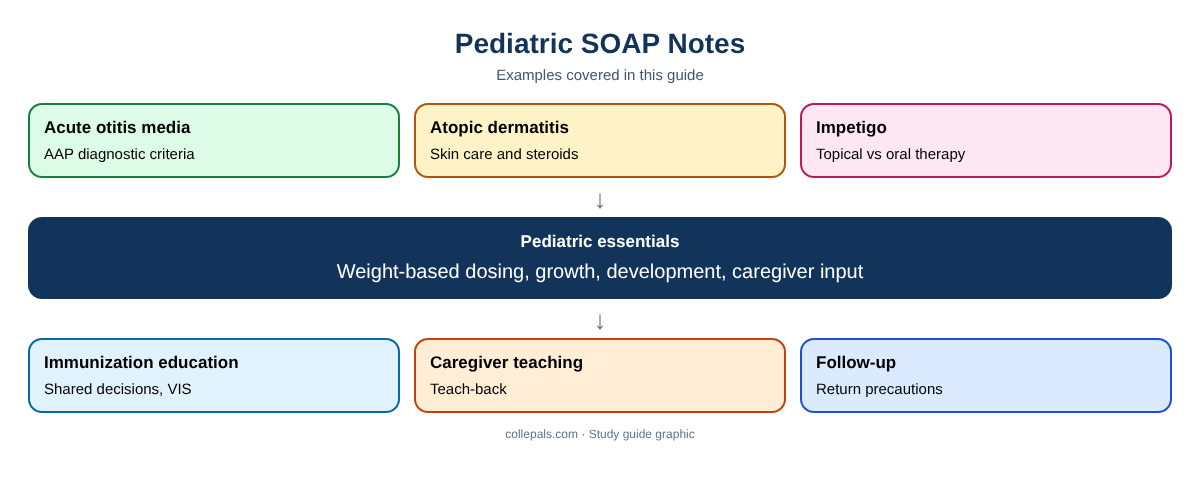
Get it written →Pediatric SOAP notes follow the same structure as adult notes but add weight-based dosing, growth and development, caregiver reports and family education. This guide provides pediatric SOAP note examples for acute otitis media, two common pediatric dermatology conditions (atopic dermatitis and impetigo) and immunization education, with guidance for each.
Quick answer
In pediatric SOAP notes, the subjective section relies heavily on caregiver reports, the objective section includes weight, age-appropriate vital signs and growth, the assessment considers age-specific differentials and the plan uses weight-based dosing, caregiver education with teach-back, return precautions and the immunization schedule your practice follows.
Patients in these examples are fictional and are used for study purposes only. Treatments and doses are illustrative; follow current guidelines, your facility’s protocols and your scope of practice. This article is educational and is not medical advice.
1. Acute Otitis Media
SOAP note: acute otitis media (fictional)
S: 18-month-old brought by mother for 2 days of fever, irritability and pulling at both ears; woke crying last night. Recent cold. Eating less but drinking well, wet diapers normal. No antibiotics in the past 30 days. Immunizations up to date per parent. No drug allergies. Attends daycare.
O: T 38.9 °C, HR 132, weight 11 kg. Alert, consolable. Both tympanic membranes erythematous and moderately bulging with poor mobility on pneumatic otoscopy; no otorrhea. Clear rhinorrhea; lungs clear.
A: Bilateral acute otitis media without otorrhea in a child 6–23 months. Differentials: otitis media with effusion (no acute inflammation), viral upper respiratory infection alone.
P: Antibiotic therapy is recommended for bilateral AOM in this age group; first-line amoxicillin 80–90 mg/kg/day divided twice daily for 10 days (Lieberthal et al., 2013), calculated by weight; acetaminophen or ibuprofen for pain and fever by weight; teach dosing with an oral syringe; return if not improved in 48–72 hours or if worsening; discuss smoke avoidance and daycare exposure.
The AAP guideline defines AOM by moderate to severe bulging of the tympanic membrane, new-onset otorrhea not caused by otitis externa or mild bulging with recent ear pain or intense erythema, and allows observation for some children depending on age, severity and laterality (Lieberthal et al., 2013).
2. Pediatric Dermatology: Atopic Dermatitis
SOAP note: atopic dermatitis (fictional)
S: 3-year-old with itchy, dry rash in elbow and knee creases for 3 months, worse in winter and after baths; scratching disrupts sleep. Uses scented soap. Father has asthma.
O: Afebrile. Erythematous, dry, lichenified patches in antecubital and popliteal fossae; excoriations; no honey-colored crusts, vesicles or signs of infection.
A: Atopic dermatitis, moderate flare. Differentials: contact dermatitis, scabies (no burrows or family members affected).
P: Gentle skin care: short lukewarm baths, fragrance-free cleanser, thick emollient at least twice daily; a low- to mid-potency topical corticosteroid to flares for a limited course as directed; trim nails; avoid triggers (Weidinger & Novak, 2016); teach signs of skin infection; follow up in 2–4 weeks.
3. Pediatric Dermatology: Impetigo
SOAP note: impetigo (fictional)
S: 5-year-old with sores around the nose and mouth for 4 days that started as small blisters and now have crusts. Sibling has a similar sore. No fever.
O: Afebrile. Three honey-colored crusted lesions on the perioral and perinasal skin, each under 2 cm; no lymphadenopathy; otherwise well.
A: Nonbullous impetigo, localized. Differentials: herpes simplex (no grouped vesicles), contact dermatitis.
P: Topical antibiotic, such as mupirocin, to lesions for a short course is appropriate for limited disease; oral antibiotics for extensive lesions (Hartman-Adams et al., 2014); gentle washing; handwashing; avoid sharing towels; return to school per local policy after treatment begins; check sibling.
4. Immunization Education
SOAP note: immunization education at a 4-year well-child visit (fictional)
S: Mother asks whether her daughter needs “all the shots” before kindergarten and is worried about side effects and “too many at once.” Child healthy; no prior vaccine reactions; no allergies.
O: Well-appearing, growth and development appropriate for age. Immunization record reviewed against the schedule the practice follows.
A: Due for kindergarten-entry vaccines, including DTaP, IPV, MMR and varicella; parental vaccine concerns.
P: Provide the required Vaccine Information Statements before administration; discuss benefits, common side effects (soreness, low-grade fever) and rare risks using plain language and teach-back (Talevski et al., 2020); address the concern about multiple vaccines; obtain consent; administer according to the current schedule; observe after administration per policy; teach comfort measures and when to call; document vaccine, dose, site, lot number and VIS date; update the record and school forms.
Note on immunization schedules: U.S. childhood immunization guidance changed rapidly in 2025–2026. In January 2026, CDC issued a revised schedule moving several vaccines to risk-based or shared clinical decision-making; a federal court later stayed it and reinstated the May 2025 schedule while an appeal proceeds, and the American Academy of Pediatrics publishes its own schedule (Congressional Research Service, 2026; Contemporary Pediatrics, 2026). Check the current schedule your program and clinical site follow before documenting recommendations.
Pediatric Documentation Tips
- Record the source of history (parent, caregiver, child) and its reliability.
- Always document weight in kilograms and calculate doses per kilogram.
- Include growth and developmental status and immunization status.
- Document caregiver education and understanding, using teach-back.
- Give clear return precautions, such as fever patterns, dehydration signs or worsening symptoms.
Frequently Asked Questions
How is amoxicillin dosed for acute otitis media?
The AAP guideline recommends high-dose amoxicillin, 80–90 mg/kg/day divided into two doses, for most children when antibiotics are indicated.
When can AOM be observed without antibiotics?
The AAP guideline allows observation with close follow-up for some children, depending on age, severity and whether one or both ears are affected.
What must be given before vaccines?
Federal law requires providing the current Vaccine Information Statement before administering covered vaccines.
Get Help With Pediatric SOAP Notes at Collepals
SOAP notes are a weekly assignment in many nursing and nurse practitioner programs. Collepals.com helps nursing students write accurate, well-organized SOAP notes. Our nursing-focused writers and tutors can:
- Show you how to organize case data into subjective, objective, assessment and plan sections.
- Help you build differential diagnoses and evidence-based plans tied to current guidelines.
- Provide model SOAP notes you can study for structure and depth.
- Find current references and format them in APA 7, and edit or proofread your drafts.
Browse our free model assignments or learn more about our nursing assignment writing service.
Use Collepals examples as study guides and follow your school’s academic integrity and AI policies when you submit your own work.
More SOAP note guides
Collepals is an independent study resource. Course templates and rubrics vary; always follow your instructor’s format and your facility’s documentation policies.
References
Congressional Research Service. (2026). The 2026 childhood immunization schedule (CRS Report No. R48982). https://www.everycrsreport.com/reports/R48982.html
Contemporary Pediatrics. (2026, September 4). The unharmonious 2026 child and adolescent immunization schedule. https://www.contemporarypediatrics.com/view/the-unharmonious-2026-child-and-adolescent-immunization-schedule
Hartman-Adams, H., Banvard, C., & Juckett, G. (2014). Impetigo: Diagnosis and treatment. American Family Physician, 90(4), 229–235.
Lieberthal, A. S., Carroll, A. E., Chonmaitree, T., Ganiats, T. G., Hoberman, A., Jackson, M. A., Joffe, M. D., Miller, D. T., Rosenfeld, R. M., Sevilla, X. D., Schwartz, R. H., Thomas, P. A., & Tunkel, D. E. (2013). The diagnosis and management of acute otitis media. Pediatrics, 131(3), e964–e999. https://doi.org/10.1542/peds.2012-3488
Talevski, J., Wong Shee, A., Rasmussen, B., Kemp, G., & Beauchamp, A. (2020). Teach-back: A systematic review of implementation and impacts. PLOS ONE, 15(4), Article e0231350. https://doi.org/10.1371/journal.pone.0231350
Weidinger, S., & Novak, N. (2016). Atopic dermatitis. The Lancet, 387(10023), 1109–1122. https://doi.org/10.1016/S0140-6736(15)00149-X
Get a plagiarism-free answer to this question
Send us your instructions and we’ll match you with the best writer in your subject.
- 100% human-written, zero AI
- Turnitin report included
- Confidential — we never share your data
- Free revisions & refunds