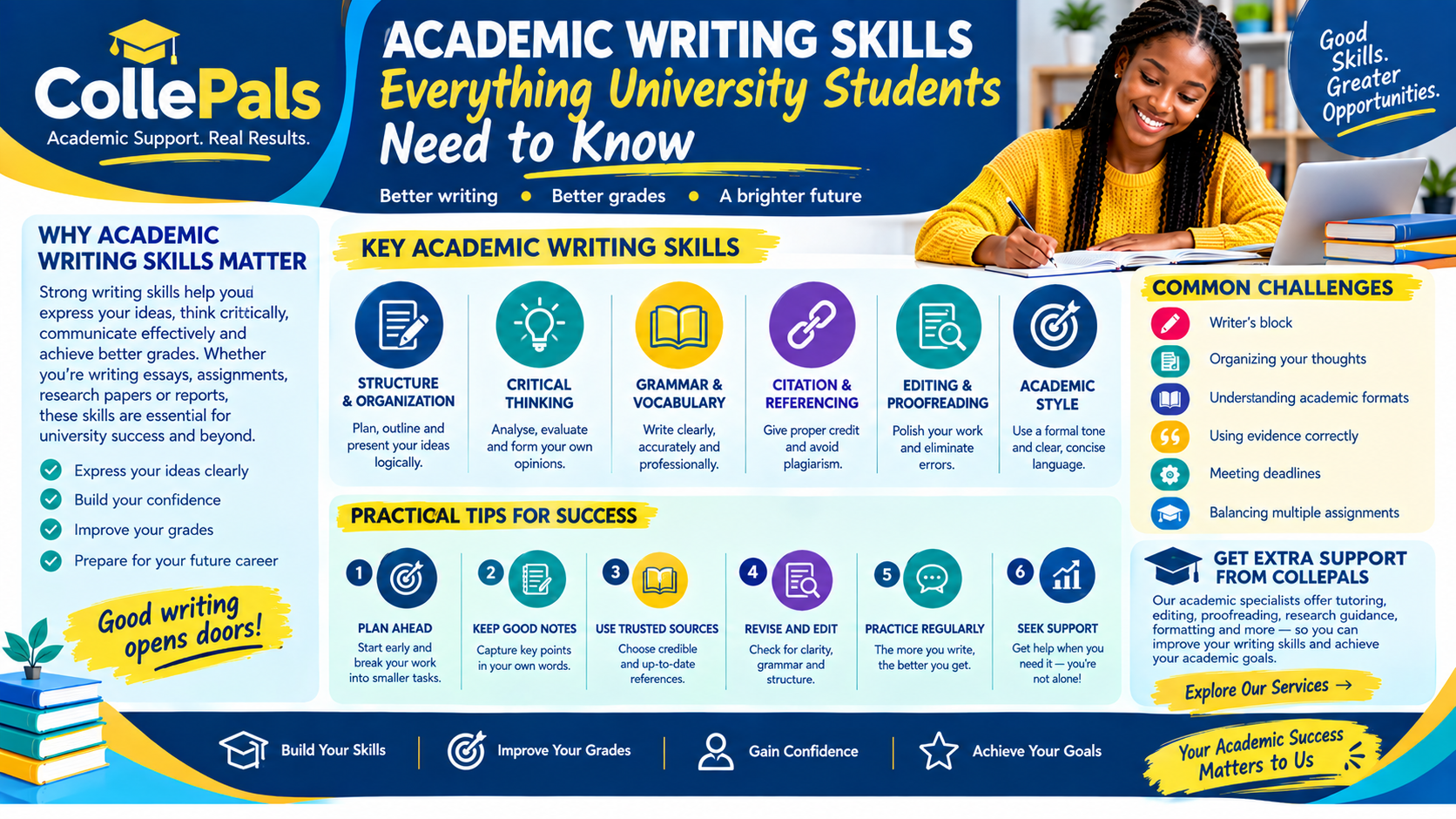
Academic Writing Skills: Everything University Students Need to Know
From essay structure and thesis development to critical analysis, referencing, and using feedback — the complete guide to academic writing skills that earn higher grades.
- The Foundations of Academic Writing
- Understanding the Assignment Question
- Academic Research Skills
- Developing a Strong Thesis
- Essay and Assignment Structure
- Critical Analysis — the Key to Higher Grades
- Evidence Integration
- Paragraph Writing
- Introductions and Conclusions
- Referencing and Citation
- Revision and Proofreading
- Using Feedback to Improve
- Writing at Different Academic Levels
- Common Academic Writing Mistakes
The Foundations of Academic Writing
Academic writing is a distinct form of written communication with conventions, standards, and expectations that differ significantly from everyday writing, professional writing, and school-level writing. Students who understand these differences and the reasoning behind them are better positioned to develop their academic writing quickly and deliberately — not through trial and error across multiple assignments, but through informed practice targeted at the specific capabilities that university-level writing requires.
The fundamental distinction between academic and non-academic writing is that academic writing makes claims and defends them — it takes positions on questions, supports those positions with evidence, and subjects both the position and the evidence to critical scrutiny. This is not a style preference but a function: academic writing is the mechanism through which scholarly knowledge is produced, evaluated, and communicated within research communities. Understanding this function explains every specific convention of academic writing: why evidence must be peer-reviewed (because it needs to have passed independent quality evaluation); why claims must be cited (because readers need to be able to verify and evaluate the evidence independently); why analysis must be critical (because uncritical acceptance of evidence is not how knowledge advances); and why structure must be explicit (because the argument must be followable by a reader who is evaluating it rigorously).
The academic writing skills discussed in this guide are not stylistic preferences — they are the functional requirements of a form of writing whose purpose is to produce and communicate defensible knowledge claims. Developing them is not about learning a code of academic etiquette; it is about learning to participate effectively in a specific form of intellectual practice.
Understanding the Assignment Question
The single most consequential academic writing skill is understanding the assignment question before beginning to write. More essays fail from misreading the question than from poor writing — and misreading is more common than students typically recognise, because it is often invisible until the work is marked and the feedback identifies the gap between what was asked and what was answered.
Effective question analysis has three stages. The first is identifying the command word — the word that specifies the analytical task the question sets. “Discuss,” “critically evaluate,” “compare and contrast,” “analyse,” “assess,” and “examine” each require a different analytical approach, and confusing them produces analytically inappropriate responses. “Discuss” requires exploration of multiple perspectives without necessarily taking a strong position. “Critically evaluate” requires taking a position and defending it through evidence and analysis of the evidence’s quality and limitations. “Compare and contrast” requires systematic comparison of two or more things and conclusion about what the comparison reveals. Identify the command word and understand what it requires before reading the rest of the question.
The second stage is identifying all the specified content requirements — the specific topics, frameworks, theorists, standards, or contexts the question requires engagement with. These are often embedded in the question in ways that can be missed in a quick reading. The third stage is identifying any scope restrictions — what the question explicitly limits the response to (specific time period, population, jurisdiction, theoretical framework, or professional context). Scope restrictions define what will be marked as off-topic — and off-topic content, however well-written, is content that earns no marks.
Practical technique: After reading your assignment question, write a one-sentence answer to it in plain English before beginning any research. If you cannot do this, you have not yet understood the question well enough to answer it analytically. If you can, that plain-English answer is the seed of your thesis statement.
Academic Research Skills
Academic research for university essays and assignments requires accessing peer-reviewed scholarly sources — journal articles, academic books, and research reports that have been evaluated by independent experts before publication. General internet searches, Wikipedia, and popular media sources do not meet the peer-review standard that university assignments require, and over-reliance on them is one of the most consistent markers of lower-grade work.
Access peer-reviewed literature through your university library’s database subscriptions. Identify the two or three databases most appropriate for your subject: CINAHL and PubMed for healthcare; PsycINFO for psychology; Westlaw for law; JSTOR for humanities; Business Source Complete for business. Develop a search strategy that combines your key concepts using Boolean operators (AND to require both concepts; OR to include synonyms; NOT to exclude irrelevant results). Filter for peer-reviewed publications and apply date restrictions (last 5–7 years for most topics) to prioritise current evidence.
Read selectively: use abstracts to assess source relevance before committing to full-text reading. Take structured notes that capture the source’s argument, the specific evidence it provides, its methodological quality, and your own analytical response — not just a summary of what the source says but your assessment of what it means for your argument. Record full citation details for every source as you read it, not from memory later.
Developing a Strong Thesis
The thesis is the central analytical claim of an academic essay — the specific, arguable position that the essay develops and demonstrates through evidence and analysis. It is the answer to the assignment question, stated concisely as a claim. Developing a strong thesis is the intellectual challenge at the centre of academic essay writing, and it is the skill that most clearly distinguishes high-achieving from average academic writers.
A strong thesis is specific (taking a precise position on the specific question asked, not a general claim about the broad topic); arguable (taking a position that someone could reasonably disagree with, which means it makes a genuine claim rather than stating a fact or hedging into irrelevance); and achievable (demonstrable within the word count and evidence available). “Social media has both positive and negative effects on mental health” fails on all three dimensions: it is not specific (it applies to any essay on the same broad topic), it is not arguable (no one would disagree), and it is not a thesis (it is an observation). “Passive social media consumption is more strongly associated with depression symptom severity than active engagement, challenging intervention approaches that restrict access without distinguishing between use patterns” is specific, arguable, and achievable.
Develop your thesis after research rather than before it. The best theses emerge from genuine engagement with the evidence — from discovering what the evidence collectively implies rather than confirming a predetermined position. A thesis derived from evidence is always better grounded than one imposed on evidence.
Essay and Assignment Structure
Effective academic essay structure is not a formula — it is a logical architecture designed to build and demonstrate an argument as clearly and compellingly as possible. The standard three-part structure (introduction → body → conclusion) provides the broad framework, but within this framework the specific structure of the body is what makes the difference between an essay that reads as a coherent argument and one that reads as a collection of relevant points.
Body structure should follow argumentative logic rather than topical logic. Topical logic groups content by subject area — “in this section I will discuss X, then Y, then Z.” Argumentative logic sequences content to progressively build the essay’s central claim — “this section establishes A; the next section uses A to demonstrate B; the following section complicates B by introducing C, which the final section resolves by showing that D explains the apparent tension.” Every body section should make a specific, identifiable contribution to the overall argument — not just cover a related topic. If you cannot describe how each section advances the argument (rather than just covering the topic), restructure until you can.
Critical Analysis — the Key to Higher Grades
Critical analysis is the academic writing skill most consistently identified by markers as differentiating First-class from 2:1 work and 2:1 from 2:2 work. It is also the skill most frequently requested in feedback (“more critical analysis needed”) and most frequently misunderstood by the students who receive that feedback. Understanding what critical analysis actually means in practice — not as an abstract concept but as a specific writing move — is the most direct route to grade improvement available to most students.
Critical analysis means: evaluating evidence rather than describing it (“this study’s cross-sectional design limits causal inference — a limitation the authors acknowledge but that significantly qualifies the strength of the effect size reported”); engaging with contradictory evidence rather than selecting only supportive sources (“however, the meta-analysis by Brown et al. (2021) found a significantly smaller effect, suggesting that the individual study results may reflect methodological variation rather than a robust underlying phenomenon”); applying theoretical frameworks analytically rather than decoratively (“Bourdieu’s concept of cultural capital is not merely a descriptor of inequality in this context — it explains the mechanism by which parental social position translates into differential educational outcomes through the habitus-field interaction”); and drawing conclusions that are proportionate to the evidence and honest about uncertainty.
The simplest practical test for whether you are analysing or describing: after writing each body paragraph, ask “am I telling the reader what the evidence says, or what it means?” If the answer is “what it says,” you are describing. Add one of these analytical moves to convert to analysis: a methodological comment on the evidence’s quality; a comparison with contradictory evidence; an implication for the argument; or a theoretical framework application.
Evidence Integration
Evidence integration — the way in which academic sources are incorporated into the essay’s argument — is a sophisticated skill that operates on two levels: selecting the right evidence and deploying it analytically. Selection means choosing sources that are high-quality (peer-reviewed, methodologically sound, recently published), directly relevant (specifically bearing on the claim the paragraph is making, not just generally related to the topic), and diverse (representing the range of perspectives in the literature, not just the supportive ones). Deployment means introducing, explaining, evaluating, and connecting each piece of evidence in ways that advance the argument rather than just supporting it.
A high-quality evidence integration sentence structure follows this pattern: signal phrase introducing the source and its claim → specific evidence from the source → your evaluation of the evidence’s quality or limitations → your analytical connection of the evidence to the argument. “Brown (2019) found, in a randomised controlled trial of 842 participants, that mindfulness-based intervention reduced depression relapse rates by 28% relative to treatment as usual — a finding that, while methodologically strong due to its controlled design, was conducted exclusively in white-collar professional populations, raising questions about its generalisability to the socioeconomically diverse patient populations typical of NHS primary care settings where implementation is most commonly proposed.” This sentence presents evidence, evaluates it, and develops an analytical implication — all in one integrative move.
Paragraph Writing
Academic paragraphs are the structural units of the essay’s argument. Each paragraph should make one specific analytical contribution to the overall argument and should develop that contribution fully — with evidence, evaluation, and analytical connection — before moving to the next. A paragraph that makes two separate analytical points insufficiently develops both; a paragraph that makes one analytical point and develops it thoroughly is the standard to aim for.
The PEEL paragraph structure (Point → Evidence → Explanation → Link) provides a reliable framework for paragraph construction. The point (topic sentence) states the paragraph’s specific analytical contribution to the argument. The evidence presents the peer-reviewed source(s) that support the point, integrated with a signal phrase and citation. The explanation evaluates the evidence — what it means, how strong it is, what its limitations are, what it implies for the argument. The link connects the paragraph’s conclusion to the next paragraph, maintaining the essay’s analytical coherence.
Introductions and Conclusions
The introduction’s job is to establish the essay’s analytical context, define its scope, and end with a clear, specific thesis. Effective introductions open with a specific, evidenced hook that establishes the topic’s significance; establish the contextual background that makes the question significant; define key terms that need precision for the argument; specify the essay’s scope (what will and will not be covered); and end with the thesis. What they do not do: start with a dictionary definition; make vague assertions of the topic’s importance; or announce a topic without taking a position (“this essay will discuss X”).
The conclusion’s job is not to summarise the essay but to synthesise its analytical achievement — demonstrating what the essay’s argument has collectively established, articulating its significance for the field or practice, acknowledging its limitations honestly, and offering a forward-looking reflection on remaining questions or future directions. A conclusion that merely restates what the body sections said is a missed analytical opportunity. A conclusion that synthesises, implies, and projects forward is the one that leaves the marker with a strong impression of the essay’s intellectual contribution.
Referencing and Citation
Referencing accuracy is a basic academic expectation and a source of entirely preventable mark loss. Every claim that draws on an external source must be cited; every in-text citation must correspond to a reference list entry; every reference list entry must correspond to an in-text citation; and every reference must be formatted correctly in your institution’s specific variant of the required style. Generic style guides from other institutions are not reliable for your specific submission — download your institution’s own referencing guide and apply it literally.
The most common referencing errors are: missing page numbers on direct quotations; missing DOIs on journal articles (now required in APA 7th and most current Harvard variants); incorrect author listing for sources with many authors; and applying a generic variant of the required style rather than the institution-specific version. Use reference management software (Zotero, Mendeley, or EndNote) to manage citations as you research — entering source details at the point of reading rather than reconstructing them from incomplete notes at the writing stage. Check every in-text citation against the reference list before submission.
Revision and Proofreading
Revision and proofreading are not the same activity, and both are essential. Revision addresses analytical quality — argument coherence, evidence strength, analytical depth, structural logic. It is where the quality gap between a competent first draft and a high-grade submission is closed. Proofreading addresses surface accuracy — spelling, grammar, punctuation, formatting. Both require a fresh perspective — time between completing a draft and reviewing it consistently produces better reviews than immediate re-reading.
Revise analytically before proofreading for surface errors. After completing a draft, read it against the assignment question (does every section advance the argument and address the specific analytical task?) and against the marking rubric (does the work meet the First-class descriptor for each marking criterion?). Where the answer to either question is no or uncertain, revise the relevant section before moving to surface proofreading. Proofreading first and revising second is less efficient — surface corrections on passages that require analytical reworking are often discarded when the passage is revised.
Using Feedback to Improve
Tutor feedback on returned assignments is calibrated information about the specific gap between your work and the module’s academic standard — and it is the most valuable academic development resource available to students after their own engagement with the subject. Most students read feedback briefly, note the grade, and move on. Students whose grades improve consistently across a module are almost always those who treat feedback as actionable information: reading every comment, identifying the specific writing behaviour it identifies as problematic, and making a concrete plan to address that behaviour in the next assignment.
For feedback that is recurring (the same comment appearing on multiple assignments), the required intervention goes beyond noting it. If “more critical analysis needed” appears across three consecutive assignments, the problem is not that you have not noted the feedback — it is that you do not yet have a concrete enough understanding of what critical analysis looks like in your specific discipline to implement it. Seeking a tutor meeting to discuss what critical analysis looks like in practice, or studying a model essay that demonstrates it, is more likely to produce genuine improvement than re-reading the feedback comment alone.
Writing at Different Academic Levels
Academic writing expectations increase significantly at each successive academic level, and students who understand these escalating expectations are better positioned to develop the required capabilities proactively rather than discovering the gap through unsatisfactory grades.
Year 1 undergraduate: Demonstrates understanding of core concepts; uses appropriate academic sources; produces a coherent argument; references correctly. The primary challenge is transitioning from school-level writing conventions to university-level analytical expectations.
Year 2–3 undergraduate: Demonstrates critical engagement with evidence (evaluation, not just description); develops an original analytical position; integrates and applies disciplinary theoretical frameworks; produces sophisticated argument structure. This is where the “more critical analysis” feedback most commonly emerges.
Master’s level: Demonstrates comprehensive knowledge of the field; justifies methodological choices philosophically; produces analysis that goes beyond competent evidence synthesis to genuine interpretive contribution; explicitly positions work within the scholarly conversation. The jump from undergraduate to master’s analytical expectations is the most significant quality transition in the university system.
Doctoral level: Makes a genuinely original contribution to knowledge; demonstrates mastery of the field’s theoretical and methodological debates; writes at publication-ready standard; can defend all choices and interpretations under rigorous external examination.
Common Academic Writing Mistakes
| Mistake | What It Looks Like | How to Fix It |
|---|---|---|
| Misreading the question | Essay addresses the topic but not the specific analytical task set | Underline the command word; write a one-sentence answer before researching |
| Description instead of analysis | “Brown (2019) found that X.” No evaluation, no implication. | Add methodological comment, contradictory evidence, or analytical implication after every evidentiary claim |
| No clear thesis | “This essay will discuss X.” Topic announcement, not a position. | Complete “This essay argues that…” before writing the introduction |
| Weak evidence base | Textbooks, general websites, secondary summaries as primary evidence | Source from subject-appropriate databases; prioritise peer-reviewed primary research |
| Topical structure instead of argumentative structure | Sections grouped by subject area; could be reordered without affecting the argument | Ensure each section has a specific, non-interchangeable argumentative function |
| Referencing errors | Missing citations, wrong format, reference list mismatches | Use reference management software; check every citation against the institution’s specific guide before submitting |
| Summary conclusion instead of synthesis | “In conclusion, this essay has shown that…” | Write: what has been demonstrated (synthesis) → what it means (implications) → what remains to be done (future directions) |
| Not acting on feedback | Same feedback comment appearing across multiple assignments | Create a checklist from feedback; verify each point is addressed before submitting the next assignment |
Developing Your Academic Writing Further
Academic writing skills develop through a combination of informed practice, quality feedback, and exposure to high-standard models of academic writing in your specific discipline. All three elements are necessary — practice without feedback produces entrenched habits rather than improvement; feedback without models makes the required standard abstract rather than concrete; models without practice produce observation without capability development.
CollePals model essays and assignments are produced by subject specialists to First-class standard in your specific discipline — providing the concrete, discipline-specific models of academic writing that accelerate skill development more efficiently than generic writing guides. Order a model essay in your subject and read it analytically alongside your own draft — the specific differences you identify between the two approaches are your most targeted development priorities. Order at collepals.com/orders.
Ready to Get Expert Academic Help?
Join thousands of students who trust CollePals for model academic work — delivered on time, written by subject specialists.